

Home
Class 12
PHYSICS
A disc of mass m has a charge Q distribu...

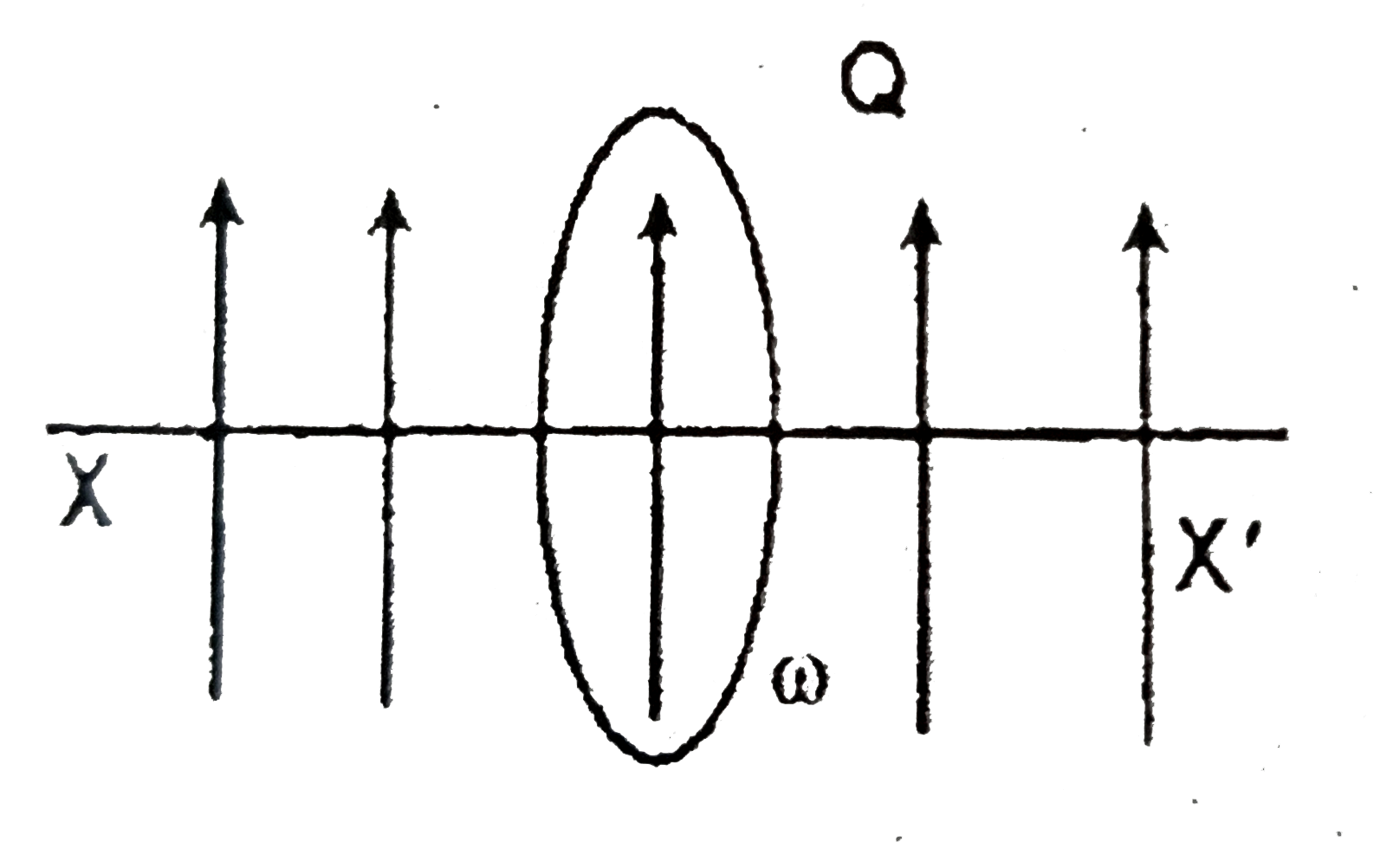
A disc of mass `m` has a charge `Q` distributed on its surface. It is rotating about an `XX'` with a angular velocity `omega`. The force acting on the disc is

Promotional Banner

Similar Questions

Explore conceptually related problems

A thin disc of radius R has charge Q distributed uniformly on its surface. The disc is rotated about one of its diametric axis with angular velocity omega . The magnetic moment of the arrangement is

A thin disc of radius R has charge Q distributed uniformly on its surface. The disc is rotated about one of its diametric axis with angular velocity omega . The magnetic moment of the arrangement is

A thin annular disc of outer radius R and R/2 inner radius has charge Q uniformly distributed over its surface. The disc rotates about its axis with a constant angular velocity omega . Choose the correct option(s):

A thin annular disc of outer radius R and R/2 inner radius has charge Q uniformly distributed over its surface. The disc rotates about its axis with a constant angular velocity omega . Choose the correct option(s):

A thin disc of radius R and mass M has charge q uniformly distributed on it. It rotates with angular velocity omega . The ratio of magnetic moment and angular momentum for the disc is

A non-conducting thin disc of radius R and mass m having charge uniformly over one side with surface density sigma rotates about its axis with an angular velocity omega . Find : (a) the magnetic induction at the centre of the disc, (b) the magnetic moment of the disc. ( c) the ratio of magnetic moment and angular momentum of disc.

A dielectric circular disc of radius R carries a uniform surface charge density sigma . If it rotates about its exis with angular velocity omega , the magnetic field at the cente of disc is :

A thin non conducting horizontal disc of mass m having total charge q distributed uniformly over its surface, can rotate freely about its own axis. Initially when the disc is stationery a magnetic field B directed perpendicular to the plane is switched on at t=0 . Find the angular velocity omega acquired by disc as a function of time, if B=kt , where t is time.

A thin non conducting horizontal disc of mass m having total charge q distributed uniformly over its surface, can rotate freely about its own axis. Initially when the disc is stationery a magnetic field B directed perpendicular to the plane is switched on at t=0 . Find the angular velocity omega acquired by disc as a function of time, if B=kt , where t is time.