

Home
Class 12
PHYSICS
A plate of mass 10 gm is in equillibrium...

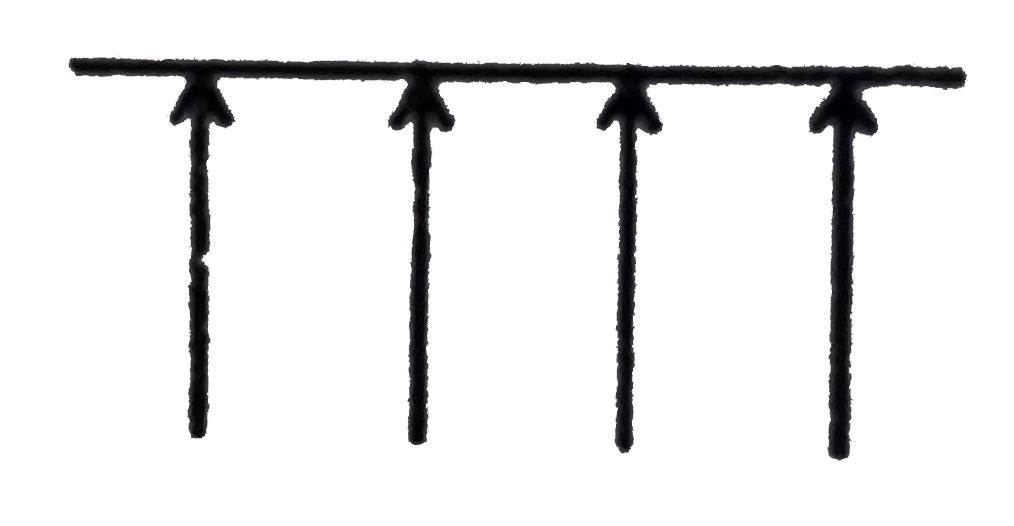
A plate of mass `10 gm` is in equillibrium in air due to the force exterted by light beam on plate. Calculate powder of beam. Assume plates is perfectly absorbing.

Promotional Banner

Similar Questions

Explore conceptually related problems

A plate of mass 10g is in equilibrium in air due to the force exerted by a light beam on the plate. Calculate power of the beam. Assume that the plate is perfectly absorbing.

A plate of mass 10g is in equilibrium in air due to the force exerted by a light beam on the plate. Calculate power of the beam. Assume that the plate is perfectly absorbing.

A plate of mass 10g is in equilibrium in air due to the force exerted by a light beam on the plate. Calculate power of the beam. Assume that the plate is perfectly absorbing.

A parallel beam of monochromatic light of frequency v is incident on a surface. Intensity of the beam is I and area of the surface is A. Find the force exerted by the light beam on the surface for following cases– (i) the surface is perfectly absorbing and the light beam is incident normally on it. (ii) the surface is perfectly reflecting and the light beam is incident normally. (iii) the surface is perfectly absorbing and the light beam is incident at an angle of incidence theta . (iv) the surface is perfectly reflecting and the light beam is incident at an angle of incidence theta .

A square plate of side length L absorbs all radiation incident on it. A point source of light is placed at a point P which is directly above a corner of the plate at a height L. The incident light on the plate produces a force of magnitude F_(0) on the plate. Calculate the magnitude of force on the plate if the source is moved to a point Q (Q is midpoint of the line PR).

A beam of light travelling in water falls on a glass plate immersed in water. When the incidence angle is 51^(@) , then the reflected beam of light is found polarized. Calculate mu of glass. Given mu of water is 4//3 .

A beam of light is incident at the polarizing angle of 35^(@) on a certain glass plate. The refractive index of the glass plate is: