

Home
Class 12
PHYSICS
A smooth fixed rod is inclined at an ang...

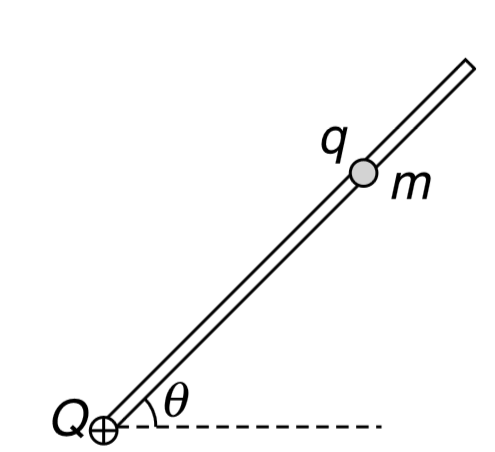
A smooth fixed rod is inclined at an angle `theta` to the horizontal. At the bottom end of the rod there is a fixed charge `+Q`. There is a bead of mas m having charge q that can slide freely on the rod. The equilibrium separation of the bead from fixed charge Q is `x_(0)` Find the frequency of oscillation of the bead if it is displaced a little from its equilibrium position.

Promotional Banner

Similar Questions

Explore conceptually related problems

A particle of mass m and charge +q is located midway between two fixed charged particles each having a charge +q and at a distance 2L apart. Assuming that the middle charge moves along the line joining the fixed charges, calculate the frequency of oscillation when it is displaced slightly.

Two positive point charges , each Q , are fixed at separation d . A third charge q is placed in the middle. Describe the equilibrium of the third charge.

A simple pendulum of mass m and charge +q is suspended vertically by a massless thread of length l. At the point of suspension, a point charge +q is also fixed. If the pendulum is displaced slightly from equilibrium position, its time period will be

A charged particle of mass m having charge q remains in equilibrium at height d above a fixed charge Q . Now the charged particle is slightly displaced along the line joining the charges, show that it will executes S.H.M. and find the time period of oscillation.

A particle of mass m and charge q is located midway between two fixed charged particles each having a charge q and at a distance 2L apart so that distance of this charge from each charge located at end is L. Assuming that the middle charge moves along the line joining the fixed charges. The frequency of oscillation when it is displaced slightly is

Two fixed point charge 4Q and 2Q are separated by a distance x. where should a third point charge q be placed for ti to be in equilibrium?

Find the electric field at a point P on the perpendicular bisector of a uniformly charged rod. The lengthof the rod is L, the charge on it is Q and the distance of P from the centre of the rod is a.

Find the electric field at a point P on the perpendicular bisector of a uniformly charged rod. The length of the rod is L, the charge on it is Q and the distance of P from the centre of the rod is a.

Find the electric field at a point P on the perpendicular bisector of a uniformly charged rod. The lengthof the rod is L, the charge on it is Q and the distance of P from the centre of the rod is a.