

Home
Class 11
PHYSICS
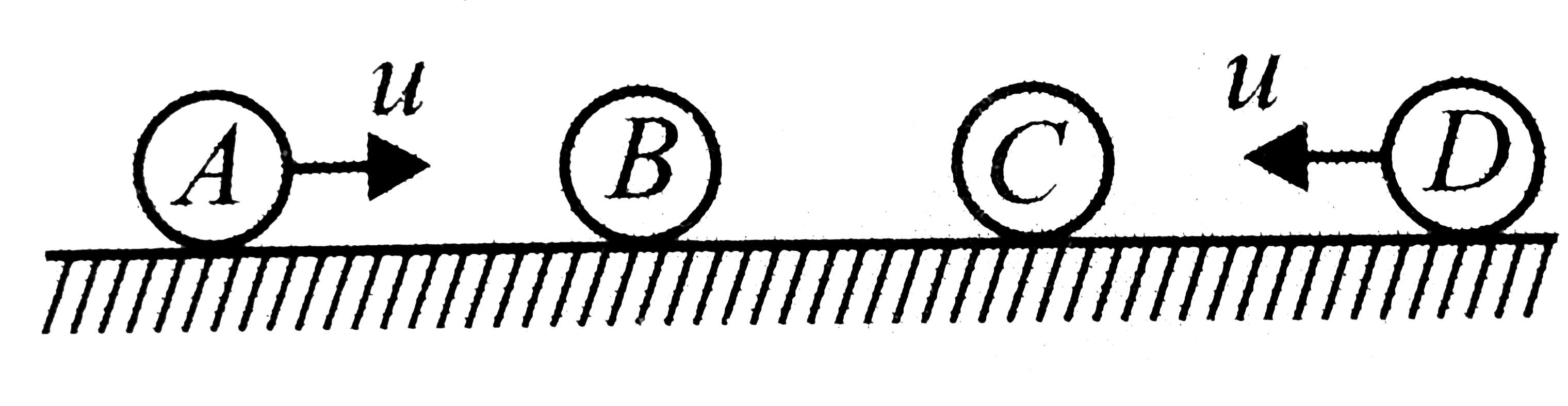
Four identical balls A,B, C and D are pl...

Four identical balls `A,B, C` and `D` are placed in a line on frictionless horizontal surface. `A` and `D` are moed with the same speed `u` towards the middle as shown. Assuming elastic collisions, find the final velocities.

Promotional Banner

Similar Questions

Explore conceptually related problems

Three balls A, B and C of same mass m are placed on a frictionless horizontal plane in a straight line as shown. Ball A is moved with velocity u towards the middle ball B . If all the collisions are elastic, find the final velocities of all the balls.

Three balls A, B and C of same mass m are placed on a frictionless horizontal plane in a straight line as shown. Ball A is moved with velocity u towards the middle ball B . If all the collisions are elastic, find the final velocities of all the balls.

A block of mass 2 kg is pushed towards a very heavy object moving with 2 m/s closer to the block (as shown). Assuming elastic collision and frictionless surface, find the final velocities of the blocks.

Three identical balls 1, 2 and 3 are placed together at rest on a smooth horizontal surface. A fourth identical ball moving with velocity u in line of first three balls collides head on elastically as shown in figure, then

Two identical blocks A and B connected by massless string, are placed on a frictionless horizontal plane. A bullet havig the same mass, moving with speed u strickes block B from behind as shown. If the bullet gets embedded into block B then find a. the velocity of A,B,C after collision. b. impulse on A due to tension in the string, c. impulse on C due to normal force of collision, d. impulse on B due to normal force of collision.

Two identical blocks A and B connected by massless string, are placed on a frictionless horizontal plane. A bullet havig the same mass, moving with speed u strickes block B from behind as shown. If the bullet gets embedded into block B then find a. the velocity of A,B,C after collision. b. impulse on A due to tension in the string, c. impulse on C due to normal force of collision, d. impulse on B due to normal force of collision.