

Home
Class 12
PHYSICS
Tangental acceleration of a particle mov...

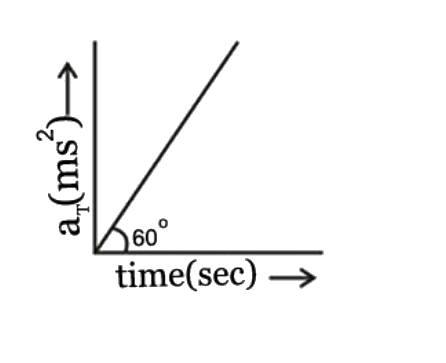
Tangental acceleration of a particle moving in a circle of radius 1 m varies with time t as shown in figure (initial velocity of the particle is zero). Time after which total acceleration of particle makes an angle of `30^(@)` with radial acceleration is

Promotional Banner

Similar Questions

Explore conceptually related problems

Tangential acceleration of a particle moving on a circle of radius 1 m varies with time t as shown in the graph (initial velocity of particle is zer). Time after which total acceleration of particle makes an angle of 30^@ with radial acceleration is,

In a circular motion of a particle , the tangential acceleration of the particle is given by a_t = 9 m s^(-2) . The radius of the circle is 4m . The particle was initially at rest. Time after which total acceleration of the particle makes an angle of 45^@ with the radial acceleration is

In a circular motion of a particle , the tangential acceleration of the particle is given by a_t = 9 m s^(-2) . The radius of the circle is 4m . The particle was initially at rest. Time after which total acceleration of the particle makes an angle of 45^@ with the radial acceleration is

In a circular motion of a particle the tangential acceleration of the particle is given by a_(t) = 2t m//s^(2) . The radius of the circle described is 4m . The particle is initially at rest. Time after which total acceleration of the particle makes 45^(@) with radial acceleration is :

In a circular motion of a particle the tangential acceleration of the particle is given by a_(1)= 2m//s^(2) . The radius of the circle described is 4 m. The particle is initially at rest. Time after which total acceleration of the particle makes 45^(@) with radial acceleration is :

In a circular motion of a particle the tangential acceleration of the particle is given by a_(1)= 2m//s^(2) . The radius of the circle described is 4 m. The particle is initially at rest. Time after which total acceleration of the particle makes 45^(@) with radial acceleration is :

The tangenital acceleration of a particle in a circular motion of radius 2 m is a_(t)=alphat m//s^(2) (where alpha is a constant) initially the particle as rest. Total acceleration of the particle makes 45^(@) with the radial acceleration after 2 sec The value of constant alpha is :

Acceleration of two identical particles moving in a straight line are as shown in figure. If initial velocity of both the particles was zero. Then velocity of their centre of mass after 10 s will be