

Home
Class 12
PHYSICS
A solid hemispherical uniformly charged ...

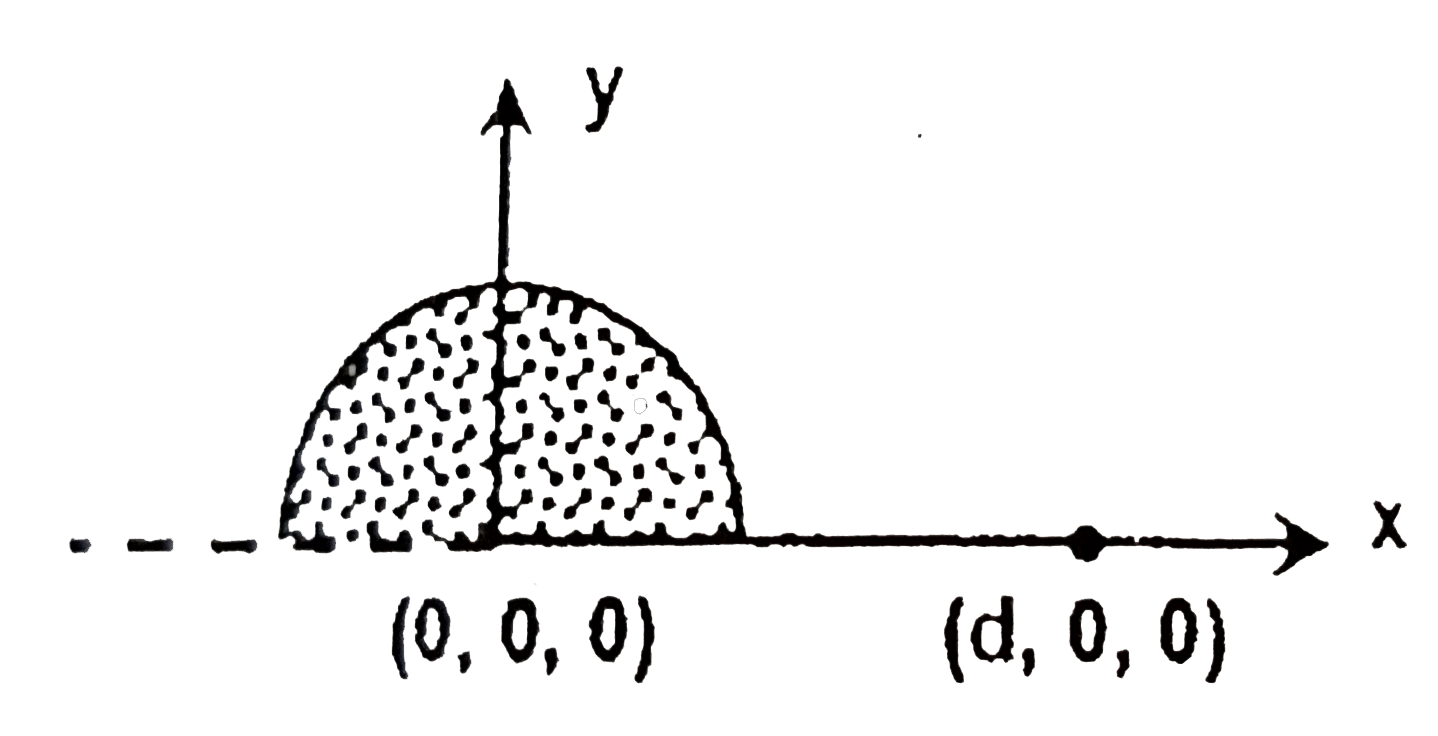
A solid hemispherical uniformly charged body having charge `Q` is kept symmetrically along the `y`-axis as shown in the figure. The net electric field at (`d`, `0`,`0`) is

Promotional Banner

Similar Questions

Explore conceptually related problems

There is one non-conducting uniformly charged hemispherical body, which carries a total charge Q which is kept in such a manner that Y-axis divides it symmetrically. The net electric field intensity at point A(d,0,0) is

A uniformly charged non-conducting spherical shell is given +q charge and a point charge -q is placed as shown. The electric field lines will be

A uniformly charged non-conducting spherical shell is given +q charge and a point charge -q is placed as shown. The electric field lines will be

A wire of length L= 20 cm is bent into a semicircular arc and the two equal halves of the arc are uniformly charged with charges +Q and -Q as shown in the figure. The magnitude of the charge on each half is |Q| =10^(3) epsilon_(0) , where epsilon_(0) is the permittivity of free the space. The net electric field at the center O is

A wire of length L= 20 cm is bent into a semicircular arc and the two equal halves of the arc are uniformly charged with charges +Q and -Q as shown in the figure. The magnitude of the charge on each half is |Q| =10^(3) epsilon_(0) , where epsilon_(0) is the permittivity of free the space. The net electric field at the center O is

3 charges are placed in a circle of radius d as shown in figure. Find the electric field along x-axis at centre of circle.

3 charges are placed in a circle of radius d as shown in figure. Find the electric field along x-axis at centre of circle.

3 charges are placed in a circle of radius d as shown in figure. Find the electric field along x-axis at centre of circle.

A solid conducting sphere of radius r is having a charge Q and point charges +q and -q are kept at distance d from the centre of sphere as shown in the figure. The electric potential at the centre of solid sphere (assume potential to be 0 at infinity)