

Home
Class 9
MATHS
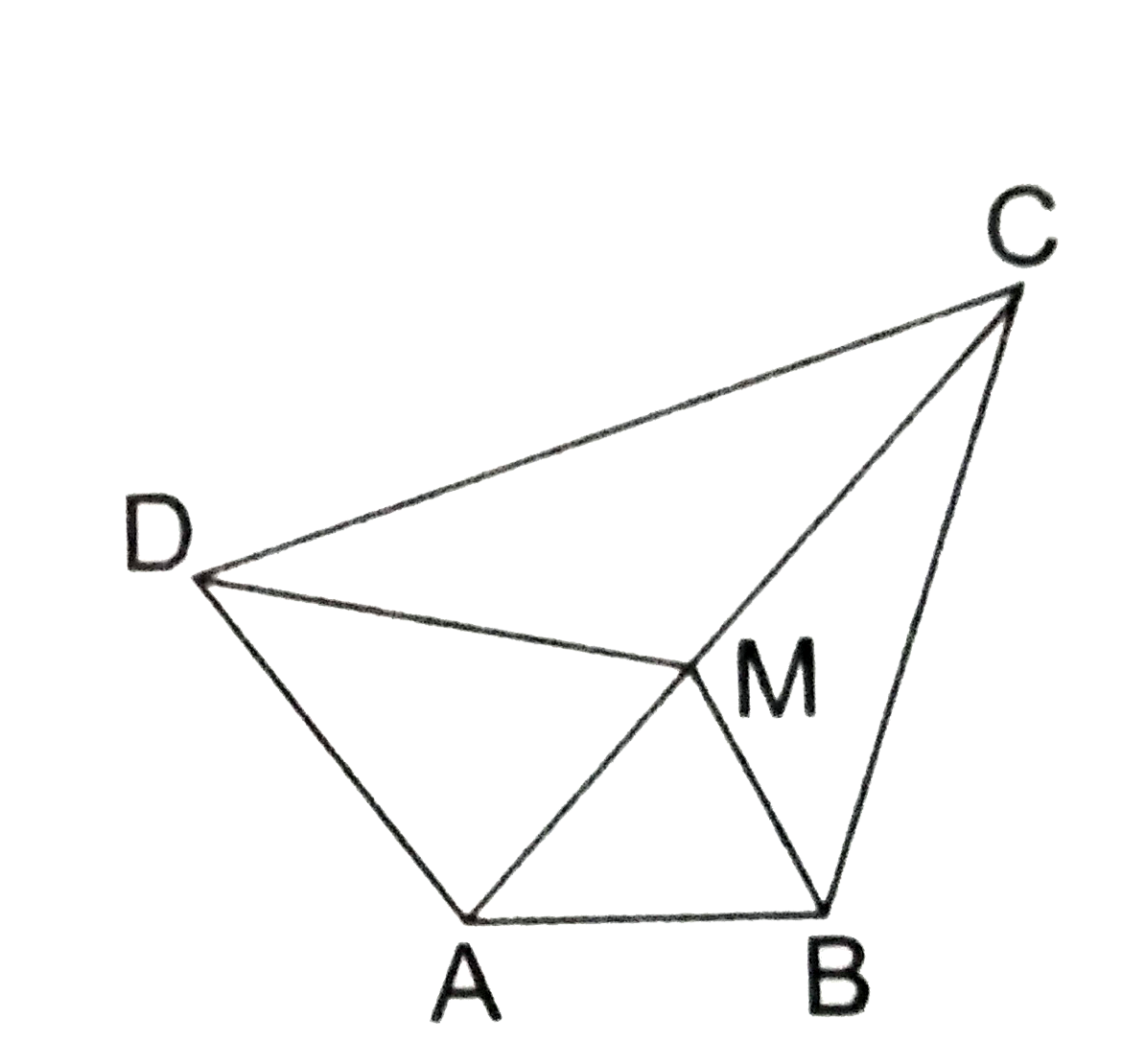
In a quadrilateral ABCD, it is being giv...

In a quadrilateral ABCD, it is being given that M is the midpoint of AC. Prove that
`ar(squareABMD)=ar(squareDMBC)`.

Promotional Banner

Similar Questions

Explore conceptually related problems

In the quadrilateral ABCD, it is given that L is the mid-point of AC. Prove that arc(qud.ABLD)=ar(quad.DLBC)

In triangleABC , point D lies on side BC. E is the midpoint of AD. Prove that, ar(EBC)= 1/2 ar(ABC)

In triangleABC , AD is a median . E is the midpoint of AD and F is the midpoint of AE. Prove that ar(ABF)= 1/8 ar(ABC).

In an equilateral Delta ABC, D is the midpoint of AB and E is the midpoint of AC. Then, ar (Delta ABC) : ar (Delta ADE)=?

ABC is a triangle in which D is the midpoint of BC and E is the midpoint of AD. Prove that ar(triangleBED)=(1)/(4)ar(triangleABC) .

In the adjoining figure, ABCD is a quadrilateral. A line through D, parallel to AC, meets BC produced in P . Prove that ar(triangleABP)=ar("qaud. ABCD") .

Diagonals AC and BD of a quadrilateral ABCD intersect at O in such a way that ar (AOD)=ar(BOC). Prove that ABCD is a trapezium.

D is the midpoint of side BC of triangleABC and E is the midpoint of BD. If O is the midpoint of AE, prove that ar(triangleBOE)=(1)/(8)ar(triangleABC) .

Diagonals AC and BD of a quadrilateral ABCD intersect at O in such a way that ar (AOD) = ar (BOC). Prove that ABCD is a trapezium.

Diagonals AC and BD of a quadrilateral ABCD intersect at O in such a way that ar (AOD) = ar (BOC) . Prove that ABCD is a trapezium.