Home
Class 12
PHYSICS
Coulomb's law for electrostatic force be...

Coulomb's law for electrostatic force between two point charges and Newton's law for gravitational force between two stationary point masses, both have inverse-square dependence on the distance between the charges and masses respectively,
(a) Compare the strength of these forces by determining the ratio of their magnitudes (i) for an electron and a proton and (ii) for two protons.
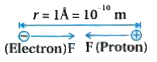
(b) Estimate the accelerations of electron an proton due to the electrical force of the mutual attraction when they are `=10^(-10)m` apart?
`(m_(p) = 1.67 xx 10^(-27) kg, m_(e) = 9.11 xx 10^(-31) kg)`

Text Solution

Verified by Experts

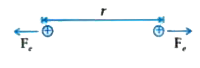
(a) (Electrons) `F_(e), F_(e)` (Proton)
`|F_(e)| = k((e)(e))/r^(2)`………..(1)

`|F_(g)| =G(m_(e).m_(p))/r^(2)`…….(2)
Required ratio,
`|F_(e)/F_(g)| = (ke^(2))/(Gm_(e).m_(p))`
`=(9 xx 10^(9) xx (1.6 xx 10^(-19))^(2)/(6.67 xx 10^(-11) xx (9.1 xx 10^(-31))(1.67 xx 10^(-27))))`
`=2.273 xx 10^(39)`
`|F_(e)| gt gt gt gt |F_(g)|`

`|F_(e)| = k((e)(e))/r^(2)`..........(3)

`|F_(g)| = G.(m_(p)^(2))/r^(2)`......(4)
Required ratio,
`|F_(e)|/|F_(g)| = (ke^(2))/(Gm_(p)^(2))`
`=(9 xx 10^(9) xx (1.6 xx 10^(-19))^(2))/((6.67 xx 10^(-11))(1.67 xx 10^(-27))^(2))`
`=1.349 xx 10^(36)`
`|F_(e)| gt gt gt gt gt |F_(g)|`

Electric force exerted between electron and proton,
`F_(e) =k((e)(e))/r^(2)`
`=(9 xx 10^(9) xx (1.6 xx 10^(-19))^(2))/(10^(-10))^(2)`
`therefore F_(e) = 2.304 xx 10^(-8)` N.........(5)
Now, here `F_(e) = m_(e)a_(e) = m_(p)a_(p)`
(i) `a_(e) =F_(e)/m_(e) = (2.304 xx 10^(-8))/(9.1 xx 10^(-31))`............(6)
`=2.532 xx 10^(22) m//s^(2)`
(ii) `a_(p) = F_(e)/m_(p) = (2.304 xx 10^(-8))/(1.67 xx 10^(-27))`
`=1.380 xx 10^(19) m//s^(2)`
Promotional Banner

Topper's Solved these Questions

  • ELECTRIC CHARGES AND FIELDS

    KUMAR PRAKASHAN|Exercise SECTION B NUMERICALS (NUMERICAL FROM TEXTUAL EXERCISES)|24 Videos
  • ELECTRIC CHARGES AND FIELDS

    KUMAR PRAKASHAN|Exercise SECTION B NUMERICALS (ADDITONAL EXERCISE)|10 Videos
  • ELECTRIC CHARGES AND FIELDS

    KUMAR PRAKASHAN|Exercise SECTION A QUESTIONS- ANSWERS (TRY YOURSELF )|73 Videos
  • DUAL NATURE OF RADIATION AND MATTER

    KUMAR PRAKASHAN|Exercise Section-D (MCQs asked in GUJCET/Board Exam)|1 Videos
  • ELECTROMAGNETIC INDUCTION

    KUMAR PRAKASHAN|Exercise Section D MCQs (MCQs asked in Competitive Exams )|38 Videos

Similar Questions

Explore conceptually related problems

Columb law for electrostatic force between two point charges and newton law for gravitational force between two the distance between the charges and masses respectively (a) compare the strength of these forces by determining the ratio of their magnitudes (i) for an electron and a proton and (ii) for two protons (b) estimate the acceleratons of electron and proton due to the electrical force oftheir mutual attarction when they are 1A (=10^(-10) m) a part (m_(p)=1.67xx10^(27) kg m_(e )=9.11xx10^(-31) kg)

Coulombian force between two charges ………….

Electric force between two protons is ...... times greater than gravitational force.

How did Coulomb find the law of value of electric force between two point charges ?

How is the gravitational force between two point masses affected when they are dipped in water keeping the separation between them the same ?

What is the charge of an electron, proton and a neutron ?

KUMAR PRAKASHAN-ELECTRIC CHARGES AND FIELDS -SECTION B NUMERICALS (NUMERICAL FROM TEXTUAL ILLUSTRATIONS)
  1. If 10^(9) electrons move out of a body to another body every second, h...

    Text Solution

    |

  2. How much positive and negative charge is there in a cup of water ?

    Text Solution

    |

  3. Coulomb's law for electrostatic force between two point charges and Ne...

    Text Solution

    |

  4. A charged metallic sphere A is suspended by a nylon thread. Another ch...

    Text Solution

    |

  5. Consider three charges q(1),q(2), q(3) each equal to q at the vertices...

    Text Solution

    |

  6. Consider the charges q, q and -q placed at vertices of an equilateral...

    Text Solution

    |

  7. An electron falls through a distance of 1.5cm in a uniform electric fi...

    Text Solution

    |

  8. Two point charges q(1) and q(2) of magnitude + 10^(-8) c and -10^(-8)...

    Text Solution

    |

  9. Tow charges pm10 mu C are placed 5.0 mm apart determine the electri...

    Text Solution

    |

  10. The electric field components are E(x)=ax^(-1//2),E(y)=E(z)=0 in whi...

    Text Solution

    |

  11. An electric field is uniform and in the positive x direction for posit...

    Text Solution

    |

  12. An early model for an atom considered it to have a positively charged ...

    Text Solution

    |

  13. How can a metallic sphere be charged negatively without touching it ?

    Text Solution

    |

  14. If 10^10 electrons move out of a body to another body every second, ho...

    Text Solution

    |

  15. How much positive and negative charge is there in a 100 g water ? (Mol...

    Text Solution

    |

  16. Charges on identical spheres A and B are equal. When the separation be...

    Text Solution

    |

  17. + q, + q, - q and - q are kept at vertices of square ABCD respectively...

    Text Solution

    |

  18. Four equal point charges of 16 muC are kept at vertices of square of ...

    Text Solution

    |

  19. An electron falls through a distance of 2 cm ir a uniform electric fie...

    Text Solution

    |

  20. Two charges of dipole +- 10 mu C are placed 1mm apart. Determine the ...

    Text Solution

    |