Home
Class 12
PHYSICS
Consider the charges q, q and -q placed ...

Consider the charges q, q and -q placed at vertices of an equilateral triangle as shown it figure. What is the force on each charge ?

Text Solution

Verified by Experts
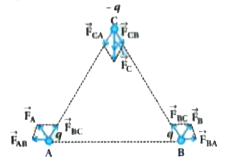

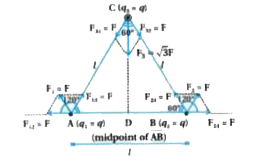
Situation given in the statement is depicted in the following figure.
Here `|q_(1)| = |q_(2)| = |q_(3)|=q`

Here since AABC is an equilateral triangle, we have AB = BC = CA = I
Magnitudes of mutual Coulombian forces are equal to F.
`F_(12) = F_(21) = F_(23) = F_(13) = F_(31) = F = (kq^(2))/l^(2)`....(1)
Resultant Coulombian force on `q_(1)` is:
`vecF_(1) = vecF_(12) + vecF_(13)`
`therefore F_(1) = sqrt(F^(2) + F^(2) + 2F F cos (120^(@))) (therefore F_(12) = F_(13) =F)`
`=sqrt(2F^(2) + 2F^(2) (-1/2))` (Here, `theta = 120^(@)`)
`=sqrt(F^(2))`
`therefore F_(1) = F` (in the direction parallel to `bar(BC)`).....(2)
Resultant Coulombian force on `q_(3)` is,
`vecF_(3) = vecF_(31) + vecF_(32)`
`therefore F_(3) = sqrt(F^(2) + F^(2) + 2F F cos 60^(@)) (therefore F_(31) = F_(32) = F)`
`therefore F_(3) = sqrt(2F^(2) + 2F^(2)(1/2))` (Here `theta = 60^(@)`)
`=sqrt(3F^(2))`
`therefore F_(3) = sqrt(3F)` (in the direction of `vec(CD)`)
where D is the midpoint of `bar(AB)` ) (or along the direction bisecting `angle(ACB)`)
`therefore vecF_(B) = {(F cos 60^(@))(-hati) + (F sin 60^(@)hatj)} + Fcos 60^(@) hati + F sin 60^(@) hatj + sqrt(3)F(-hatj)`
`=-F/2hati + sqrt(3)/2 Fhatj + F/2hati + sqrt(3)/2 Fhatj - sqrt(3)Fhatj`
`=sqrt(3)Fhatj - sqrt(3)Fhatj`
`therefore vecF_(B) = vec0`
`therefore vecF_(B) =0`
Here, if given point charges have equal mass then resultant gravitational force on this isolated system will also be zero.
Another alternative Method (Aliter) :
Here, resultant Coulombian force acting on whole system is,
`vecF_(B) = vecF_(1) + vecF_(2) + vecF_(3)`
`therefore =(vecF_(12) + vecF_(13) + vecF_(21) + vecF_(23) + vecF_(31) + vecF_(32))`
`=(vecF_(12) + vecF_(21)) + (vecF_(13) + vecF_(31)) + (vecF_(23) + vecF_(32))`
`=vec0 + vec0 + vec0`
`=vec0` (`therefore` According to Newton.s third law)
`vecF_(12) =-vecF_(21).vecF_(13) =-vecF_(31)` and `vecF_(23) =-vecF_(32)`
Promotional Banner

Topper's Solved these Questions

  • ELECTRIC CHARGES AND FIELDS

    KUMAR PRAKASHAN|Exercise SECTION B NUMERICALS (NUMERICAL FROM TEXTUAL EXERCISES)|24 Videos
  • ELECTRIC CHARGES AND FIELDS

    KUMAR PRAKASHAN|Exercise SECTION B NUMERICALS (ADDITONAL EXERCISE)|10 Videos
  • ELECTRIC CHARGES AND FIELDS

    KUMAR PRAKASHAN|Exercise SECTION A QUESTIONS- ANSWERS (TRY YOURSELF )|73 Videos
  • DUAL NATURE OF RADIATION AND MATTER

    KUMAR PRAKASHAN|Exercise Section-D (MCQs asked in GUJCET/Board Exam)|1 Videos
  • ELECTROMAGNETIC INDUCTION

    KUMAR PRAKASHAN|Exercise Section D MCQs (MCQs asked in Competitive Exams )|38 Videos

Similar Questions

Explore conceptually related problems

consider three charges q_(1),q_(2),q_(3) each equal to q at the vertices of an equilateral triangle of side l what is the force on a charge Q placed at the centroid of the triangle

Consider three charges q_(1),q_(2), q_(3) each equal to q at the vertices of an equilateral triangle of side l. What is the force on a charge Q (with the same sign as q) placed at the centroid of the triangle, as shown in figure ?

Three poistive charges of equal value q are placed at the vertices of an equilateral triangle. The resulting lines of force should be sketched as in

Three points charges are placed at the corners of an equilateral triangle of side L as shown in the figure: find the resultant dipole moment

Six charges are kept at the vertices of a regular hexagon as shown in the figure. If magnitude of force applied by +Q on +q charge is F, then net electric force on the +Q is nF. Find the value of n.

Charges +q and -q are located at the corners of a cube of side as show in the figure. Find the work done to separate the charges to infinite distance

Two spherical , nonconducting and very tin shells of uniformly distributed positive charge Q and radius d are located a distance 10d from each other . A positive point charge q is placed inside one of the shells at a distance d//2 from the center, on the line connecting the centers of the two shells , as shown in the figure, What is the net force on the charge q ? .

Three charges Q, +q and +q are placed at the vertices of a right angle triangle (isoscles triangle) as shown. The net electrostatic energy of the configuration is zero, if Q is equal to :

Conisder a system of three charges q//3 , q//3 and -2q//3 placed at point A, B and C, respectively, as shown in the figure. Take O to be centre of the circle of radius R and angle CAB=60^@

KUMAR PRAKASHAN-ELECTRIC CHARGES AND FIELDS -SECTION B NUMERICALS (NUMERICAL FROM TEXTUAL ILLUSTRATIONS)
  1. A charged metallic sphere A is suspended by a nylon thread. Another ch...

    Text Solution

    |

  2. Consider three charges q(1),q(2), q(3) each equal to q at the vertices...

    Text Solution

    |

  3. Consider the charges q, q and -q placed at vertices of an equilateral...

    Text Solution

    |

  4. An electron falls through a distance of 1.5cm in a uniform electric fi...

    Text Solution

    |

  5. Two point charges q(1) and q(2) of magnitude + 10^(-8) c and -10^(-8)...

    Text Solution

    |

  6. Tow charges pm10 mu C are placed 5.0 mm apart determine the electri...

    Text Solution

    |

  7. The electric field components are E(x)=ax^(-1//2),E(y)=E(z)=0 in whi...

    Text Solution

    |

  8. An electric field is uniform and in the positive x direction for posit...

    Text Solution

    |

  9. An early model for an atom considered it to have a positively charged ...

    Text Solution

    |

  10. How can a metallic sphere be charged negatively without touching it ?

    Text Solution

    |

  11. If 10^10 electrons move out of a body to another body every second, ho...

    Text Solution

    |

  12. How much positive and negative charge is there in a 100 g water ? (Mol...

    Text Solution

    |

  13. Charges on identical spheres A and B are equal. When the separation be...

    Text Solution

    |

  14. + q, + q, - q and - q are kept at vertices of square ABCD respectively...

    Text Solution

    |

  15. Four equal point charges of 16 muC are kept at vertices of square of ...

    Text Solution

    |

  16. An electron falls through a distance of 2 cm ir a uniform electric fie...

    Text Solution

    |

  17. Two charges of dipole +- 10 mu C are placed 1mm apart. Determine the ...

    Text Solution

    |

  18. The electric field components in figure are E(x) =ax, E(y) = E(z) =0 ...

    Text Solution

    |

  19. If the electric field components due to electric charge in cube sho...

    Text Solution

    |

  20. A hollow cylinder is kept in 3-dimensional coordinate system of lm len...

    Text Solution

    |