Home
Class 12
PHYSICS
A point charge + mu c is a distance 5 c...

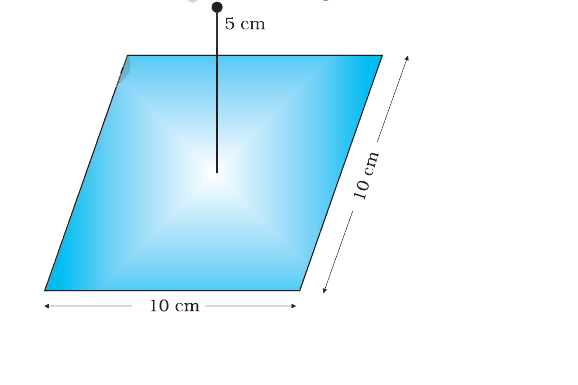
A point charge + `mu` c is a distance 5 cm directly above the centre of a square of side 10 cm as what is the magnitude of the electric flux through the square

Text Solution

Verified by Experts
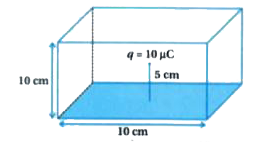
Situation given in the statement is equivalent to following situation.

Here given point charge `q= 10 muC` can be considered to be at the centroid of a cube of side length 10 cm. This position of charge is symmetric to all the six identical faces of a cube. Hence, total electric flux `phi_(t)` emanating from charge q is shared equally by these six faces. Hence, electric flux passing through one face (bottom face given in the statement) will be,
`phi = 1/6 phi_(t)`
`=1/6 (q/epsilon_(0))`
`=(10 xx 10^(-6))/(6v xx 8.85 xx 10^(-12))`
`therefore phi = 1.883 xx 10^(5) Nm^(2)//C`
Promotional Banner

Topper's Solved these Questions

  • ELECTRIC CHARGES AND FIELDS

    KUMAR PRAKASHAN|Exercise SECTION B NUMERICALS (ADDITONAL EXERCISE)|10 Videos
  • ELECTRIC CHARGES AND FIELDS

    KUMAR PRAKASHAN|Exercise SECTION B NUMERICALS (NUMERICAL FOR .DARPAN. BASED ON TEXTBOOK)|8 Videos
  • ELECTRIC CHARGES AND FIELDS

    KUMAR PRAKASHAN|Exercise SECTION B NUMERICALS (NUMERICAL FROM TEXTUAL ILLUSTRATIONS)|24 Videos
  • DUAL NATURE OF RADIATION AND MATTER

    KUMAR PRAKASHAN|Exercise Section-D (MCQs asked in GUJCET/Board Exam)|1 Videos
  • ELECTROMAGNETIC INDUCTION

    KUMAR PRAKASHAN|Exercise Section D MCQs (MCQs asked in Competitive Exams )|38 Videos

Similar Questions

Explore conceptually related problems

A point charge of 2.0 mu c is at the centre of a cubic gaussian surface 9.0 cm on edge what is the net electric flux through the surface

A point charge of 2.0 muC is at the centre of a cubic Gaussian surface 9.0 cm on edge. What is the net electric flux through the surface ?

Five point charges, each of value +q are placed on five vertices of a regular hexagon of side Lm. What is the magnitude of the force on a point charge of value -q coulomb placed at the centre of the hexagon?

A point charge q is placed at the centre of a cube of side length L . The electric flux emerging from the cube is……

A point charge Q is placed at the centre of a spherical conducting shell. A total charge of -q is placed on the shell. The magnitude of the electric field at point P_1 at a distance R_1 from the centre is X. The magnitude of the electric field due to induced charges at point P_2 a distance R_2 from the centre is Y. The values of X and Y are respectively.

Four point charges q_(A) =2 muC, q_(B) = -5 muC, q_(C) =2 muC , and q_(D) = -5 muC are located at the corners of a square ABCD of side 10 cm. What is the force on a charge of 1 muC placed at the centre of the square ?

(a) Two insulated charged copper spheres a and b have their centres separated by a distance of 50 cm what is the nutual force of electrostatic repulsion if the charge on each is 6.5 xx10^(-7) c the radii of a and b negligible compared to the distance of separation (b) what is the force of repuslion if each spere is charged double the above amount andf the distance between them is haved

An electric field is uniform and in the positive x direction for postive x and uniform with the same magnitude but in the negative x direction x it is given that E=200 I N/C length 20 cm and radius 5 cm has its centre at the origin and its axis x =-10 cm (a) what is the net ioutward flux through each flate face (b) what is the flux through the side of the cylinder (C ) what is the net outward flux thoght the cylinder (d) what is the net charge inside the cylinder

A point charge Q is located on the axis of a disc of radius R at a distance b from the plane of the disc (figure). Show that if one-fourth of the electric flux from the charge passes through the disc, then R=sqrt3b .

Four charges of 1mu C, 2mu C, 3mu C and -6 mu C are placed one at each corner of the square of side 1 m . The square lies in the x-y plane with its centre at the origin.The electric field at the centre

KUMAR PRAKASHAN-ELECTRIC CHARGES AND FIELDS -SECTION B NUMERICALS (NUMERICAL FROM TEXTUAL EXERCISES)
  1. When a glass rod is rubbed with a silk cloth, charges appear on both. ...

    Text Solution

    |

  2. Four point charges q(A) =2 muC, q(B) = -5 muC, q(C) =2 muC, and q(D) =...

    Text Solution

    |

  3. (a) An electrostatic field line is a continuous curve. That is, a fiel...

    Text Solution

    |

  4. Two point charges q(A) =3 muC and q(B) = -3 muC are located 20 cm apa...

    Text Solution

    |

  5. A system has two charges qA = 2.5 xx 10^(-7) C and q(B) = - 2.5 xx 1...

    Text Solution

    |

  6. An electric dipole with dipole moment 4 xx 10^(-9) Cm is aligned at 30...

    Text Solution

    |

  7. A polythene piece rubbed with wool is found to have a negative charge ...

    Text Solution

    |

  8. (a) Two insulated charged copper spheres a and b have their centres ...

    Text Solution

    |

  9. Suppose the spheres A and B in Exercise 1.12 have identical sizes. A t...

    Text Solution

    |

  10. Figure shows tracks of three charged particles in a uniform electrosta...

    Text Solution

    |

  11. Consider a uniform electric field E=3xx10^(3) hati N/C (a) what is ...

    Text Solution

    |

  12. What is the net flux of the uniform electric field of exercise th...

    Text Solution

    |

  13. Careful measurement of the electric field at the surface of a black bo...

    Text Solution

    |

  14. A point charge + mu c is a distance 5 cm directly above the centre of...

    Text Solution

    |

  15. A point charge of 2.0 muC is at the centre of a cubic Gaussian surface...

    Text Solution

    |

  16. A point charge causes an elelctric flux of -1.0 xx10^(3) Nm^(2) /C to...

    Text Solution

    |

  17. A conducting sphere of radius 10 cm has an unknown charge if the elect...

    Text Solution

    |

  18. A uniformly charged conducting sphere of 2.4 m diameter has a (a)...

    Text Solution

    |

  19. An infinite line charge produces a field of 9xx10^(4) N/C at a dis...

    Text Solution

    |

  20. Two large thin metal plates are parallel and close to each other on...

    Text Solution

    |

