Home
Class 12
PHYSICS
A uniformly charged conducting sphere ...

A uniformly charged conducting sphere of 2.4 m diameter has a (a) find the charge on the sphere (b) what is the total eletric fluxd leaving the surface of the sphere

Text Solution

Verified by Experts
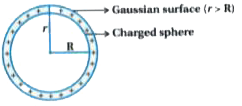
(a) Surface charge density is (by definition),
`sigma Q/A = Q/(4piR^(2))`
`therefore Q = 4piR^(2) sigma`
`=(4) (3.14) (1.2)^(2) (80 xx 10^(-6))`
`therefore Q = 1.447 xx 10^(_3)` C

Electric flux emanating from given charged sphere is passing through concentric Gaussian surface which encloses charge Q of the sphere, which is (according to Gauss.s law)
`phi = q/epsilon_(0)`
`=Q/epsilon_(0)` (Here q=Q)
`=(1.447 xx 10^(-3))/(8.85 xx 10^(-12))`
`therefore phi = 1.635 xx 10^(8) Nm^(2)//C`
Promotional Banner

Topper's Solved these Questions

  • ELECTRIC CHARGES AND FIELDS

    KUMAR PRAKASHAN|Exercise SECTION B NUMERICALS (ADDITONAL EXERCISE)|10 Videos
  • ELECTRIC CHARGES AND FIELDS

    KUMAR PRAKASHAN|Exercise SECTION B NUMERICALS (NUMERICAL FOR .DARPAN. BASED ON TEXTBOOK)|8 Videos
  • ELECTRIC CHARGES AND FIELDS

    KUMAR PRAKASHAN|Exercise SECTION B NUMERICALS (NUMERICAL FROM TEXTUAL ILLUSTRATIONS)|24 Videos
  • DUAL NATURE OF RADIATION AND MATTER

    KUMAR PRAKASHAN|Exercise Section-D (MCQs asked in GUJCET/Board Exam)|1 Videos
  • ELECTROMAGNETIC INDUCTION

    KUMAR PRAKASHAN|Exercise Section D MCQs (MCQs asked in Competitive Exams )|38 Videos

Similar Questions

Explore conceptually related problems

Two charged conducting spheres of radii a and b are connected to each other by a wire. What is the ratio of electric fields at the surfaces of the two spheres? Use the result obtained to explain why charge density on the sharp and pointed ends of a conductor is higher than on its flatter portions.

Charge Q is distributed uniformly over a non conducting sphere of radius R. Find the electric p-0tential at distance r from the centre of the sphere r (r lt R) . The electric field at a distance r from the centre of the sphere is given as (1)/(4pi epsilon_(0)). (Q)/(R^(3))hatr . Also find the potential at the centre of the sphere .

A solid sphere of diameter 0.1 m and 5 kg is rolling down an inclined plane with a speed of 4 m/s. The total kinetic energy of the sphere is :

A solid metallic sphere has a charge +3Q . Concentric with this sphere is a conducting spherical shell having charge -Q . The radius of the sphere is a and that of the spherical shell is b(bgta) What is the electric field at a distance R(a lt R lt b) from the centre

The electrostatic force on a small sphere of charge 0.4 muC due to another small sphere of charge -0.8 uC in air is 0.2 N. (a) What is the distance between the two spheres ? (b) What is the force on the second sphere due to the first ?

An insulating solid sphere of radius R has a uniformaly positive charge density rho . As a result of this uniform charge distribution there is a finite value of electric potential at the centre of the sphere, at the surface of the sphere and also at a point out side the sphere. The electric potential at infinity is zero. Statement-1: Wgen a charge 'q' is taken from the centre to the surface of the sphere, its potential energy charges by (qrho)/(3 in_(0)) Statement-2 : The electric field at a distance r (r lt R) from the centre of the the sphere is (rho r)/(3in_(0))

A unit positive point charge of mass m is projected with a velocity v inside the tummel as shown. The tunnel has been made inside a uniformly charged non conducting sphere. The minimum velocity with which the point charge should be projected such that it can it reach the opposite end of the tunnel, is equal to:

Consider a neutral conducting sphere. A positive point charge is placed outside the sphere. The net charge on the sphere is then

A conducting sphere of radius R is given a charge Q. The electric potential and the electric field at the centre of the sphere respectively are

KUMAR PRAKASHAN-ELECTRIC CHARGES AND FIELDS -SECTION B NUMERICALS (NUMERICAL FROM TEXTUAL EXERCISES)
  1. When a glass rod is rubbed with a silk cloth, charges appear on both. ...

    Text Solution

    |

  2. Four point charges q(A) =2 muC, q(B) = -5 muC, q(C) =2 muC, and q(D) =...

    Text Solution

    |

  3. (a) An electrostatic field line is a continuous curve. That is, a fiel...

    Text Solution

    |

  4. Two point charges q(A) =3 muC and q(B) = -3 muC are located 20 cm apa...

    Text Solution

    |

  5. A system has two charges qA = 2.5 xx 10^(-7) C and q(B) = - 2.5 xx 1...

    Text Solution

    |

  6. An electric dipole with dipole moment 4 xx 10^(-9) Cm is aligned at 30...

    Text Solution

    |

  7. A polythene piece rubbed with wool is found to have a negative charge ...

    Text Solution

    |

  8. (a) Two insulated charged copper spheres a and b have their centres ...

    Text Solution

    |

  9. Suppose the spheres A and B in Exercise 1.12 have identical sizes. A t...

    Text Solution

    |

  10. Figure shows tracks of three charged particles in a uniform electrosta...

    Text Solution

    |

  11. Consider a uniform electric field E=3xx10^(3) hati N/C (a) what is ...

    Text Solution

    |

  12. What is the net flux of the uniform electric field of exercise th...

    Text Solution

    |

  13. Careful measurement of the electric field at the surface of a black bo...

    Text Solution

    |

  14. A point charge + mu c is a distance 5 cm directly above the centre of...

    Text Solution

    |

  15. A point charge of 2.0 muC is at the centre of a cubic Gaussian surface...

    Text Solution

    |

  16. A point charge causes an elelctric flux of -1.0 xx10^(3) Nm^(2) /C to...

    Text Solution

    |

  17. A conducting sphere of radius 10 cm has an unknown charge if the elect...

    Text Solution

    |

  18. A uniformly charged conducting sphere of 2.4 m diameter has a (a)...

    Text Solution

    |

  19. An infinite line charge produces a field of 9xx10^(4) N/C at a dis...

    Text Solution

    |

  20. Two large thin metal plates are parallel and close to each other on...

    Text Solution

    |

