Home
Class 12
PHYSICS
Obtain the formula for the electric fiel...

Obtain the formula for the electric field due to a long thin wire of uniform linear charge density E without using Gauss's law. (Hint: Use Coulomb's law directly and evaluate the necessary integral.)

Text Solution

Verified by Experts

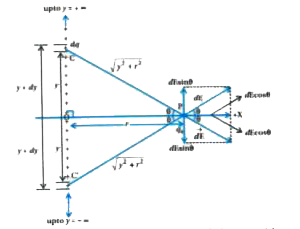
Consider infinitely extended line of charge with constant linear charge density `lambda` . Let us determine its electric field at perpendicular distance r say at point P as shown in the figure. For this consider a charge element dq at distance y from central point O. Here, `dq = lambdady`
`(therefore lambda = (dq)/(dy))`
Magnitude of Coulombian force exerted by above charge element dq on test charge `q_(0)` placed at point P is,
`dF = k((dq)q_(0))/(CP)^(2) = (k(dq)q_(0))/(y^(2) + r^(2))`........(1)
Magnitude of electric field of charge element dq at point P is,
`dE = (dF)/(q_(0)) = (kdq)/(y^(2) + r^(2))`.........(2)
Similary magnitude of electric field of charge element dq (selected on opposite side of central point O) at point P is also, `dE = (kdq)/(y^(2) + r^(2))`
When we resolve above two electric fields into two mutually perpendicular components at point p we find that dEsinG components cancel each other (because of equal magnitudes and opposite directions). Hence, we get electric field at point P only due to `dEcostheta` components which are in same directions and so we can make their scalar addition to find resultant electric field E at point P Thus,
`E = int dEcostheta`
`int(kdq)/(y^(2) + r^(2)).r/sqrt(y^(2) + r^(2))`
From eqn. (2) and from `DeltaCOP`
`therefore E = intklambda dy xx r/(y^(2) + r^(2))^(3//2)`...........(3)
In right angled `triangleCOP`
`tantheta = y/r rArr y = r tan theta`.......(4)
For a given point P value of r is constant and so from above equation,
`(dy)/(d theta) = r(d)/(d theta) (tan theta)`
`therefore (dy)/(d theta) = r sec^(2)theta`
`therefore dy = rsec^(2)theta d theta`........(5)
Now, `(y^(2) + r^(2))^(3//2) = (r^(2)tan^(2)theta + r^(2))^(3//2)` (From equation (4))
`=(r^(2) sec^(2)theta)^(3//2)`
`=r^(2)sec^(3)theta`.........(6)
From equation (4)
`tan theta = y/r`
When `y =-infty, tan theta = -infty rArr theta = -pi/2`
`y=+infty, tan theta =+ infty rArr theta = + pi/2` ............(7)
From eqn (3), (5),(6) and (7),
`E = int_(-pi//2)^(+pi//2) klambda(r sec^(2)theta d theta) xx r/(r^(3) sec^(3)theta)`
`therefore E=(klambda)/r {sin(pi/2)- sin(-pi/2)}`
`therefore E =(2klambda)/r`
`therefore E = (lambda)/(2pi epsilon_(0)r) (therefore k=1/(4pi epsilon_(0)))`
Promotional Banner

Topper's Solved these Questions

  • ELECTRIC CHARGES AND FIELDS

    KUMAR PRAKASHAN|Exercise SECTION B NUMERICALS (NUMERICAL FOR .DARPAN. BASED ON TEXTBOOK)|8 Videos
  • ELECTRIC CHARGES AND FIELDS

    KUMAR PRAKASHAN|Exercise SECTION C NCERT EXEMPLAR SOLUTION (MULTIPLE CHOICE QUESTIONS (MCQs))|7 Videos
  • ELECTRIC CHARGES AND FIELDS

    KUMAR PRAKASHAN|Exercise SECTION B NUMERICALS (NUMERICAL FROM TEXTUAL EXERCISES)|24 Videos
  • DUAL NATURE OF RADIATION AND MATTER

    KUMAR PRAKASHAN|Exercise Section-D (MCQs asked in GUJCET/Board Exam)|1 Videos
  • ELECTROMAGNETIC INDUCTION

    KUMAR PRAKASHAN|Exercise Section D MCQs (MCQs asked in Competitive Exams )|38 Videos

Similar Questions

Explore conceptually related problems

Obtain the formula for the electric field due to a long thin wire of uniform linear charge density E without using gauss law

Obtain the expression of electric field by a straight wire of infinite length and with linear charge density lambda .

Find the electric field due to an infinitely long cylindrical charge distribution of radius R and having linear charge density lambda at a distance half of the radius from its axis.

Two charged conducting spheres of radii a and b are connected to each other by a wire. What is the ratio of electric fields at the surfaces of the two spheres? Use the result obtained to explain why charge density on the sharp and pointed ends of a conductor is higher than on its flatter portions.

Let E_1(r) , E_2(r) and E_3(r) be the respectively electric field at a distance r from a point charge Q , an infinitely long wire with constant linear charge density lambda , and an infinite plane with uniform surface charge density sigma . If E_1(r_0)=E_2(r_0)=E_3(r_0) at a given distance r_0 , then

(a) Magnetic field lines show the direction (at every point) along which a small magnetised needle aligns at the point). Do the magnetic field lines also represent the lines of force on a moving charged particle at every point? (b) Magnetic field lines can be entirely confined within the core of a toroid, but not within a straight solenoid. Why? (c) If magnetic monopoles existed, how would the Gauss's law of magnetism be modified? (d) Does a bar magnet exert a torque on itsell due to its own field? Does one element of a current-carrying wire exert a force on another element of the same wtre? (e) Magnetic field arises due to charges in motion. Can a system have magnetic moments even though its net charge is zero?

(a) Show that the normal component of electrostatic field has a discontinuity from one side of a charged surface to another given by (E_(2)-E_(1)).n = sigma/epsilon_(0) where hatn is a unit vector normal to the surface at a point and sigma is the surface charge density at that point. (The direction of hatn is from side 1 to side 2.) Hence, show that just outside a conductor, the electric field is sigma hatn //epsilon_(0) . (b) Show that the tangential component of electrostatic field is continuous from one side of a charged surface to another. [Hint: For (a), use Gauss’s law. For, (b) use the fact that work done by electrostatic field on a closed loop is zero.]

For what type of charge distribution, electric field can be obtained by using Coulomb's law and superposition principle ?

Electric field produced due to an infinitely long straight uniformly charged wire at perpendicular distance of 2 cm is 3 xx 10^8 NC^(-1) . Then linear charge density on the wire is.......
