Home
Class 12
PHYSICS
(a) Consider an arbitrary electrostatic ...

(a) Consider an arbitrary electrostatic field configuration. A small test charge is placed at a null point (i.e., where E = 0) of the configuration. Show that the equilibrium of the test charge is necessarily unstable.
(b) Verify this result for the simple configuration of two charges of the same magnitude and sign placed a certain distance apart.

Text Solution

Verified by Experts
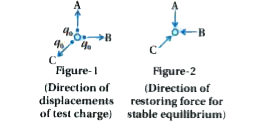
(a) For any electrostatic field configuration, test charge `q_0` (extremely small, point like positive charge) when placed at null point (where resultant electric field is zero) remains certainly under unstable equilibrium condition. Let us prove this by method of contradiction.

Suppose point 0 is null point and suppose test charge `q_0` is under stable equilibrium condition at that point. If really it is so then when `q_0` is displaced in any direction like `vec(OA), vec(OB)` or `vec(OC)`...... and then released, it should return back to same point O. For this to happen, restoring force must act towards null point O from all the directions for which all the electric field lines at point 0 should be radially inward. This can happen if Gaussian surface imagined around point O encloses some negative charge ! But actually it is not so. Hence, our assumption is wrong. This means that test charge placed at null point remains under unstable equilibrium condition,
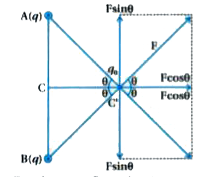
(b) Consider a system of two identical point charges q and q lying respectively at points A and B.

For above configuration (arrangement) null point is C which is midpoint of `bar(AB)`.
Now, when test charge `q_0` is displaced from C to C. resultant Coulombian force on `q_0` is `2Fcostheta`, which is pointing away from null point C, which means that test charge `q_(0)` will never come back to its equilibrium position at C. Thus, test charge qQ placed at C is under unstable equilibrium condition (because it had been stable equilibrium condition then test charge would have returned to position C from all the directions).
Promotional Banner

Topper's Solved these Questions

  • ELECTRIC CHARGES AND FIELDS

    KUMAR PRAKASHAN|Exercise SECTION B NUMERICALS (NUMERICAL FOR .DARPAN. BASED ON TEXTBOOK)|8 Videos
  • ELECTRIC CHARGES AND FIELDS

    KUMAR PRAKASHAN|Exercise SECTION C NCERT EXEMPLAR SOLUTION (MULTIPLE CHOICE QUESTIONS (MCQs))|7 Videos
  • ELECTRIC CHARGES AND FIELDS

    KUMAR PRAKASHAN|Exercise SECTION B NUMERICALS (NUMERICAL FROM TEXTUAL EXERCISES)|24 Videos
  • DUAL NATURE OF RADIATION AND MATTER

    KUMAR PRAKASHAN|Exercise Section-D (MCQs asked in GUJCET/Board Exam)|1 Videos
  • ELECTROMAGNETIC INDUCTION

    KUMAR PRAKASHAN|Exercise Section D MCQs (MCQs asked in Competitive Exams )|38 Videos

Similar Questions

Explore conceptually related problems

(a) consider an arbitrary electrostic field configuration a small test charge is placed at a null point of the configuration show that the equailibrium of the test charge is necessarly unstable (b) verify this result for the simple configuration of two charges of the same mangnitude and sign placed a certain distance apart

Answer carefully: (a) Two large conducting spheres carrying charges Q_(1) and Q_(2) are brought close to each other. Is the magnitude of electrostatic force between them exactly given by Q_(1),Q_(2)//4pi epsilon_(0)r^(2) , where r is the distance between their centres? (b) If Coulomb’s law involved 1//r^(3) dependence (instead of would Gauss’s law be still true ? (c) A small test charge is released at rest at a point in an electrostatic field configuration. Will it travel along the field line passing through that point? (d) What is the work done by the field of a nucleus in a complete circular orbit of the electron? What if the orbit is elliptical? (e) We know that electric field is discontinuous across the surface of a charged conductor. Is electric potential also discontinuous there? (f) What meaning would you give to the capacitance of a single conductor? (g) Guess a possible reason why water has a much greater dielectric constant (= 80) than say, mica (= 6).

The method of electrical images is used to solve the electrostatic problems, where charge distribution is not specified completely. The method consists of replacement of given charge distribution by a simplified charge distribution or a signal point charge or a number of point charges [rovided the original boundary conditions are still satisfied. For example consider a system consider a system containing a point charge q placed at a distance d of form an infinite conducting plane. The boundary conditions are : (i) Potential is zero at infinity (ii) Potential is zero at each point on the conducting plane If we replaced the conducting plane by a point charge (-q) placed at a distance 'd' opposite to conducting plane. The charge (-q) is called the electrical image. Now system consists of two charge +q an -q at seperation 2d . If charge +q moves to a distance 'y' from the boundary of conducting plane (now absent), the electrical image -q also moves to the same 'y' from the boundary of conducting plane, so that the new distance between +q and -q is 2y The potential energy of system of charge +q placed at a distance d from the earthed conducting plane is

The method of electrical images is used to solve the electrostatic problems, where charge distribution is not specified completely. The method consists of replacement of given charge distribution by a simplified charge distribution or a signal point charge or a number of point charges [rovided the original boundary conditions are still satisfied. For example consider a system consider a system containing a point charge q placed at a distance d of form an infinite conducting plane. The boundary conditions are : (i) Potential is zero at infinity (ii) Potential is zero at each point on the conducting plane If we replaced the conducting plane by a point charge (-q) placed at a distance 'd' opposite to conducting plane. The charge (-q) is called the electrical image. Now system consists of two charge +q an -q at seperation 2d . If charge +q moves to a distance 'y' from the boundary of conducting plane (now absent), the electrical image -q also moves to the same 'y' from the boundary of conducting plane, so that the new distance between +q and -q is 2y The work done in carrying charge q from distance d to distance y from earthed conducting plane is

The method of electrical images is used to solve the electrostatic problems, where charge distribution is not specified completely. The method consists of replacement of given charge distribution by a simplified charge distribution or a signal point charge or a number of point charges [rovided the original boundary conditions are still satisfied. For example consider a system consider a system containing a point charge q placed at a distance d of form an infinite conducting plane. The boundary conditions are : (i) Potential is zero at infinity (ii) Potential is zero at each point on the conducting plane If we replaced the conducting plane by a point charge (-q) placed at a distance 'd' opposite to conducting plane. The charge (-q) is called the electrical image. Now system consists of two charge +q an -q at seperation 2d . If charge +q moves to a distance 'y' from the boundary of conducting plane (now absent), the electrical image -q also moves to the same 'y' from the boundary of conducting plane, so that the new distance between +q and -q is 2y The force between point charge +q and earthed conducting plane is

Coulomb's law for electrostatic force between two point charges and Newton's law for gravitational force between two stationary point masses, both have inverse-square dependence on the distance between the charges and masses respectively, (a) Compare the strength of these forces by determining the ratio of their magnitudes (i) for an electron and a proton and (ii) for two protons. (b) Estimate the accelerations of electron an proton due to the electrical force of the mutual attraction when they are =10^(-10)m apart? (m_(p) = 1.67 xx 10^(-27) kg, m_(e) = 9.11 xx 10^(-31) kg)

Four charges Q_(1), Q_(2), Q_(3) and Q_(4) oof same magnitude are fixed along the x axis at x=-2a, -a, +a and +2a , respectively. A positive charge q is placed on the positive y axis at a distance b gt 0 . Four options of the signs of these charges are given in List I. The direction of the forces on the charge q is given in List II. Match List I with List II and select the correct answer using the code given below the lists. {:(,"List-I",,,"List-II"),((P),Q_(1)","Q_(2)","Q_(3)","Q_(4) "all positive",,(1),+x),((Q),Q_(1)","Q_(2) " positive, "Q_(3)","Q_(4)" negative",,(2),-x),((R),Q_(1)","Q_(4)" positive ,"Q_(2)","Q_(3)" negative",,(3),+y),((S),Q_(1)","Q_(3)" positive , "Q_(2)","Q_(4)" negative",,(4),-y):}

(a) Determine the electrostatic potential energy of a system consisting of two charges 7 µC and –2 µC (and with no external field) placed at (–9 cm, 0, 0) and (9 cm, 0, 0) respectively. (b) How much work is required to separate the two charges infinitely away from each other? (c) Suppose that the same system of charges is now placed in an external electric field E = A(1//r^(2)):A = 9 xx 10^(5) NC^(-1) . What would the electrostatic energy of the configuration be?