Home
Class 12
PHYSICS
Consider a sphere of radius R with charg...

Consider a sphere of radius R with charge density distributed as :
`rho( r) =kr, r le R`
`=0` for `r gt R`
(a) Find the electric field at all points r.
(b) Suppose the total charge on the sphere is 2e where e is the electron charge. Where can two protons be embedded such that the force on each of them is zero. Assume that the introduction of the proton does not alter the negative charge distribution.

Text Solution

Verified by Experts
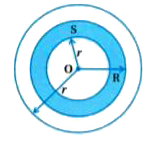
(a) Let us consider a sphere S of radius R and two hypothetic spheres of radius r < R and r > R.
Electric field intensity for point r < R,
`ointvecE.dvecS = 1/epsilon_(0) int rho dN`
But volume, `V = 4/3 pir^(3)`
`dV = 4/3 pi xx 3r^(2) dr`
`dV = 4pir^(2)dr`

`therefore ointvecE.dvecS = 1/epsilon_(0) 4pikint_(0)^(r)r^(3)dr |rho =kr|`
`therefore E=1/(4epsilon_(0)).kr^(2)`
As charge density is positive it means the direction of `vecE` is radially outwards. Electric field intensity for point `r gt R`.
`ointvecE.dvecS = 1/epsilon_(0)intrho dV`
`therefore E=(kR^(4))/(4epsilon_(0)r^(2))`.........(1)
Here, also the charge density is again positive. So, the direction of `vecE` is radially outward.
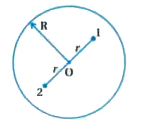
(b) The two protons must be placed symmetrically on the opposite sides of the centre along a diameter. This can shown by the figure given below.

Charge on sphere,
`q = int_(0)^(R)rho dN = int_(0)^(R)(kr)4pir^(2)dr`
`therefore q=4pik R^(4)/4=2e`
`therefore k = (2e)/(piR^(4))`........(2)
The protons 1 and 2 are embedded at distance r from the centre of the sphere as shown, then attractive force on proton 1, due to charge distribution is,
`F_(1) = eE = (-ekr^(2))/(4epsilon_(0))`.........(3)
And repulsive force on proton 1 due to proton 2 is, Net force on proton 1.
`F =F_(1) + F_(2)`
`therefore F=[(-er^(2))/(4epsilon_(0)).(Ze)/(piR^(4)) + e^(2)/(16 pi epsilon_(0)r^(4))]`
Thus, net force on proton 1 will be zero, when
`therefore (er^(2)2e)/(4epsilon_(0)piR^(4)) = e^(2)/(16piepsilon_(0)r)`
`therefore r=R/(8^(1//4))`
Hence, the protons must be at a distance r from the centre.
Promotional Banner

Topper's Solved these Questions

  • ELECTRIC CHARGES AND FIELDS

    KUMAR PRAKASHAN|Exercise SECTION D (MULTIPLE CHOICE QUESTIONS (MCQS)) (MCQS FROM .DARPAN. BASED ON TEXTBOOK) (ELECTROSTATIC ELECTRIC CHARGE AND FRICTIONAL ELECTRICAL CHARGE)|55 Videos
  • ELECTRIC CHARGES AND FIELDS

    KUMAR PRAKASHAN|Exercise SECTION D (MULTIPLE CHOICE QUESTIONS (MCQS)) (MCQS FROM .DARPAN. BASED ON TEXTBOOK) (LECTRIC FIELD AND ELECTRIC DIPOLE)|26 Videos
  • ELECTRIC CHARGES AND FIELDS

    KUMAR PRAKASHAN|Exercise SECTION C NCERT EXEMPLAR SOLUTION (SHORT ANSWER TYPE QUESTIONS)|6 Videos
  • DUAL NATURE OF RADIATION AND MATTER

    KUMAR PRAKASHAN|Exercise Section-D (MCQs asked in GUJCET/Board Exam)|1 Videos
  • ELECTROMAGNETIC INDUCTION

    KUMAR PRAKASHAN|Exercise Section D MCQs (MCQs asked in Competitive Exams )|38 Videos

Similar Questions

Explore conceptually related problems

The electric field at a distance (3R)/2 from the centre of a charged conducting spherical shell of radius R is E. The electric field at a distance R/2 from the centre of the sphere is :

Figure shows a uniformly charged hemisphere of radius R. It has a volume charge density rho . If the electric field at a point 2R, above the its center is E, then what is the electric field at the point 2R below its center?

Charges q is uniformly distributed over a thin half ring of radius R . The electric field at the centre of the ring is

A conducting sphere of radius R is given a charge Q. The electric potential and the electric field at the centre of the sphere respectively are

A solid sphere of radius R has a charge Q distributed in its volume with a charge density rho=kr^a , where k and a are constants and r is the distance from its centre. If the electric field at r=(R)/(2) is 1/8 times that r=R , find the value of a.

Charge Q is distributed uniformly over a non conducting sphere of radius R. Find the electric p-0tential at distance r from the centre of the sphere r (r lt R) . The electric field at a distance r from the centre of the sphere is given as (1)/(4pi epsilon_(0)). (Q)/(R^(3))hatr . Also find the potential at the centre of the sphere .

A thin spherical shell of radius R has charge Q spread uniformly over its surface. Which of the following graphs most closely represents the electric field E(r) produced by the shell in the range 0lerltoo , where r is the distance from the centre of the shell?

An electric field converges at the origin whose magnitude is given by the expression E=100r N//C , where r is the distance measured from the origin.

Let P(r)=(Q)/(piR^4)r be the charge density distribution for a solid sphere of radius R and total charge Q. For a point 'p' inside the sphere at distance r_1 from the centre of the sphere, the magnitude of electric field is:

An insulating solid sphere of radius R has a uniformaly positive charge density rho . As a result of this uniform charge distribution there is a finite value of electric potential at the centre of the sphere, at the surface of the sphere and also at a point out side the sphere. The electric potential at infinity is zero. Statement-1: Wgen a charge 'q' is taken from the centre to the surface of the sphere, its potential energy charges by (qrho)/(3 in_(0)) Statement-2 : The electric field at a distance r (r lt R) from the centre of the the sphere is (rho r)/(3in_(0))