Home
Class 12
PHYSICS
Two fixed, identical conducting plates (...

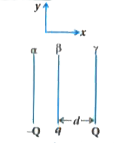
Two fixed, identical conducting plates (a and (3), each of surface area S are charged to - Q and q, respectively, where Q > q > 0. A third identical plate (`lambda` ), free to move Is located on the other side of the plate with charge q at a distance d as per figure. The third plate is released and collides with the plate `f_3` . Assume the collision is elastic and the time of collision is sufficient to redistribute charge amongst `beta` and `gamma`.

(a) Find the electric field acting on the plate `gamma` before collision.
(b) Find the charges on `beta` and `gamma` after the collision.
(c) Find the velocity of the plate `gamma` after the collision and at a distance d from the plate `beta`

Text Solution

Verified by Experts
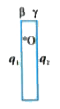
(a) Net electric field at plate `gamma` before collision is vector sum of electric field at plate `gamma` due to plate a and p.
The electric field at plate `gamma` due to plate `alpha` is,
`vecE_(1) = -Q(S(2epsilon_(0))(-hati))`
The electric field at plate `gamma` due to plane `beta` is,
`vecE_(2) = q/(S(2epsilon_(0))(-hati)`
`therefore` Hence, the net electric field at plate `gamma` before collision is,
`vecE = vecE_(1) + vecE_(2) = (q-Q)/(S(2epsilon_(0))(hati)`
`therefore (Q-q)/(S(2epsilon_(0))` to the field, If `Q gt q`
(b) During collision plates `beta` and `gamma` are in contact with each other, hence their potentials become same.
Suppose charge on plate `beta` is `q_(1)` and charge on plate `gamma` is `q_2`. At any point O in between the two plates, the electric field must be zero.
Electric field at O due to plate `alpha`,
`vecE_(a) = Q/(S(2epsilon_(0))(-hati)`
Electric field at O due to plate `beta`
`vecE_(2) = q_(1)/(S(2epsilon_(0))(hati)`
Electric field at O due to plate `gamma`
`vecE_(y) = q_(2)/(S(2epsilon_(0))(-hati)`
As the electric field at O is zero, therefore,
`(Q + q_(2))/(S(2epsilon_(0)))= q_(1)/(S(2epsilon_(0))`
`therefore Q + q_(2) = q_(1)`

On solving eq. (1) and (2) we get,
`q_(1) =(Q+ q/2)` = Change on plate `beta`
`q_(1) = (q/2)` = charge on plate `gamma`
(c) Let the velocity be v at the distance d from plate `beta` after the collision. If m is the mass of the plate `gamma`, then the gain in K.E. over the round trip must be equal to the work done by the electric field.
`vecE_(2) = Q/(2epsilon_(0)S)(-hati) + (Q+q/2)/(2epsilon_(0)S)hati =(q/2)/(2 epsilon_(0)S)hati`
Just before collision, electric field at plate:
`gamma` is `vecE_(1) = (Q-q)/(2epsilon_(0)S) hati`
and `vecF_(2) = vecE_(2).q/2 =(q/2)^(2)/(2epsilon_(0)S)hati`
Total work done by the electric field is round trip movement of plate `gamma`
`W = (F_(1) + F_(2))d`
`=((Q-q/2)^(2)d)/(2epsilon_(0)S)`
If m is the mass of plate `gamma` , the K.E. gained by the plate = `1/2mv^(2)`
According to work energy principle,
`1/2mv^(2) = W rArr 1/2mv^(2) = ((Q-q/2)^(2)d)/(2epsilon_(0)S)`
`therefore v= (Q-q/2)(d/(mepsilon_(0)S))^(1//2)`
Promotional Banner

Topper's Solved these Questions

  • ELECTRIC CHARGES AND FIELDS

    KUMAR PRAKASHAN|Exercise SECTION D (MULTIPLE CHOICE QUESTIONS (MCQS)) (MCQS FROM .DARPAN. BASED ON TEXTBOOK) (ELECTROSTATIC ELECTRIC CHARGE AND FRICTIONAL ELECTRICAL CHARGE)|55 Videos
  • ELECTRIC CHARGES AND FIELDS

    KUMAR PRAKASHAN|Exercise SECTION D (MULTIPLE CHOICE QUESTIONS (MCQS)) (MCQS FROM .DARPAN. BASED ON TEXTBOOK) (LECTRIC FIELD AND ELECTRIC DIPOLE)|26 Videos
  • ELECTRIC CHARGES AND FIELDS

    KUMAR PRAKASHAN|Exercise SECTION C NCERT EXEMPLAR SOLUTION (SHORT ANSWER TYPE QUESTIONS)|6 Videos
  • DUAL NATURE OF RADIATION AND MATTER

    KUMAR PRAKASHAN|Exercise Section-D (MCQs asked in GUJCET/Board Exam)|1 Videos
  • ELECTROMAGNETIC INDUCTION

    KUMAR PRAKASHAN|Exercise Section D MCQs (MCQs asked in Competitive Exams )|38 Videos

