Home
Class 12
PHYSICS
Two charges -q each are fixed separated ...

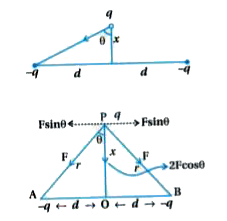
Two charges -q each are fixed separated by distance 2d. A third charge q of mass m placed at the midpoint is displaced slightly by x (x < < d) perpendicular to the line joining the two fixed charged as shown in figure. Show that q will perform simple harmonic oscillation of time period. `T = [(8pi^(3) epsilon_(0)md^(3))/q^(2)]^(1//2)`

Text Solution

Verified by Experts

Suppose charge at A and B are - q and O is mid point of AB and PO is x.
`therefore AB = AO + OB`
=d+d
=2d
`x lt d` and `angleAPO =theta`
m is mass of charge q.
Attractive force by each charge A and B on charge at P,
`F = (k(q)(q))/r^(2)`
where r = AP = BP
`F sin theta` components of force are of same magnitude but in opposite directions hence, their resultant is zero and Fcos6 components are in same direction,
`F. = 2F cos theta`
`=(2kq^(2))/r^(2) cos theta`
But from figure, `r = sqrt(d^(2) + x^(2))` and `cos theta = x/r`
`therefore F. = (2kq^(2))/(d^(2) + x^(2))^(2).x/(d^(2) + x^(2))^(1//2)`
`=(2kq^(2)x)/(d^(2) + x^(2))^(3//2)`
If `x lt lt d`, then x can be neglected,
`F. = (2kq^(2)x)/(d^(3))`..........(1)
`F. = Kx`
where `K = (2kq^(2))/d^(3)` is constant
`therefore F. prop x`
Hence, q can perform simple harmonic motion. Here, force is directly proportional to x and towards point O.
`omega = sqrt(K/m)`
`therefore (2pi)/T = sqrt(K/m)`
`therefore T = 2pi sqrt(m/(2kq^(2)//a^(3))`
By taking `k = 1/(4pi epsilon_(0))`
`therefore T=[(8pi^(3)epsilon_(0)md^(3))/q^(2)]^(1//2)`
Promotional Banner

Topper's Solved these Questions

  • ELECTRIC CHARGES AND FIELDS

    KUMAR PRAKASHAN|Exercise SECTION D (MULTIPLE CHOICE QUESTIONS (MCQS)) (MCQS FROM .DARPAN. BASED ON TEXTBOOK) (ELECTROSTATIC ELECTRIC CHARGE AND FRICTIONAL ELECTRICAL CHARGE)|55 Videos
  • ELECTRIC CHARGES AND FIELDS

    KUMAR PRAKASHAN|Exercise SECTION D (MULTIPLE CHOICE QUESTIONS (MCQS)) (MCQS FROM .DARPAN. BASED ON TEXTBOOK) (LECTRIC FIELD AND ELECTRIC DIPOLE)|26 Videos
  • ELECTRIC CHARGES AND FIELDS

    KUMAR PRAKASHAN|Exercise SECTION C NCERT EXEMPLAR SOLUTION (SHORT ANSWER TYPE QUESTIONS)|6 Videos
  • DUAL NATURE OF RADIATION AND MATTER

    KUMAR PRAKASHAN|Exercise Section-D (MCQs asked in GUJCET/Board Exam)|1 Videos
  • ELECTROMAGNETIC INDUCTION

    KUMAR PRAKASHAN|Exercise Section D MCQs (MCQs asked in Competitive Exams )|38 Videos

Similar Questions

Explore conceptually related problems

Two charges - q each are separated by distanc · 2d. A third charge + q is kept at mid point C Find potential energy of + q as a function small distance x from O due to - q charges Sketch P.E. v/s x and convince yourself that the, charge at O is in an unstable equilibrium.

Two charges q and - 3q are placed fixed on x-axis separated by distance'd'. Where should a third charge 2q be placed such that it will not experience any force ?

Two particles A and B having equal charges are placed at distance d apart. A third charged particle placed on the perpendicular bisector at a distance x will experience the maximum Coulomb’s force when :

Two bodies, each of mass M, are kept fixed with a separation 2L. A particle of mass m is projected from the midpoint of the line joining their cehntres, perpendicualr to the line. The gravitational constant is G. The correct statement (s) is (are)

Two point charges Q and - Q //4 are separated by a distance X . Then . force between this two charge

Two charges, each equal to q, aer kept at x=-a and x=a on the x-axis. A particle of mass m and charge q_0=q/2 is placed at the origin. If charge q_0 is given a small displacement (ylt lt a) along the y-axis, the net force acting on the particle is proportional to

Two equal point charges are fixed at x=-a and x=+a on the x-axis. Another point charge Q is placed at the origin. The change in the electrical potential energy of Q, when it is displaced by a small distance x along the x-axis, is approximately proportional to

When charge is given to a soap bubble, it shows:Two equal negative charges -q are fixed fixed at point (0, -a) and (0,a) on y-axis. A positive charge Q is released from rest at the point (2a, 0) on the x-axis. The charge Q will:

Two charges are at a distance d apart. If a copper plate of thickness d/2 is placed between them, if effective force will be,

Two spherical , nonconducting and very tin shells of uniformly distributed positive charge Q and radius d are located a distance 10d from each other . A positive point charge q is placed inside one of the shells at a distance d//2 from the center, on the line connecting the centers of the two shells , as shown in the figure, What is the net force on the charge q ? .
