Home
Class 12
PHYSICS
A wheel having mass m has charges + q an...

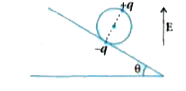
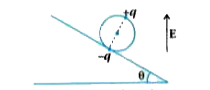
A wheel having mass m has charges + q and - q on diametrically opposite points. It remains in equilibrium on a rough inclined plane in the presence of a vertical electric field E. Then value of E is ......

A

`(mg tantheta)/q`

B

`(mg)/q`

C

`(mg)/(2q)`

D

`(mg tantheta)/(2q)`

Text Solution

Verified by Experts

The correct Answer is:
C


For balance of wheel, `vecF_(G) =vecF_(E)`
`vecr xx vecF_(G) =vectau`
`rF_(G)sintheta =pEsintheta`
`rmg sintheta =pEsintheta rArr` where p = 2rq
`therefore E=(mg)/(2q)`
Promotional Banner

Topper's Solved these Questions

  • ELECTRIC CHARGES AND FIELDS

    KUMAR PRAKASHAN|Exercise SECTION D MCQS ASKED IN COMPETITIVE EXAMES (MCQS AKSED IN BOARD EXAM AND GUJCET)|14 Videos
  • ELECTRIC CHARGES AND FIELDS

    KUMAR PRAKASHAN|Exercise SECTION D MCQS ASKED IN COMPETITIVE EXAMES (MCQS ASKED IN AIEEE AND JEE MAINS)|13 Videos
  • DUAL NATURE OF RADIATION AND MATTER

    KUMAR PRAKASHAN|Exercise Section-D (MCQs asked in GUJCET/Board Exam)|1 Videos
  • ELECTROMAGNETIC INDUCTION

    KUMAR PRAKASHAN|Exercise Section D MCQs (MCQs asked in Competitive Exams )|38 Videos

Similar Questions

Explore conceptually related problems

Acceleration of electron charge e and mass m moving electric field E will be……

Three particles, each of mass m and carrying a charge q each, are suspended from a common point by insulating mass-less strings each of length L. If the particles are in equilibrium and are located at the corners of an equilateral triangle of side a, calculate the charge q on each particle. Assume Lgtgta .

Two particles of equal mass m and charge t are placed at a distance 16 cm. They do no experience any force. The value of q/m is……..

The diagram show a small bead of mass m carrying charge q . The bead can freely move on the smooth fixed ring placed on a smooth horizontal plane . In the same pane a charge +Q has also been fixed as shown. The potential at the point P due to +Q is V . The velocity which the bead should projected from the point P so that it can complete a circle should be greater than .

A particle having mass m and charge q is , rest. On applying a uniform electric field E it, it starts moving. What is its kinetic energ when it travels a distance y in the direction force ?

A particle of mass m and charge q is thrown in a region where uniform gravitational field and electric field are present. The path of particle:

A thin homogeneous rod of mass m and length l is free to rotate in vertical plane about a horizontal axle pivoted at one end of the rod. A small ballof mass m and charge q is attached to the opposite end of this rod. The whole system is positioned in a horizontal electric field of magnitude E=(mg)/(2q) . The rod is released from, shown position from rest. What is the speed of ball when rod becomes vertical?

The work done by the charge Q through displacement Delta vecr = a hati +b hatj in electric field vecE= E_(1)hati +E_(2) hatj is ............

A thin homogeneous rod of mass m and length l is free to rotate in vertical plane about a horizontal axle pivoted at one end of the rod. A small ballof mass m and charge q is attached to the opposite end of this rod. The whole system is positioned in a horizontal electric field of magnitude E=(mg)/(2q) . The rod is released from, shown position from rest. What is the angular acceleration of the rod at the instant of releasing the rod?

A thin homogeneous rod of mass m and length l is free to rotate in vertical plane about a horizontal axle pivoted at one end of the rod. A small ballof mass m and charge q is attached to the opposite end of this rod. The whole system is positioned in a horizontal electric field of magnitude E=(mg)/(2q) . The rod is released from, shown position from rest. What is the acceleration of the small ball at the instant of releasing the rod?

