Home
Class 12
PHYSICS
Derive the formula for the electric pote...

Derive the formula for the electric potential energy of system of three charges.

Text Solution

Verified by Experts
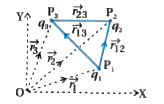
Let charge `q_(1),q_(2)` and `q_(3)` are bring from infinity distance to at the point `P_(1), P_(2)` and `P_(3)`, located at distance `r_(1),r_(2)` and `r_(3)` respectively.
All three charges are brought as shown in figure.

To bring `q_(1)` first from infinity to `P_(1)`, the work done `W_(1)=0`
because there is no external force to bring `q_(1)` to `P_(1)`
Electric potential at `P_(2)` due to charge `q_(1)`
`V_(1)= (kq_(1))/(r_(12))`
Now work done to bring charge `q_(2)` at point `P_(2)`
`W_(2)=V_(1)xxq_(2)`
`:. W_(2)=(kq_(1)q_(2))/(r_(12))`
Electric potential at Pz due to charge `q_(1) + q_(2)`
`V_(2)=(kq_(1))/(r_(13))+(kq_(2))/(r_(23))`
`:.` Work done to bring charge `q_(3)` to `P_(3)`
`W_(3)` potential at `P_(3)` due to `q_(1)+q_(2)xxq_(3)` charge
`=k[(q_(1))/(r_(13))+(q_(2))/(r_(23))]xxq_(3)`
`=k[(q_(1)q_(3))/(r_(13))+(q_(2)q_(3))/(r_(23))]`
`:.` otal potential energy of charges `q_(1)+q_(2)+q_(3)`
`U=W_(1)+W_(2)+W_(3)`
`[ because` Electric force is conservative and hence W U]
`:. U=k[0+(q_(1)q_(2))/(r_(12))+(q_(1)q_(3))/(r_(13))+(q_(2)q_(3))/(r_(23))]`
`:. U=k[(q_(1)q_(2))/(r_(12))+(q_(1)q_(3))/(r_(13))+(q_(2)q_(3))/(r_(23))]`
Equation (3) is true for any sign of `q_(1)` and `q_(2 )`
If `q_(1) q_(2) gt 0 ` potential energy will be positive. And if `q_(1)q_(2) lt 0` potential energy will be negative.
Promotional Banner

Topper's Solved these Questions

  • ELECTROSTATIC POTENTIAL AND CAPACITANCE

    KUMAR PRAKASHAN|Exercise ( Section -A) Try Yourself|50 Videos
  • ELECTROSTATIC POTENTIAL AND CAPACITANCE

    KUMAR PRAKASHAN|Exercise Section B Numericals|16 Videos
  • ELECTROMAGNETIC WAVES

    KUMAR PRAKASHAN|Exercise BOARD.S QUESTION PAPER MARCH - 2020 (PART - B) SECTION - C|5 Videos
  • MAGNETISM AND MATTER

    KUMAR PRAKASHAN|Exercise SECTION D Multiple Choice Questions (MCQs) (MCQs asked in Competitive Exams) MCQs asked in Board Exam and GUJCET|7 Videos

Similar Questions

Explore conceptually related problems

Derive the formula for the electric potential energy of system of two charges.

Obtain the equation of electric potential energy of a system of two electric charges in external electric field.

Derive the formula for the electric potential due to an electric dipole at a point from it.

Give dimensional formula of electric potential.

(a) Determine the electrostatic potential energy of a system consisting of two charges 7 µC and –2 µC (and with no external field) placed at (–9 cm, 0, 0) and (9 cm, 0, 0) respectively. (b) How much work is required to separate the two charges infinitely away from each other? (c) Suppose that the same system of charges is now placed in an external electric field E = A(1//r^(2)):A = 9 xx 10^(5) NC^(-1) . What would the electrostatic energy of the configuration be?

Determine the electrostatic potential energy of a system consisting of two charges 7 mu C and - 2 muC (and with no external field) placed at (-9 cm, 0, 0) and (9 cm, 0, 0) respectively.

Determine the electrostatic potential energy of a system consisting of two charges 6 mu C and - 3 mu C (and with no external field) placed at (-9 cm, 0, 0) and (9 cm, 0, 0) respectively.

A positively charged particle is released from rest in an unform electric field. The electric potential energy of the charge

The formula for electric current is ………. .

Write an equation for potential due to a system of charges.

KUMAR PRAKASHAN-ELECTROSTATIC POTENTIAL AND CAPACITANCE-Section D ( MCQs asked in Cometitive Exams )
  1. Derive the formula for the electric potential energy of system of thre...

    Text Solution

    |

  2. Capacitance of a capacitor 100 mu F. The work is done for depositing c...

    Text Solution

    |

  3. A fully charged capacitor has a capacitance· C. It is discharged thro...

    Text Solution

    |

  4. Two insulating plates arc both uniformly charged in such a way that th...

    Text Solution

    |

  5. An electric charge 10^(-3) muC is placed at the origin (0, 0) of X-Y c...

    Text Solution

    |

  6. A battery is used to charge a parallel plate capacitor till the potent...

    Text Solution

    |

  7. Potentials of points P and Q are 10 V and - 4 V respectively. Work d...

    Text Solution

    |

  8. Two capacitors C(1) and C(2) are charged to 120 V and 200 V respectiv...

    Text Solution

    |

  9. A parallel plate capacitor is made of two circular plates separated ...

    Text Solution

    |

  10. Assum that an electric field vecE = 30 x^(2) hati exists in space. The...

    Text Solution

    |

  11. A combination of capacitors is set up as shown in the figure. The mag...

    Text Solution

    |

  12. An electrical technician requires a capacitance,of 2 muF in a circuit...

    Text Solution

    |

  13. Consider A, D and C to be the co-centric shells of metal . Their radii...

    Text Solution

    |

  14. A parallel plate capacitor of capacitance 90 pF is connected to a bat...

    Text Solution

    |

  15. A 60 pF capacitor is fully charged by a 20 V supply. It is then discon...

    Text Solution

    |

  16. If two capacitors C(1) and C(2) are connected in a parallel combinatio...

    Text Solution

    |

  17. lf the electric field around a surface is given by |vecE|=(Q)/(E(0)...

    Text Solution

    |

  18. A parallel plate air capacitor of capacitance C is connected to a cell...

    Text Solution

    |

  19. A parallel plate air capacitor has capacity 'C' distance of separation...

    Text Solution

    |

  20. In a certain region, the electric potential is given by the formula V(...

    Text Solution

    |

  21. A capacitor of 2 muF is charged as shown in the diagram . When the swi...

    Text Solution

    |

