Home
Class 12
PHYSICS
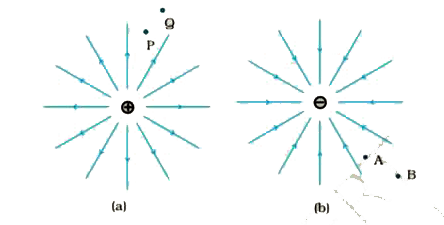
Figures 2.8 (a) and (b) show the field l...

Figures 2.8 (a) and (b) show the field lines of a positive and negative point charge respectively.

(a) Give the signs of the potential difference `V_(P)-V_(Q): V_(B)-V_(A)`.
(b) Give the sign of the potential energy difference of a small negative charge between the points Q and P, A and B.
(c) Give the sign of the work done by the field in moving a small positive charge from Q to P.
(d) Give the sign of the work done by the external agency in moving a small negative charge from B to A.
(e) Does the kinetic energy of a small negative charge increase or decrease in going from B to A?

Text Solution

Verified by Experts

In V`=(k(+q))/(r) ` k(+q) is constant
`:. V prop (1)/(r)`
Let the distance of point P from + q charge is `r_(p)` and distance of point Q is `r_(Q)`,
`r_(P) lt r_(Q)`
`:. V_(P) gt V_(Q) implies V_(P)-V_(Q) gt 0 :. ` Positive
and in `V=(k(-q))/(r)` if kq is considered as positive
`V prop -(1)/(r)`
Let the distance of point A from - q chargd is .A and distance of point B is `r_(B)`
`r_(A) lt r_(B)`
`:. V_(A) -V_(B) lt 0`
`:. V_(B) - V_(a) gt 0`
(b) Potential energy decrease as attraction force acts. Here attraction force acts when negative charge is placed in the field of positive charge and hence potential energy decreases so,
`U_(Q) gt U_(P)`
`:. U_(Q) - U_(P) gt 0 " " :.` Positive and when negative charge is placed in the field of negative charge and hence potential energy increases so `U_(A) lt V_(B)` taking from B to A
`:. U_(B) -U_(A) gt 0 " " :.` Positive
( c) In moving a positive charge from Q to P, work has to be done against the electric field. Therefore, work done by the field is negative but work done on the field is positive.
(d) In moving a negative charge from B to Aworlc has to be don.e by the external agency. It is positive.
(e) Due to force of repulsion on the negative charge, velocity decreases and hence the lcinetic energy decreases in going from B to A.
Promotional Banner

Topper's Solved these Questions

  • ELECTROSTATIC POTENTIAL AND CAPACITANCE

    KUMAR PRAKASHAN|Exercise Section B ( Numerical From Textual Exercise )|46 Videos
  • ELECTROSTATIC POTENTIAL AND CAPACITANCE

    KUMAR PRAKASHAN|Exercise Section B ( Numerical From DARPAN. Based on Textbook )|19 Videos
  • ELECTROSTATIC POTENTIAL AND CAPACITANCE

    KUMAR PRAKASHAN|Exercise ( Section -A) Try Yourself|50 Videos
  • ELECTROMAGNETIC WAVES

    KUMAR PRAKASHAN|Exercise BOARD.S QUESTION PAPER MARCH - 2020 (PART - B) SECTION - C|5 Videos
  • MAGNETISM AND MATTER

    KUMAR PRAKASHAN|Exercise SECTION D Multiple Choice Questions (MCQs) (MCQs asked in Competitive Exams) MCQs asked in Board Exam and GUJCET|7 Videos

Similar Questions

Explore conceptually related problems

The potential difference (V_(A) - V_(B)) between the points A and B in the given figure is

……………... is the work done in moving a unit positive charge from point A to B in an electric field.

Positive and negative charges of 1 muC each are placed at two points as shown in the figure. Find the potential difference between A and B

The potential difference between the points A and B in the following circuit shown in the figure:-

Potential difference between points P and Q would be ......

Potential difference between points P and Q would be ...... .

A moving positive charge approaches a negative charge. What will happen to the potential energy of the system?

How much work is done in moving a charge of 2 C across two points having a potential difference 12 V ?

Two charges - q and + q are located at points A(0, 0, - a) and B(0, 0, + a) respectively, work done in moving small test charge from point P(7, 0, 0) to Q(- 3, 0, 0) is ...... .

KUMAR PRAKASHAN-ELECTROSTATIC POTENTIAL AND CAPACITANCE-Section B Numericals
  1. Calculate the potential at a point P due to a charge of 4 × 10^(-7) C ...

    Text Solution

    |

  2. Hence ohtaln the work done in bringing charge of 2 xx 10^(-9) C . Fro...

    Text Solution

    |

  3. Two charges 3 xx 10^(-8) C and - 2 xx 10^(-8) C are located 15 cm apar...

    Text Solution

    |

  4. Figures 2.8 (a) and (b) show the field lines of a positive and negativ...

    Text Solution

    |

  5. Four charges are arranged at the corners of a square ABCD of side d as...

    Text Solution

    |

  6. Determine the electrostatic potential energy of a system consisting of...

    Text Solution

    |

  7. How much work is required separate the two charges infinitely away fro...

    Text Solution

    |

  8. Suppose that the same system of charge is now placed in an external el...

    Text Solution

    |

  9. A molecule of a substance has a permanent electric dipole moment of ma...

    Text Solution

    |

  10. (a) A comb run through one’s dry hair attracts small bits of paper. Wh...

    Text Solution

    |

  11. (a) A comb run through one’s dry hair attracts small bits of paper. Wh...

    Text Solution

    |

  12. (a) A comb run through one’s dry hair attracts small bits of paper. Wh...

    Text Solution

    |

  13. (a) A comb run through one’s dry hair attracts small bits of paper. Wh...

    Text Solution

    |

  14. A slab of material of dielectric constant K has the same area as the p...

    Text Solution

    |

  15. A network of four 10 µF capacitors is connected to a 500 V supply, as ...

    Text Solution

    |

  16. (a) A 900 pF capacitor is charged by 100 V battery [Fig. 2.31(a)]. How...

    Text Solution

    |
