Home
Class 12
PHYSICS
If one of the two electrons of a H(2) mo...

If one of the two electrons of a `H_(2)` molecule is removed, we get a hydrogen molecular ion `H_(2)^(+)`.In the ground state of an `H_(2)^(+)` , the two protons are separated by roughly 1.5 Å, and the electron is roughly 1 Å from each proton. Determine the potential energy of the system. Specify your choice of the zero of potential energy

Text Solution

Verified by Experts
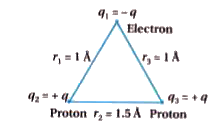
System of charges is shown in the figure

Charge on electron `q_(1)=- 1.6xx10^(-19)` C
Charge on proton `q_(2)=q_(3)= 1.6xx10^(-19)` C
Talcing potential zero at infinity distance then, potential energy of the system,
`U = U_(12)+U_(23) +U_(13)`
`= k[(q_(1)q_(2))/(r_(1))+(q_(2)q_(3))/(2)+(q_(1)q_(3))/(r_(3))]`
`=9xx10^(9) [((-16xx10^(-19))(1.6xx10^(-19)))/(10^(-10))+((1.6xx10^(-19))^(2))/(1.5xx10^(-10))+(-(1.6xx10^(-19))^(2))/(10^(-10))]`
`=(9xx10^(9)xx(1.6xx10^(19)xx1.6xx10^(-19))^(2))/(10^(-10))[-1+(1)/(1.5)-1]`

`=(9xx10^(9)xx(1.6xx10^(19)xx1.6xx10^(-19))^(2))/(10^(-10))[(-3+1)/(1.5)]`
`=23.04xx10^(-10)xx((-2)/(1.5))`J
`=(-23.04xx10^(-19)xx2)/(1.6xx10^(-19)xx1.5)eV[because1.6xx10^(-19)` J = 1 eV]
=-19.2 eV
Promotional Banner

Topper's Solved these Questions

  • ELECTROSTATIC POTENTIAL AND CAPACITANCE

    KUMAR PRAKASHAN|Exercise Section B ( Numerical From DARPAN. Based on Textbook )|19 Videos
  • ELECTROSTATIC POTENTIAL AND CAPACITANCE

    KUMAR PRAKASHAN|Exercise Section B (questions)|2 Videos
  • ELECTROSTATIC POTENTIAL AND CAPACITANCE

    KUMAR PRAKASHAN|Exercise Section B Numericals|16 Videos
  • ELECTROMAGNETIC WAVES

    KUMAR PRAKASHAN|Exercise BOARD.S QUESTION PAPER MARCH - 2020 (PART - B) SECTION - C|5 Videos
  • MAGNETISM AND MATTER

    KUMAR PRAKASHAN|Exercise SECTION D Multiple Choice Questions (MCQs) (MCQs asked in Competitive Exams) MCQs asked in Board Exam and GUJCET|7 Videos

Similar Questions

Explore conceptually related problems

An ionised H-molecule consists of an electron and two protons. The protons are separated by a small distance of the order of angstrom In the ground state

In a hydrogen atom, the electron and proton are bound at a distance of about 0.53 Å (a) Estimate the potential energy of the system in eV, taking the zero of the potential energy at infinite separation of the electron from proton. (b) What is the minimum work required to free the electron, given that its kinetic energy in the orbit is half the magnitude of potential energy obtained in (a)? (c) What are the answers to (a) and (b) above if the zero of potential energy is taken at 1.06 Å separation?

Two capacitors C_(1) and C_(2) are charged to 120 V and 200 V respectively. It is found that by connecting them together the potential on each one can be made zero. Then

The electron energy of hydrogen atom in the ground state works out to be - 2.18 xx 10^(-18) J per atom. Calculate what will happen to the position of the electron in this atom if an energy of 1.938 xx 10^(-18) J is supplied to the each hydrogen atom.

When water rises in a capillary tube of radius r to height h, then its potential energy U_(1) if capillary tube of radius 2r is dipped in same water then potential energy of water is U_(2) then U_(1):U_(2) will be

Statement-1 : When two charged spheres are touched then total charge is h? Statement-2: Flow of charge take place untill potential equals.

Statement-1 : Work function of a metal is 8 eV. Two photons each having energy 5 eV can't eject the electron from the metal. and Statement-2 : More than one photon can't collide simultaneously with an electron.

An accelration produces a narrow beam of protons, each having an initial speed of v_(0) . The beam is directed towards an initially uncharges distant metal sphere of radius R and centered at point O. The initial path of the beam is parallel to the axis of the sphere at a distance of (R//2) from the axis, as indicated in the diagram. The protons in the beam that collide with the sphere will cause it to becomes charged. The subsequentpotential field at the accelerator due to the sphere can be neglected. The angular momentum of a particle is defined in a similar way to the moment of a force. It is defined as the moment of its linear momentum, linear replacing the force. We may assume the angular momentum of a proton about point O to be conserved. Assume the mass of the proton as m_(P) and the charge on it as e. Given that the potential of the sphere increases with time and eventually reaches a constant velue. If the initial kinetic energy of a proton is 2.56 ke V , then the final potential of the sphere is

If a proton had a radius R and the charge was uniformly distributed, calculate using Bohr theory, the ground state energy of a H-atom when (i) R=0.1 Å and (ii) R=10 Å

KUMAR PRAKASHAN-ELECTROSTATIC POTENTIAL AND CAPACITANCE-Section B ( Numerical From Textual Exercise )
  1. A long charged cylinder of linear charged density lambda is surrounded...

    Text Solution

    |

  2. In a hydrogen atom, the electron and proton are bound at a distance of...

    Text Solution

    |

  3. If one of the two electrons of a H(2) molecule is removed, we get a hy...

    Text Solution

    |

  4. Two charged conducting spheres of radii a and b are connected to each ...

    Text Solution

    |

  5. Two charges –q and +q are located at points (0, 0, –a) and (0, 0, a), ...

    Text Solution

    |

  6. Figure 2.32 shows a charge array known as an electric quadrupole. For ...

    Text Solution

    |

  7. An electrical technician requires a capacitance,of 2 muF in a circuit...

    Text Solution

    |

  8. What is the area of the plates of a 2 F parallel plate capacitor given...

    Text Solution

    |

  9. Obtain the equivalent capacitance of the network in Fig. 2.33. For a 3...

    Text Solution

    |

  10. The plates or a parallel plate capacitor have an area of 90 cm^(2) eac...

    Text Solution

    |

  11. A 4 muF capacitor is charged by a 200 V supply. It is then disconnecte...

    Text Solution

    |

  12. Show that the force on each plate of a parallel plate capacitor has a ...

    Text Solution

    |

  13. A spherical capacitor consists of two concentric spherical conductors,...

    Text Solution

    |

  14. A spherical capacitor has an inner sphere of radius 12 cm and an outer...

    Text Solution

    |

  15. Answer carefully: (a) Two large conducting spheres carrying charges ...

    Text Solution

    |

  16. Answer carefully: (a) Two large conducting spheres carrying charges ...

    Text Solution

    |

  17. Answer carefully: (a) Two large conducting spheres carrying charges ...

    Text Solution

    |

  18. Answer carefully: (a) Two large conducting spheres carrying charges ...

    Text Solution

    |

  19. Answer carefully: (a) Two large conducting spheres carrying charges ...

    Text Solution

    |

  20. Answer carefully: (a) Two large conducting spheres carrying charges ...

    Text Solution

    |

