Home
Class 12
PHYSICS
Calculate potential on the axis of a dis...

Calculate potential on the axis of a disc of radius R due to a charge Q uniformly distributed on its surface.

Text Solution

Verified by Experts
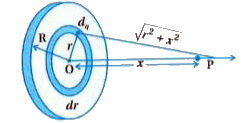
Let us consider a point P on the axis of the disc at a distance x from the centre of the disc. Let the disc is divided into a numerous charged rings as shown in figure.

Let radius of ring r width dr and charges dq
`:. Sigma dA = sigma2 pi rdr `
Potential at P
`dV = (kdq)/(r)`
charge on the ring dq = `+sigma [ pi (r+dr)^(2)-pir^(2)]`
`:. dq = +sigma pi [ (r+dr)^(2)-r^(2)]`
`= +sigma pi [ r^(2)+2rdr +dr^(2)-r^(2)]`
`= +sigma pi [ 2 rdr +dr^(2)]`
Neglecting `dr^(2)` as dr is very small
dq = `2 pi r sigma dr `
and dV = `(kdq)/(sqrt(r^(2)+x^(2)))`
`= (kxx2pir sigmadr)/(sqrt(r^(2)+x^(2)))` [From equation (2)]
`:. V = 2 pi k sigma int _(0)^(R) (rdr)/(sqrt(r^(2)+x^(2)))=2piksigmaint_(0)^(R)( r^(2)+x^(2))(-1//2)rdr`
`:. V= 2pi ksigma[(r^(2)+x^(2))^(1//2)-x]_(0)^(R)`
`:. V = (2pi sigma)/(4 pi in_(0))[(R^(2)+x^(2))^(1//2)-x]`
`:. V = (2pixxQ)/(4pi in_(0)xxpi R^(2))[sqrt((R^(2)+x^(2))^(1//2))-x]`
`:. V =(2Q)/(4pi inn_(0)R^(2))[sqrt((R^(2)+x^(2))^(1//2))-x]`
Promotional Banner

Topper's Solved these Questions

  • ELECTROSTATIC POTENTIAL AND CAPACITANCE

    KUMAR PRAKASHAN|Exercise Section D ( Multiple Choice Questions (MCQs) )|93 Videos
  • ELECTROSTATIC POTENTIAL AND CAPACITANCE

    KUMAR PRAKASHAN|Exercise Section D ( MCQs asked in Cometitive Exams )|39 Videos
  • ELECTROSTATIC POTENTIAL AND CAPACITANCE

    KUMAR PRAKASHAN|Exercise Section C ( NCERT Exemplar Solution ) (Short ,Aswer Type Questions )|5 Videos
  • ELECTROMAGNETIC WAVES

    KUMAR PRAKASHAN|Exercise BOARD.S QUESTION PAPER MARCH - 2020 (PART - B) SECTION - C|5 Videos
  • MAGNETISM AND MATTER

    KUMAR PRAKASHAN|Exercise SECTION D Multiple Choice Questions (MCQs) (MCQs asked in Competitive Exams) MCQs asked in Board Exam and GUJCET|7 Videos

Similar Questions

Explore conceptually related problems

Calculate potential on the axis of a ring due to charge Q uniformly distributed along the ring of radius R.

statement 1 : For practical purposes, the earth is used as a reference at zero potencial in electrical circuits. statement 2 : The electrical potential of a sphere of radius R with charge Q uniformly distributed on the surface is given by (Q)/(4piepsilon_0R) .

Calculate potential energy of a point charge - q placed along the axis due to a charge + Q uniformly distributed along a ring of radius-, R. Sketch P .F. as a function or axial distance z from the centre of the ring. Looking at graph, can you see what would happen if - q is displaced slightly from the centre of the ring (along the axis) ?

A point charge Q is located on the axis of a disc of radius R at a distance b from the plane of the disc (figure). Show that if one-fourth of the electric flux from the charge passes through the disc, then R=sqrt3b .

A long straight solid metal wire of radius R carries a current I, uniformly distributed over its circular cross-section. Find the magnetic field at a distance r from axis of wire (i) inside and (ii) outside the wire.

A point charge 4 is situated at a distance r on axis from one end of a thin conducting rod of length L having a charge Q (Uniformly distributed along its length). "The magnitude of electric force between the two is ________.

If a proton had a radius R and the charge was uniformly distributed, calculate using Bohr theory, the ground state energy of a H-atom when (i) R=0.1 Å and (ii) R=10 Å

Statement-1: When a charged particle is placed in the cavity in a conducting sphere, the induced charge on the outer surface of the sphere is found to be uniformly distributed. Statement-2 : Conducting surface is equipotential surface.

Write an equation for potential due to linear charge distribution.

A disc of radius a//4 having a uniformly distributed charge 6C is placed in the x-y plane with its centre at (-a//2, 0, 0) . A rod of length a carrying a uniformly distributed charge 8C is placed on the x-axis from x=a//4 to x=5a//4 . Two point charges -7C and 3C are placed at (a//4, -a//4, 0) and (-3a//4, 3a//4, 0) , respectively. Conisder a cubical surface formed by isx surfaces x=+-a//2 , y=+-a//2 , z=+-a//2 . The electric flux through this cubical surface is

