Home
Class 12
PHYSICS
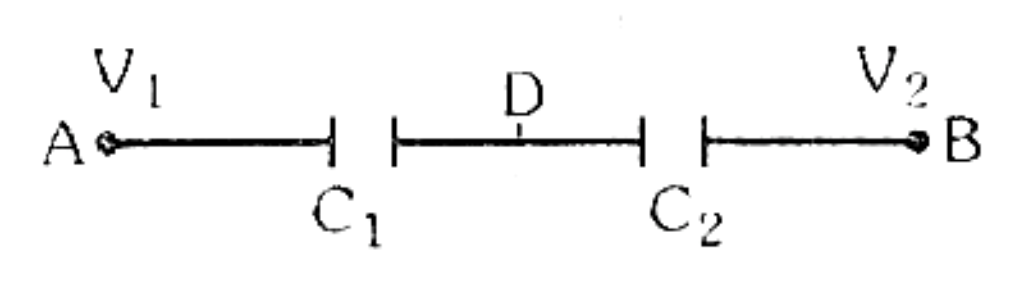
The potential at point D is = ....... as...

The potential at point D is = ....... as shown In below figure.

(a) `(1)/(2) (V_(1)+V_(2))`
(b) `(C_(1)V_(2)+C_(2)V_(1))/(C_(1)+C_(2))`
(c) `(C_(1)V_(1)+C_(2)V_(2))/(C_(1)+C_(2))`
(d) `(C_(2)V_(1)-C_(1)V_(2))/(C_(1)+C_(2))`

A

`(1)/(2) (V_(1)+V_(2))`

B

`(C_(1)V_(2)+C_(2)V_(1))/(C_(1)+C_(2))`

C

`(C_(1)V_(1)+C_(2)V_(2))/(C_(1)+C_(2))`

D

`(C_(2)V_(1)-C_(1)V_(2))/(C_(1)+C_(2))`

Text Solution

Verified by Experts

The correct Answer is:

A, B, C

Suppose electric potential at D is V.
`:. V_(1)-V= (q)/(C_(1))` and `V-V_(2)=(q)/(C_(2))`
( both are in series )
`:. (V_(1)-V)/(V-V_(2))=(C_(2))/(C_(1))`
`:. V_(1)C_(1)-VC_(1)=VC_(2)-V_(2)C_(2)`
`:. V_(1)C_(1)=V(C_(1)+C_(2))`
`:. V= (V_(1)C_(1)+V_(2)C_(2))/(C_(1)+C_(2))`
Promotional Banner

Topper's Solved these Questions

  • ELECTROSTATIC POTENTIAL AND CAPACITANCE

    KUMAR PRAKASHAN|Exercise Section D ( MCQs asked in Cometitive Exams )|39 Videos
  • ELECTROSTATIC POTENTIAL AND CAPACITANCE

    KUMAR PRAKASHAN|Exercise Section C ( NCERT Exemplar Solution ) ( Long Answer Type Questions )|12 Videos
  • ELECTROMAGNETIC WAVES

    KUMAR PRAKASHAN|Exercise BOARD.S QUESTION PAPER MARCH - 2020 (PART - B) SECTION - C|5 Videos
  • MAGNETISM AND MATTER

    KUMAR PRAKASHAN|Exercise SECTION D Multiple Choice Questions (MCQs) (MCQs asked in Competitive Exams) MCQs asked in Board Exam and GUJCET|7 Videos

Similar Questions

Explore conceptually related problems

Answer each question by selecting the proper alternative from those given below each question so as to make the statement true: The solution of the pair of linear equations a_(1)x+b_(1)y+c_(1)=0 and a_(2)x+b_(2)y+c_(2)=0 by corss-multiplication method is given by .................. x=(b_(2)c_(1)-b_(1)c_(2))/(a_(1)b_(2)-a_(2)b_(1)), y=(a_(1)c_(2)-a_(2)c_(1))/(a_(1)b_(2)-a_(2)b_(1)) x=(b_(1)c_(2)-b_(2)c_(1))/(a_(1)b_(2)-a_(2)b_(1)), y=(a_(1)c_(2)-a_(2)c_(1))/(a_(1)b_(2)-a_(2)b_(1)) x=(b_(2)c_(1)-b_(1)c_(2))/(a_(1)b_(2)-a_(2)b_(1)), y=(a_(2)c_(1)-a_(1)c_(2))/(a_(1)b_(2)-a_(2)b_(1)) x=(b_(1)c_(2)-b_(2)c_(1))/(a_(1)b_(2)-a_(2)b_(1)), y=(a_(2)c_(1)-a_(1)c_(2))/(a_(1)b_(2)-a_(2)b_(1))

Evaluate |{:(.^(x)C_(1),,.^(x)C_(2),,.^(x)C_(3)),(.^(y)C_(1),,.^(y)C_(2),,.^(y)C_(3)),(.^(x)C_(1),,.^(z)C_(2),,.^(z)C_(3)):}|

For any arbitrary motion in space , which of the following relations are true : (a) V_("average")=(1//2)(v(t_(1))+v(t_(2))) (b) V_("average")=[r(t_(2))-r(t_(1))]//(t_(2)-t_(1)) (c ) V(t)=V(0)+at (d) r(t) =r(0)+v(0)T+(1//2)at^(2) (e ) a_("average")=[v(t_(2))-v(t_(1))]//(t_(2)-t_(1)) (The average stands for average of the quantity over the time interval t_(1)" to "t_(2))

The velocity - time graph of a particle in one dimensional motion is shown in figure. Which of the following formulae are correct for describing the motion of the particle over the time- interval t _(1) to t _(2) : (a) x (t _(2)) = x (t _(1)) +v (t _(2) - t _(1)) + ((1)/(2)) a (t _(2) - t _(1)) ^(2) (b) v (t_(2)) = v (t_(1)) + a (t _(1)))//(t_(2) -t _(1)) (C) v _("average")= (x (t _(2)) -x (t _(1)))//(t_(2) -t _(1)) (d) a _("average")= (v(t _(2)) - v (t _(1))) //(t_(2) -t _(1)) (e) x (t _(2))=x(t_(1)) + v _("average") (t _(2) - t _(1)) + ((1)/(2)) a _("average") (t _(2) -t _(1)) ^(2) (f) c (t _(2)) - c (t _(1)) = area under the v-t curve bonunded by the t -axis and the dotted line shown.

f(n)=sum_(r=1)^(n) [r^(2)(""^(n)C_(r)-""^(n)C_(r-1))+(2r+1)(""^(n)C_(r ))] , then

If |a_(1)|gt|a_(2)|+|a_(3)|,|b_(2)|gt|b_(1)|+|b_(3)| and |c_(2)|gt|c_(1)|+|c_(2)| then show that |{:(a_(1),a_(2),a_(3)),(b_(1),b_(2),b_(3)),(c_(1),c_(2),c_(3)):}|ne0.

Prove that the result : ((2^(a) )/( 2^(b)) ) ^(a+b) xx( (2^(b))/( 2^(c))) ^(b+c) xx( (2^(c))/( 2^(a)))^(c+a)=1

A : Three capacitors having C_(1) lt C_(2) lt C_(3) are connected in parallel its effective capacitance will be C_(p) gt C_(3) . R : (1)/(C_(P))=(1)/(C_(1))+(1)/(C_(2))+(1)/(C_(3))

Statement -1 Consider the determinant Delta=|{:(a_(1)+b_(1)x^(2),a_(1)x^(2)+b_(1),c_(1)),(a_(2)+b_(2)x^(2),a_(2)x^(2)+b_(2),c_(2)),(a_(3)+b_(3)x^(2),a_(3)x^(2)+b_(3),c_(3)):}|=0, where a_(i),b_(i),c_(i) in R (i=1,2,3) and x in R Stement -2 If |{:(a_(1),b_(1),c_(1)),(a_(2),b_(2),c_(2)),(a_(3),b_(3),c_(3)):}| =0, then Delta =0

If three lines whose equations are y=m_(1) x+c_(1), y=m_(2) x + c_(2) and y=m_(3) x + c_(3) are concurrent, then show that m_(1) (c_(2) - c_(3))+m_(2) (c_(3) - c_(1) ) + m_(3) ( c_(1) - c_(2) ) =0 .

KUMAR PRAKASHAN-ELECTROSTATIC POTENTIAL AND CAPACITANCE-Section D ( Multiple Choice Questions (MCQs) )
  1. If a capacitor having capacitance of 600 muF is charged at a uniform r...

    Text Solution

    |

  2. The capacitance of a capildtor is 10 muF . The potential difference on...

    Text Solution

    |

  3. 3 identical capacitors are joined in parallel and are charged with a b...

    Text Solution

    |

  4. To get 2F capacitance, the area of each plate kept at separation of 2 ...

    Text Solution

    |

  5. Considering the earth as a metallic sphere its capacitance would be n...

    Text Solution

    |

  6. If volume of Earth is V and area of Earth is A, then its capacitance w...

    Text Solution

    |

  7. The distance between two plates of capacitor is d and area of each pla...

    Text Solution

    |

  8. Find the effective capacitance between A and B or a given circuit.

    Text Solution

    |

  9. For a given circuit, the effective capacitance between P and U is .......

    Text Solution

    |

  10. A network of capacitors are prepared as shown in figure. Find the equi...

    Text Solution

    |

  11. The potential at point D is = ....... as shown In below figure. ...

    Text Solution

    |

  12. Energy of a charged capacitor is U. Now it is removed from a battery a...

    Text Solution

    |

  13. For a capacitor the distane between two plates is 4x and the electric ...

    Text Solution

    |

  14. In the beginning the space between the plates of a parallel plate capa...

    Text Solution

    |

  15. In the figure below, what is the equivalent capacitance between points...

    Text Solution

    |

  16. By which type of supply capacitor works ?

    Text Solution

    |

  17. Whichof the following represents unit Faraday ?

    Text Solution

    |

  18. The the following table, the area of plates and separation benvcen th...

    Text Solution

    |

  19. A : When an electric charge is distributed between two bodies , no cha...

    Text Solution

    |

  20. A : Three capacitors having C(1) lt C(2) lt C(3) are connected in para...

    Text Solution

    |
