

Home
Class 12
PHYSICS
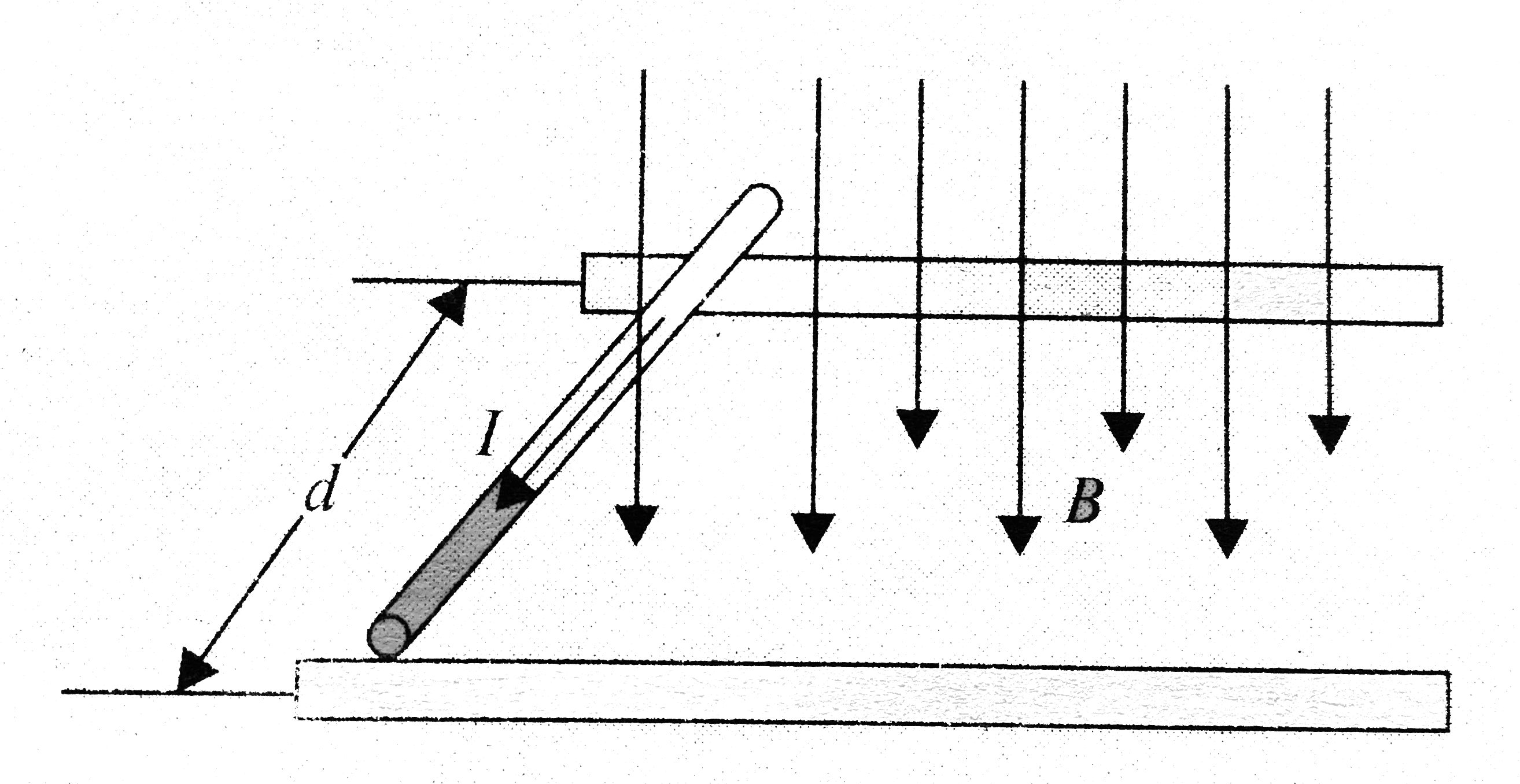
A rod of mass 0.720 kg and radius 6 cm r...

A rod of mass 0.720 kg and radius 6 cm rests on two parallel rails that are `d=12 cm` apart and length of rails is `L=49 cm.` The rod carried a current of `I=48 A` Fig. and rolls along the rails without slipping. A uniform magnetic field of magnetude 0.240 T is directed perpendicular to the rod and the rails. If it starts from rest, what is the speed of the rod as it leaves the rails?

Promotional Banner

Similar Questions

Explore conceptually related problems

A rod of mass m and radius R rest on two parallel rails that are distance l apart and have a length L . The rod carries a current I ( in the direction shown ) and rolls along the rails without slipping. A uniform magnetic field B is directed perpendicular to the rod and the rails. If it starts from rest, wat is the speed of the rod as it leaves the rails ?

Two parallel rails with negligible resistance are 10.0 cm apart. The are connected by a 5.0Omega resistor. The circuit also contains two metal rods having resistances of 10.0Omega and 15.0Omega along the rails. The rods are pulled away from the resistor at constant speeds 4.00 m/\s and 2.00 m//s respectively. A uniform magnetic field of magnitude 0.01 T is applied perpendicular to the, plane of the rails. Determine the current in the 5.0Omega resistor.

Two parallel rails with negligible resistance are 10.0 cm apart. The are connected by a 5.0Omega resistor. The circuit also contains two metal rods having resistances of 10.0Omega and 15.0Omega along the rails. The rods are pulled away from the resistor at constant speeds 4.00 m/\s and 2.00 m//s respectively. A uniform magnetic field of magnitude 0.01 T is applied perpendicular to the, plane of the rails. Determine the current in the 5.0Omega resistor.

A copper rod of mass m slides under gravity on two smooth parallel rails l distance apart set at an angle theta to the horizontal. At the bottom, the rails are joined by a resistance R . There is a uniform magnetic field perpendicular to the plane of the rails. the terminal valocity of the rod is

A copper rod of mass m slides under gravity on two smooth parallel rails l distance apart set at an angle theta to the horizontal. At the bottom, the rails are joined by a resistance R . There is a uniform magnetic field perpendicular to the plane of the rails. the terminal valocity of the rod is

A conducting rod MN of mass m and length 'l' is placed on parallel smooth conducting rails connected to an uncharged capacitor of capacitance C and a battery of emf epsilon as shown. A uniform magnetic field B is existing perpendicular to the plane of the rails. The steady state velocity acquired by the conducting rod MN after closing switch S is (neglect the resistance of the parallel rails and the conducting rod)

A conducting rod MN of mass m and length 'l' is placed on parallel smooth conducting rails connected to an uncharged capacitor of capacitance C and a battery of emf epsilon as shown. A uniform magnetic field B is existing perpendicular to the plane of the rails. The steady state velocity acquired by the conducting rod MN after closing switch S is (neglect the resistance of the parallel rails and the conducting rod)

Two vertical conducting rails separted by distance 1.0m are placed parallel to z -axis as shown in figure. At z=0 , a capacitor of 0.15 F is connected between the rails and a metal rod of mass 100g placed across the rails slides down along the rails. if a constant magnetic fields of 2.0 T exists perpendicular to the plane of the rails, what is the acceleration of the rod?