


Similar Questions
Explore conceptually related problems
Recommended Questions
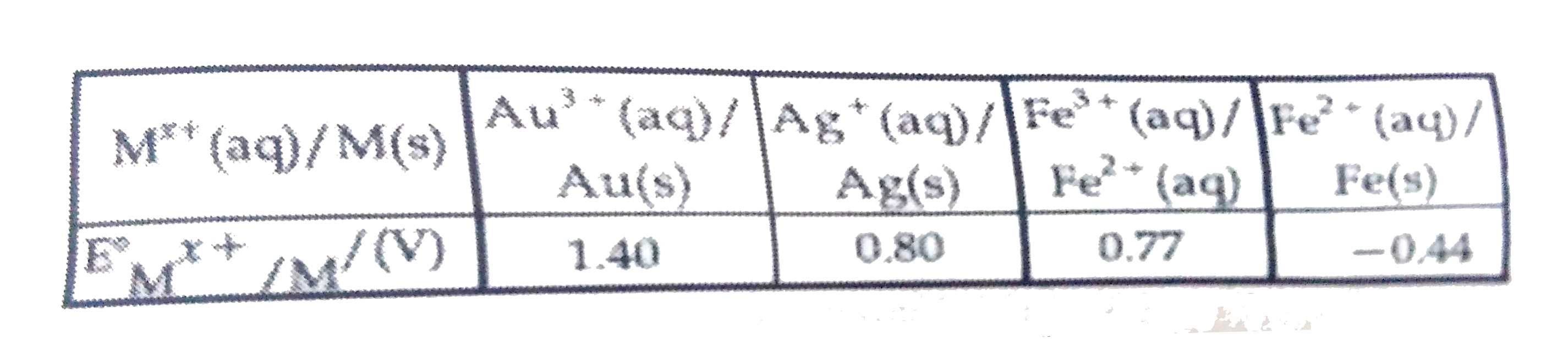
- For the cell Zn(s)|Zn^(2+)(aq)||M^(x+)(aq)|M(s) different half cells a...
Text Solution
|
- For the cell Zn(s) + 2H^(+)(aq) rightarow Zn^(2+)(aq) + H(2)(g), E^(...
Text Solution
|
- If in a galvanic cell, the cell reaction is reversed as Cu(s)|Cu^(2...
Text Solution
|
- Calculate the maximum possible electrical work that can be obtined fro...
Text Solution
|
- For the cell Zn(s)|Zn^(2+)(aq)||M^(x+)(aq)|M(s) different half cells a...
Text Solution
|
- E^(@) for the electrochemical cell Zn(s)|Zn^(2+) 1 M (Aq.)||Cu^(2+) 1 ...
Text Solution
|
- The standard cell potential for the cell Zn|Zn^(2+) (1 M)|| Cu^(2+) (1...
Text Solution
|
- Calculate the half-cell potential at 298 K for the reaction, Zn^(2+)...
Text Solution
|
- For galvanic cell M^(2+)(aq) + Zn(s) rarr M(s) +Zn^(2+)(aq) triangleG^...
Text Solution
|