Home
Class 9
MATHS
In an equilateral triangle prove that th...

In an equilateral triangle prove that the centroid and the centre of the circumcircle (circumcentre) coincide.

Text Solution

Verified by Experts
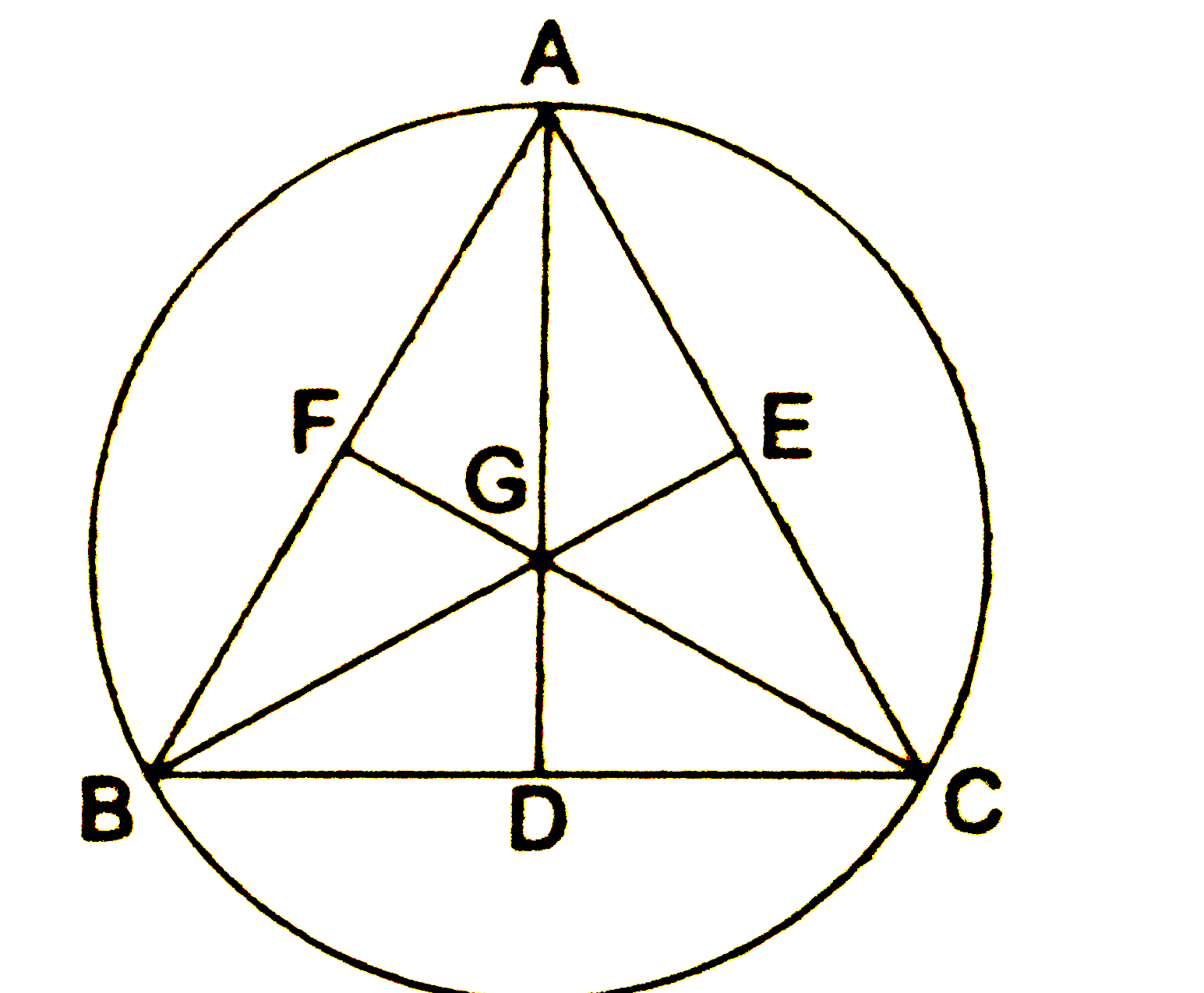
The point of intersection of the medians of a triangle is called its centroid. The centroid of a triangle is the point located at `(2)/(3)` of the distance from a vertex along a median. The center of the circumcircle of this triangle is called the circumcentre.
Let `Delta ABC` be the given equilateral triangle and let its medians `AD, BE` and `CF` intersect at `G`.
Then `G` is the centroid of `Delta ABC`.
In `Delta BCE` and `Delta CBF` we have
`BC` `=` `CB` [common]
`/_ B = /_ C `[ each equal to `60^(@) ]`
`CE = BE [ AC = AB implies (1)/(2) AC =(1)/(2)AB]`
`:. Delta ABC =CF`
Similarly, `AD=BE`.
Thus, `AD=BE=CFimplies(2)/(3)AC=(1)/(2)AB]`
`implies GA=GB=GC`
This shows that `G` is the circumcentre of `Delta ABC`
Hence, `G` is the centroid as well as circumcentre of `Delta ABC`.
Promotional Banner

Similar Questions

Explore conceptually related problems

In an equilateral triangle,prove that the centroid and centre of the circum-circle (circum centre) coincide.TO PROVE: The centroid and circum centre are coincident. CONSTRUCTION: Draw medians AD,BE and CF.

In an equilateral triangle, prove that the centroid and centre of the circum-circle (circum centre) coincide) Given : An equilateral triangle A B C in which D , E a n d F are the mid-points of sides B C , C A a n d A B respectively. To Prove: The centroid and circum centre are coincident. Construction : Draw medians A D , B E a n d C F

From the figure,ABC is an equilateral triangle of side 14cm. M is the center of the circumcircle.Find the area of shaded resin.

In an equilateral triangle ABC, G is the centroid. Each side of the triangle is 6 cm. The length of AG is

The controid of an equilateral triangles is (0,0) and the length of the altitude is 6. The equation of the circumcircle of the triangle is

The height of an equilateral triangle is 4sqrt(3) cm . The ratio of the area of its circumcircle to that of its in-circle is

