Home
Class 9
MATHS
The figure formed by joining the mid-poi...

The figure formed by joining the mid-points of the adjacent sides of a quadrilateral is

Text Solution

Verified by Experts


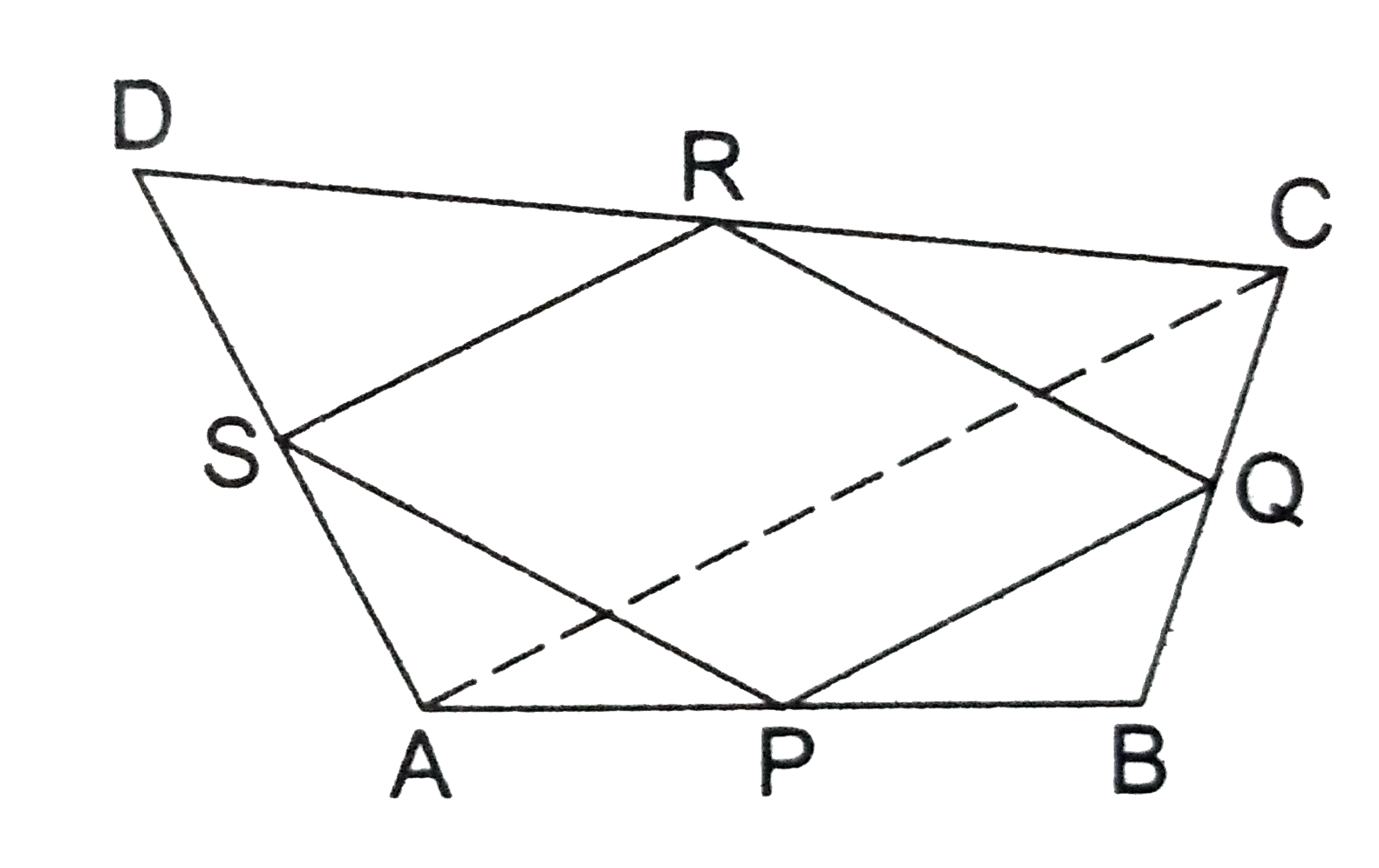
Let ABCD be a quadrilateral in which P, Q, R, S are the midpoints of AB, BC, CD and DA respectively. Join AC.
In `triangle `ABC, the points P and Q are the midpoints of AB and BC respectively.
`therefore " PQ ||AC and "PQ=(1)/(2) AC " " ` (by midpoint theorem).
Again , in `triangle ` DAC, the points S and R are the midpoints of AD and DC respectively.
`therefore " SR||AC and " SR=(1)/(2) AC " " ` (by midpoint theorem).
Now, PQ||AC and and SR||AC `rArr ` PQ||SR.
Also, `PQ=SR " " ("each equal to "(1)/(2)AC).`
`therefore " PQ||SR and " PQ=SR.`
Hence, PQRS is a parallelogram.

Promotional Banner

Topper's Solved these Questions

  • QUADRILATERALS

    RS AGGARWAL|Exercise EXAMPLE|32 Videos
  • QUADRILATERALS

    RS AGGARWAL|Exercise Exercise 10 A|10 Videos
  • PROBABILITY

    RS AGGARWAL|Exercise Multiple Choice Questions (Mcq)|16 Videos
  • TRIANGLES

    RS AGGARWAL|Exercise MULTIPLE-CHOICE QUESTIONS (MCQ)|10 Videos

Similar Questions

Explore conceptually related problems

The figure formed by joining the mid-point of the adjacent sides of a parallelogram is a rectangle (b) parallelogram (c) rhombus (d) square

Fill in the blanks to make the following statements correct The triangle formed by joining the mid-points of the sides of an isosceles triangle is .... The triangle formed by joining the mid-points of the sides of a right triangle is .......... The figure formed by joining the mid-points of consecutive sides of a quadrilateral is ....

Area of the quadrilaterals formed by joining the mid points of the adjacent sides of a quadrilateral is________ the area of given quadrilateral.

The figure formed by joining the mid-points of the sides of a quadrilateral ABCD, taken in order, is a square only, if

The figure formed by joining the midpoints of the adjacent sides of a rectangle of sides 8 cm and 6 cm is a

The figure formed by joining the mid-points of the adjacent sides of a rhombus is a square (b) rectangle (c) trapezium (d) none of these
