

Home
Class 12
PHYSICS
A block A of mass m is placed on a frict...

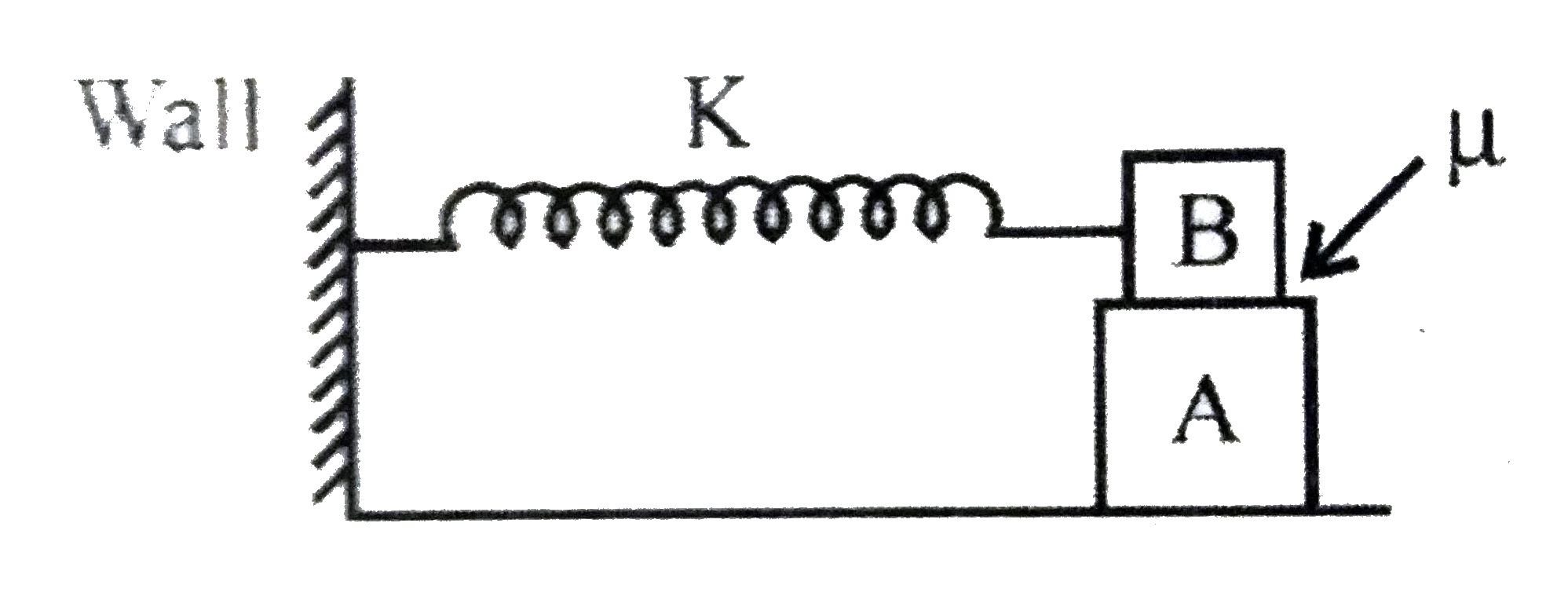
A block A of mass m is placed on a frictionless horizontal surface. Another block B of the same mass is kept on A and connected to the wall with the helpf of a spring of force constant K as shown in the figure. The coefficient of friction between the blocks A and B is `mu`. The blocks move together execting simple harmonic motion of amplitude 'a'. What is the maximum value of the fricitional force between A and B ?

Promotional Banner

Similar Questions

Explore conceptually related problems

A long block A is at rest on a smooth horizontal surface. A small block B whose mass is half of mass of A is placed on A at one end and is given an initial velocity u as shown in figure. The coefficient of friction between the blocks is mu .

A long block A is at rest on a smooth horizontal surface. A small block B whose mass is half of mass of A is placed on A at one end and is given an initial velocity u as shown in figure. The coefficient of friction between the blocks is mu .

A block of mass m is moving with a speed v on a horizontal rought surface and collides with a horizontal monted spring of spring constant k as shown in the figure .The coefficient of friction between the block and the floor is mu The maximum cobnpression of the spring is

A block of mass m =1 kg placed on top of another block of mass M = 5 kg is attached to a horizontal spring of force constant K = 20 N/m as shown in figure. The coefficient of friction between the blocks is µ where as the lower block slides on a frictionless surface. The amplitude of oscillation is 0.4 m. What is the minimum value of µ such that the upper block does not slip over the lower block ?

A block of mass M is being pulled along rough horizontal surface. The coefficient of friction between the block & surface is mu . If another block of mass M/2 is placed on the block & it is again pulled on the surface. The coefficient of friction between the block and surface will be

A block P of mass m is placed on a smooth horizontal surface. A block Q of the same mass is placed over the block P and the coefficient of static friction between them is mu . A spring of spring constant K is attached to block Q. The blocks are displaced together to a distance A and released. The upper block oscillates without slipping over the lower block. The maximum frictional force between the block is:

A block P of mass m is placed on a smooth horizontal surface. A block Q of the same mass is placed over the block P and the coefficient of static friction between them is mu . A spring of spring constant K is attached to block Q. The blocks are displaced together to a distance A and released. The upper block oscillates without slipping over the lower block. The maximum frictional force between the block is: