

Home
Class 11
PHYSICS
A body of mass m is attached by an inela...


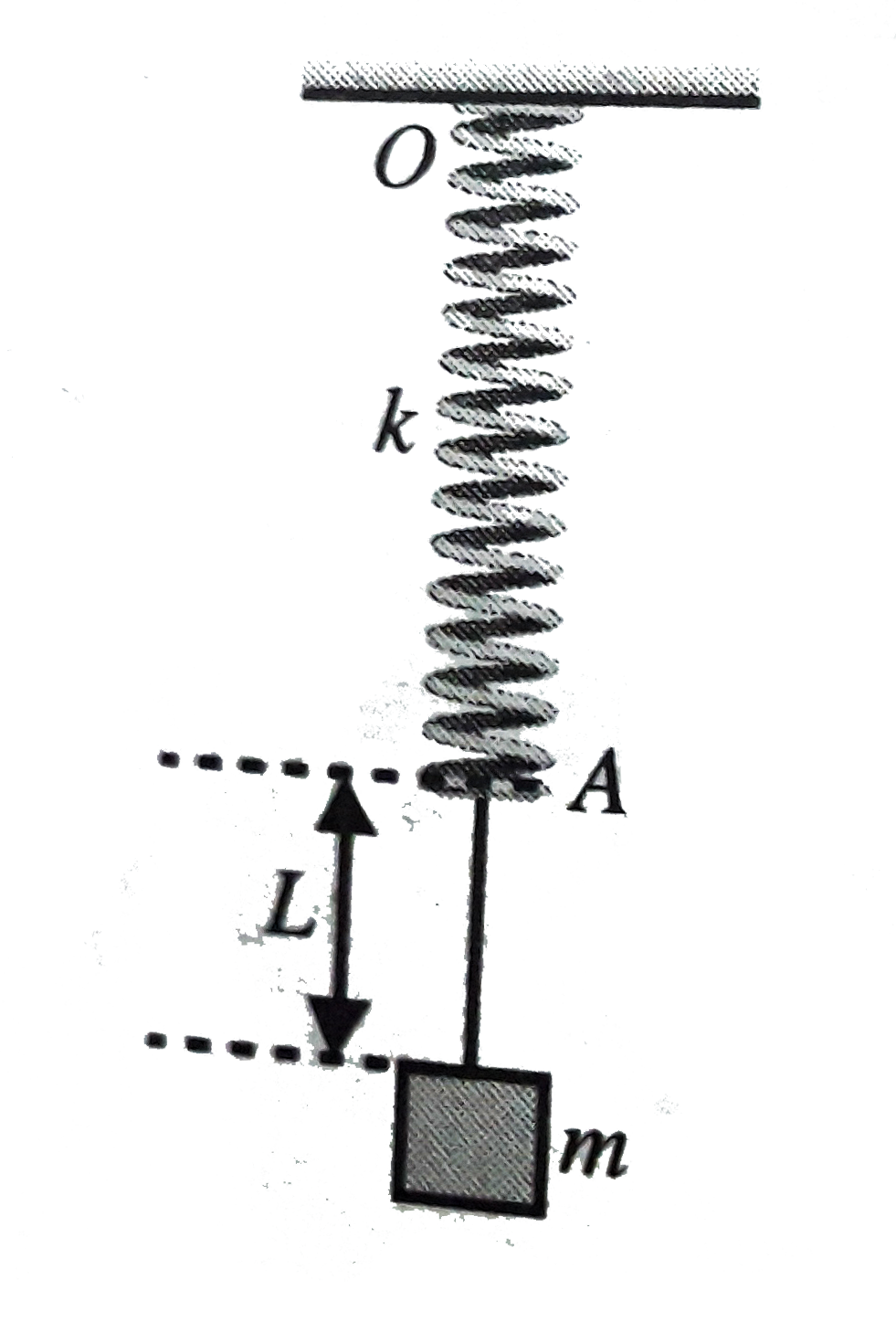
A body of mass `m` is attached by an inelastic string to a suspended spring of spring constant `k`. Both the string and the spring have negligible mass and the string is inextensible and of length `L`. Initially, the mass `m` is at rest.
Q. If the mass `m` is now raised up to point `A` (the top end of the string see fig. and allowed to fall from rest, the maximum extension of the spring in the subsequent motion will be

Promotional Banner

Similar Questions

Explore conceptually related problems

A body of mass m is attached by an inelastic string to a suspended spring of spring constant k . Both the string and the spring have negligible mass and the string is inextensible and of length L . Initially, the mass m is at rest. The largest amplitude A_(max) , for which the string will remain taut throughout the motion is

A body of mass m is attached by an inelastic string to a suspended spring of spring constant k . Both the string and the spring have negligible mass and the string is inextensible and of length L . Initially, the mass m is at rest. The largest amplitude A_(max) , for which the string will remain taut throughout the motion is

A body of mass m is attached by an inelastic string to a suspended spring of spring constant k . Both the string and the spring have negligible mass and the string is inextensible and of length L . Initially, the mass m is at rest. If the mass m , from the initial position of rest is pulled down a distance A and then released, assuming that the string remains taut throughout the motion, the maximum (downwards) acceleration of the oscillating body will be

Two blocks A and B of same mass m attached with a light string are suspended by a spring as shown in fig. Find the acceleration of block A and B just after the string is cut.

Two blocks A and B of same mass m attached with a light spring are suspended by a string as shown in fig. Find the acceleration of block A and B just after the string is cut.

Two blocks A and B of same mass m attached with a light spring are suspended by a string as shown in fig. Find the acceleration of block A and B just after the string is cut.

A body of mass m is allowed to fall with the help of string with downward acceleration g/6 to distance x. The work done by the string is

A body of mass M is hanging by an inextensible string of mass m. If the free end of the string accelerates up with constant acceleration a. find the variation of tension in the string a function of the distance measured from the mass M (bottom of the string).

In the figure a mass m is hung by a light spring and a light string as shown .Both the spring and the string make an angle theta with the horizontal at equilbrium .If the string is suddenly cut then the instantaneous acceleration of the mass m is :

In fig mass m is lifted up by attaching a mass 2m to the other end of the string while in fig (b) m is lifted by pulling the other end of the string with a constant force F=2mg then: