

Home
Class 11
PHYSICS
Rectangular block B, having height h and...

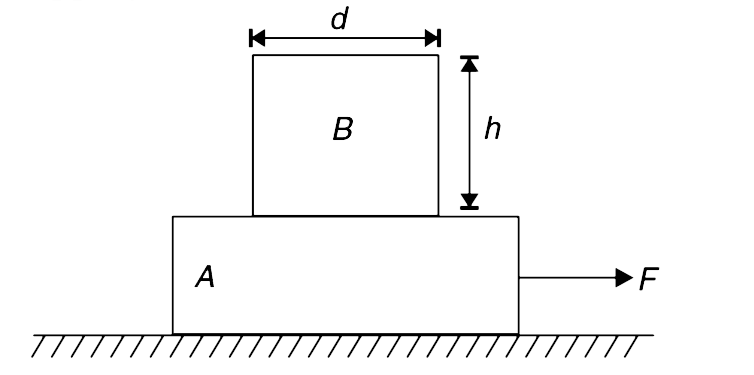
Rectangular block B, having height `h` and width `d` has been placed on another block A as shown in the figure. Both blocks have equal mass and there is no friction between A and the horizontal surface. A horizontal time dependent force `F = kt` is applied on the block A. At what time will block B topple? Assume that friction between the two blocks is large enough to prevent B from slipping.

Promotional Banner

Similar Questions

Explore conceptually related problems

Block 'A' is placed ober the block 'B' as shown in the figure. Wedge is fixed and there is no friction. Between block 'B' and fixed inclined. Force of friction on the block 'A' is

Block 'A' is placed ober the block 'B' as shown in the figure. Wedge is fixed and there is no friction. Between block 'B' and fixed inclined. Force of friction on the block 'A' is

On a smooth horizontal surface a block A of mass 10kg is kept. On this block a second block B of mass 5kg is kept. The coefficient of friction between the two blocks is 0.4 .A horizontal force of 30N is applied on the lower block as shown. The force of friction between the blocks is

A block of mass m is kept over another block of mass 2m. Coefficient of friction between two blocks is mu and that of between lower blood from the horizontal surface is zero. A horizontal force F=4/3 mu mg is applied on the block of mass 2m . Acceleration of lower block is

A block of mass m is kept over another block of mass 2m. Coefficient of friction between two blocks is mu and that of between lower blood from the horizontal surface is zero. A horizontal force F=4/3 mu mg is applied on the block of mass 2m . Acceleration of lower block is

A block is placed on a rough horizontal plane. Three horizontalforces are applied on the block as shown in the figure. If the block is in equilibrium, find the friction force acting on the block.

A block is placed on a rough horizontal plane. Three horizontalforces are applied on the block as shown in the figure. If the block is in equilibrium, find the friction force acting on the block.

A block is placed on a rough horizontal plane. Three horizontalforces are applied on the block as shown in the figure. If the block is in equilibrium, find the friction force acting on the block.

Two blocks A and B each of mass m are placed on a smooth horizontal surface. Two horizontal force F and 2F are applied on blocks A and B, respectively, as shown in fig. Block A does not slide on block B. Then then the normal reaction acting between the two blocks is (assume no friction between the blocks)