

Home
Class 11
PHYSICS
Blocks shown in figure have been placed ...

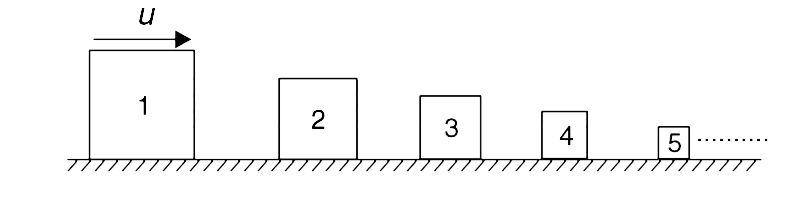
Blocks shown in figure have been placed on a smooth horizontal surface and mass of `(n + 1)^(th)` block is `(1)/(20)` times the mass of `n^(th)` block (where `n=1,2,3,4,….`). The first block is given an initial velocity `u` towards the second block. All collision are head on elastic collisions. If `u = 10 m//s` then how many blocks must be kept so that the last one acquires speed equal to or greater than the escape speed `(=11.0 km s^(-1))`
[Take `log_(10)((40)/(21))=0.28 and log_(10)(11)=1.04`]

Promotional Banner

Similar Questions

Explore conceptually related problems

A long block A is at rest on a smooth horizontal surface. A small block B whose mass is half of mass of A is placed on A at one end and is given an initial velocity u as shown in figure. The coefficient of friction between the blocks is mu .

A long block A is at rest on a smooth horizontal surface. A small block B whose mass is half of mass of A is placed on A at one end and is given an initial velocity u as shown in figure. The coefficient of friction between the blocks is mu .

A set of n identical cubical blocks lies at rest parallel to each other along a line on a smooth horizontal surface. The separation between the near surfaces of any two adjacent blocks is L . The block at one end is given a speed v towards the next one at time 0 t . All collisions are completely inelastic, then

A set of n identical cubical blocks lies at rest parallel to each other along a line on a smooth horizontal surface. The separation between the near surfaces of any two adjacent blocks is L . The block at one end is given a speed v towards the next one at time 0 t . All collisions are completely inelastic, then

Three blocks are placed on smooth horizontal surface and lie on same horizontal straight line. Block 1 and block 3 have mass m each and block 2 has mass M (M gt gt m) . Block 2 and block 3 are initially stationary, while block 1 is initially moving towards block 2 with speed v as shown. Assume that all collisions are head on and perfectly elastic. What value of M//m ensures that block 1 and block 3 have the same final speed?

Three blocks are placed on smooth horizontal surface and lie on same horizontal straight line. Block 1 and block 3 have mass m each and block 2 has mass M (M gt gt m) . Block 2 and block 3 are initially stationary, while block 1 is initially moving towards block 2 with speed v as shown. Assume that all collisions are head on and perfectly elastic. What value of M//m ensures that block 1 and block 3 have the same final speed?

The right block in the figure moves at a speed v towards the left block placed in equilibrium. All the surfaces are smooth and all the collisions are elastic. Find the time period of the motion