

Home
Class 12
PHYSICS
The instant of time at which acceleratio...

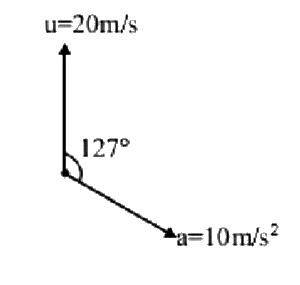
The instant of time at which acceleration and velocity are perpendicular is :-

Promotional Banner

Similar Questions

Explore conceptually related problems

A foot ball is thrown in a parabolic path. Is there a point at which the acceleration is parallel to the velocity ?Perpendicular to the velocity ? Explain.

Figure shows the direction of the total acceleration and velocity of a particle moving clockwise in a circle radius m at an instant of time. Tangential acceleration this instant is 5m//s^(2) . Which of the following statements is not correct?

Figure shows the direction of the total acceleration and velocity of a particle moving clockwise in a circle radius m at an instant of time. Tangential acceleration this instant is 5m//s^(2) . Which of the following statements is not correct?

Give examples where a. the velocity of a particle is zero but its acceleration is not zero. b.the velocity is opposite in direction to the acceleration, c. the velocity is perpendicular to the acceleration.

Give examples where a. the velocity of a particle is zero buts its acceleration is not zero. b.the velocity is opposite in direction to the acceleration, c. the velocity is perpendicular to the acceleration.

Give examples where a. the velocity of a particle is zero but its acceleration is not zero. b.the velocity is opposite in direction to the acceleration, c. the velocity is perpendicular to the acceleration.

A ball is thrown in a parabolic path. Is there any point at which the acceleration is perpendicular to the velocity .

Figur shows the total acceleration and velocity of a particle moving clockwise in a circle of radius 2.5m at a given instant of time. At this instant, find: (a) the radius acceleration, (b) the speed of the acceleration, (c) its tangential acceleration.

Figur shows the total acceleration and velocity of a particle moving clockwise in a circle of radius 2.5m at a given instant of time. At this instant, find: (a) the radius acceleration, (b) the speed of the acceleration, (c) its tangential acceleration.

Figure shows the total acceleration and velocity of a particle moving clockwise in a circle of radius 2.5 m at a given instant of time. At this instant, Find: (i) the radial acceleration, (ii) the speed of the particle and (iii) its tangential acceleration.