

Home
Class 11
PHYSICS
The magnitude of difference in accelerat...

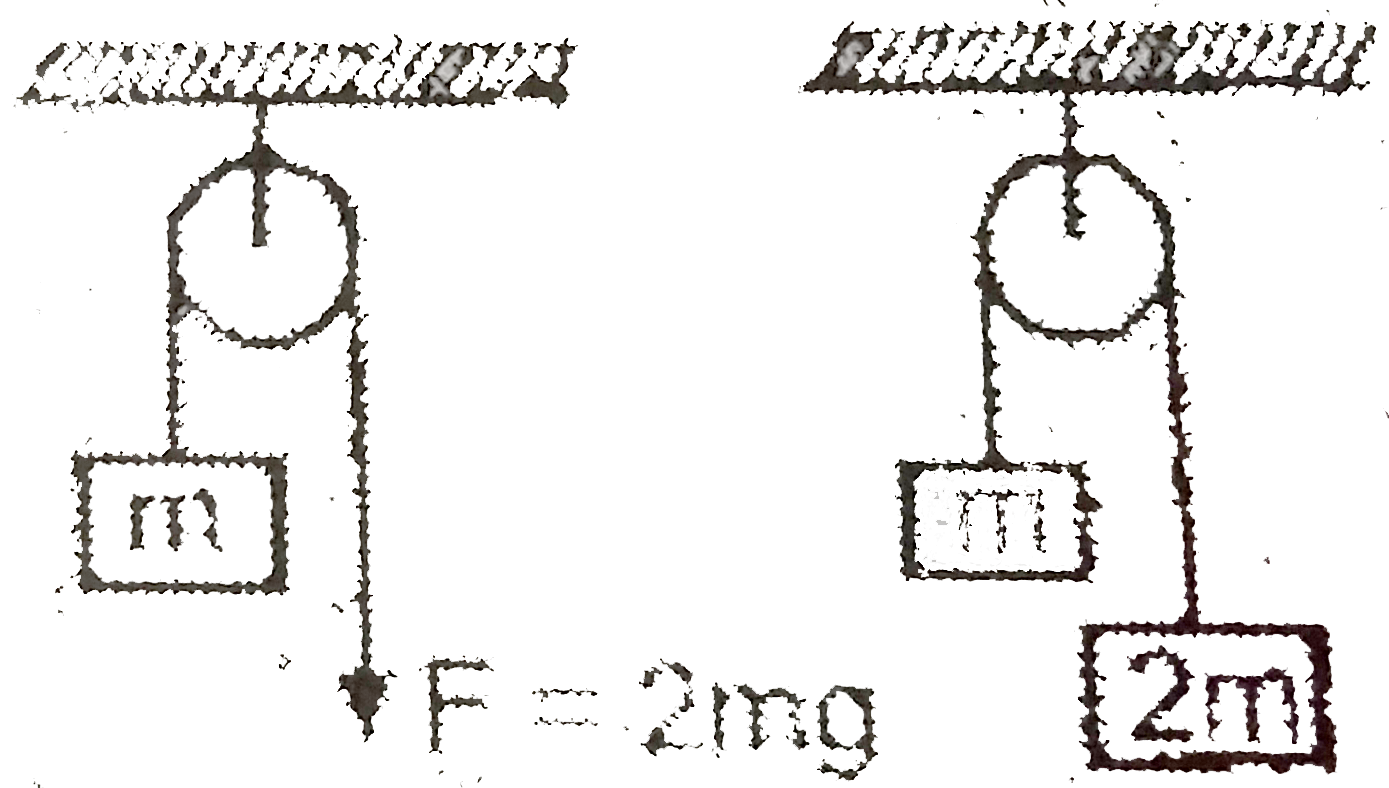
The magnitude of difference in accelerations of block of mass `m` in both the cases shown below is

Promotional Banner

Similar Questions

Explore conceptually related problems

The magnitud of difference in accelerations of blocks of mass m in . Both the cases shown below is

34.The magnitude of acceleration of blocks of mass

Determine the magnitude of frictional force and acceleration of the block in each of the following cases :

Determine the magnitude of frictional force and acceleration of the block in each of the following cases :

Two blocks of equal mass are tied with a light string, which passes over a massless pulley as shown in figure. The magnitude of acceleration of centre of mass of both the blocks is : (neglect friction everywhere)

In the figure shown, the blocks have equal masses. Friction, mass of the string and the mass of the pulley are negligible. The magnitude of the acceleration of the centre of mass of the blocks is (Acceleration due to gravity = g).

Two blocks of equal masses m are released from the top of a smooth fixed wedge as shown in the figure. Find the magnitude of the acceleration of the centre of mass of the two blocks in m//s^(2) if g =10 m//s^(2)

Find the acceleration of the block of mass m in the arrangement shown in the following figures. The masses of the pulleys and the threads, as well as the friction are assumed to be negligible.

In the situation shown in fig., all the strings are light and inextensible and pullies are light. There is no friction at any surface and all blocks are of cuboidal shape. A horizontal force of magnitude F si applied to right most free end of string in both cases shown in the figure. At the instant shown, the tension in all strings are non-zero. Let the magnitudes of acceleration of large blocks (of mass M) in fig. be a_(1) and a_(2) respectively. Then,

In the situation shown in fig., all the strings are light and inextensible and pullies are light. There is no friction at any surface and all blocks are of cuboidal shape. A horizontal force of magnitude F si applied to right most free end of string in both cases shown in the figure. At the instant shown, the tension in all strings are non-zero. Let the magnitudes of acceleration of large blocks (of mass M) in fig. be a_(1) and a_(2) respectively. Then,