Home
Class 11
PHYSICS
Plot a stress to strain curve for a met...

Plot a stress `to` strain curve for a metal and explain.

Text Solution

Verified by Experts
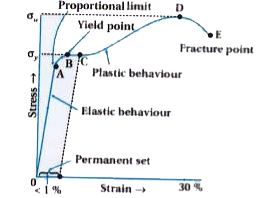
A stress `to` strain curve for a metal is shown as in figure.
From the graph, we can see that in the region between 0 to A, the curve is linear. In this region Hooke.s law is obeyed.
The body regains its original dimensions when the applied force is removed. In this region the solid behaves as an elastic body.

In the region from A to B stress and strain are not proportional. The body still returns to its original dimension when the load is removed. The point B in the curve is known as yield point (also known as elastic limit) and the corresponding stress is known as yield strength `(sigma_(y))` of the material.
If the load is increased further, from point B the stress developed exceeds the yield strength and strain increases rapidly.
The portion of the curve between B and D shows this, when the load is removed say at some point C between B and D, the body does not regain its original dimension.
In this state, even when the stress is zero, the strain is not zero. The material is said to have a permanent set. The deformation is said to be plastic deformation. The point D on the curve isthe ultimate tensile strength `(sigma_(u))` of the material. Beyond this point, additional strain is produced even by a reduced applied force and fracture occurs at point E.
If the ultimate strength and fracture points D and E are close, the material is said to be brittle. If they are far apart, the material is said to be ductile.
Promotional Banner

Topper's Solved these Questions

  • MACHANICAL PROPERTIES OF SOLIDS

    KUMAR PRAKASHAN|Exercise SECTION-A TRY YOURSELF (VSQs)|40 Videos
  • MACHANICAL PROPERTIES OF SOLIDS

    KUMAR PRAKASHAN|Exercise SECTION-B|45 Videos
  • LAW OF MOTION

    KUMAR PRAKASHAN|Exercise (QUESTION PAPER) SECTION-D|1 Videos
  • MECHANICAL PROPERTIES OF FLUIDS

    KUMAR PRAKASHAN|Exercise QUESTION PAPER (SECTION -C)|3 Videos

Similar Questions

Explore conceptually related problems

What is an elastomer's ? Plot stress to strain curve for it and explain.

In plotting stress versus strain curves for two materials P and Q, a student by mistake puts strain on the y-axis and stress on the x-axis as shown in the figure. Then the correct statement(s) is (are)

Draw Hysterisis curve (B to H) and explain.

Two different types of rubber are found to have the stress-strain curves shown in fig. (a) In which significant ways do these curves differ form the stress-strain curve of a metal wire. (b) A heavy machine is to be installed in a factory. To absorb vibrations of the machine, a block of rubber is placed between the machinery and the floor. which of the two rubbers A and B would you perfer to use for this purpose? why? (c) Which of the two rubber materials would you choose for a car tyre ?

Figure shows the strain-stress curve for a given material. What are (a) Young's modulus and (b) approximate yield strength for this material ?

The stress-strain graphs for materials A and B The graphs are drawn to the same scale. (a) Which of the materials has the greater Young's modulus ? (b) Which of the two is the stronger material ?

The stress-strain graphs for two materials are shown in figure. (Assume same scale).

What is the slope of graph of stress to strain upto elastic limit?

Figure shows the relationship between tensile stress and strain for a typical material. Below proportional point A, stress is directly proportional to strain which means Young's moudulus (Y) is a constant. In this region the material obeys Hooke's law. Provided the strain is below the yield point 'B' the material returns to its original shape and size when the force is removed. Beyond the yield point, the material retains a permancnt deformation after the stress is removed. For stresses beyond the yeld point, the material exhibit plastic flow, which means that it continues to elongate for little increases in the stress. Beyond C a local constriction occurs. The material fractures at D (i.e. breaking point). The graph below shows the stress-strain curve for 4 different materials. If you bough a new shoe which bites in the beginning and later on fits perfectly, then the material used to making the shoe is

Figure shows the relationship between tensile stress and strain for a typical material. Below proportional point A, stress is directly proportional to strain which means Young's moudulus (Y) is a constant. In this region the material obeys Hooke's law. Provided the strain is below the yield point 'B' the material returns to its original shape and size when the force is removed. Beyond the yield point, the material retains a permancnt deformation after the stress is removed. For stresses beyond the yeld point, the material exhibit plastic flow, which means that it continues to elongate for little increases in the stress. Beyond C a local constriction occurs. The material fractures at D (i.e. breaking point). The graph below shows the stress-strain curve for 4 different materials. Material which is good for making wires by stretching is

