Home
Class 11
PHYSICS
Explain experimental determination of Yo...

Explain experimental determination of Young's modulus.

Text Solution

Verified by Experts
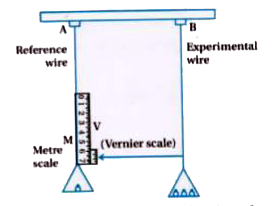
A typical experimental arrangment to determine Young.s modulus of a material of wire is shown as in figure.

It consists of two long straight wires of same length and equal radius suspended side by side from a fixed rigid support.
The wire A (reference wire) carries a millimeter main scale M and a pan to place a weight. The wire B (experimental wire) of uniform area of cross-section also carries a pan in which known weights can be placed
A vernier scale V is attached to a pointer at the bottom of the experimental wire B and the main scale M is fixed to the reference wire A. The weights placed in the pan exert a downward force and stretch the experimental wire under a tensile stress. The elongation of the wire is measured by the vernier arrangement.
The reference wire is used to compensate for any change in length that may occur due to change in room temperature, any change ir length of the reference wire will be accompanied by an equal change in experimental wire.
Both the reference and experimental wires are given an initial small load to keep the wires straight and the vernier reading is noted.
Now the experimental wire is gradually loaded with more weights to bring it under a tensile stress and the vernier reading is noted again.
The difference between two vernier readings gives the elongation produced in the wire.
Let r and L be the initial radius and length of the experimental wire respectively then the area of cross-section of wire would be `pir ^(2)` Let M be the mass that produced an elongation `DeltaL` in the wire, thus the applied force is equal to Mg where g is the acceleration due to gravity
The Young.s modulus of the material of wire,
`Y=(sigma )/(epsi ) = (F//A)/( Delta L//L) = (FL)/(ADelta L)`
`= (Mg)/(pi r ^(2)) = (L)/(Delta L)`
` Y = (MgL)/(pi r ^(2) Delta L)`
Y can be determined by putting each of known velues in above equation.
Promotional Banner

Topper's Solved these Questions

  • MACHANICAL PROPERTIES OF SOLIDS

    KUMAR PRAKASHAN|Exercise SECTION-A TRY YOURSELF (VSQs)|40 Videos
  • MACHANICAL PROPERTIES OF SOLIDS

    KUMAR PRAKASHAN|Exercise SECTION-B|45 Videos
  • LAW OF MOTION

    KUMAR PRAKASHAN|Exercise (QUESTION PAPER) SECTION-D|1 Videos
  • MECHANICAL PROPERTIES OF FLUIDS

    KUMAR PRAKASHAN|Exercise QUESTION PAPER (SECTION -C)|3 Videos

Similar Questions

Explore conceptually related problems

In an experiment for measurement of young's modulus, following readings are taken. Load = 3.00 kg, length = 2.820 m, diameter = 0.041 cm and extension = 0.87. We shell determine the percentage error in measurement of Y.

Explain sex-determination in human.

What is Young's modulus ? Explain.

A student performs an experiment to determine the Young's modulus of a wire, exactly 2m long, by Searle's method. In a particular reading, the student measures the extension in the length of the wire to be 0.8mm with an uncertainty of +- 0.05mm at a load of exactly 1.0kg , the student also measures the diameter of the wire to be 04mm with an uncertainty of +-0.01mm . Take g=9.8m//s^(2) (exact). the Young's modulus obtained from the reading is

A thin 1m long rod has a radius of 5mm . A force of 50pi KN is applied at one end to determine its Young's modulus Assume that the force is exactly known. If the least count in the measurement of all lengths is 0.01mm which of the following statements is false ?

Explain how Corpuscular theory predicts the speed of light in a medium, say, water, to be greater than the speed of light in vacuum. Is the prediction confirmed by experimental determination of the speed of light in water? If not, which alternative picture of light is consistent with experiment?

Explain sex determination in Grasshopper .

In an imeganary experiment, the Young's modulus Y of a material is given by Y=( tau cos thetaT^(x))/(l^(3)) where tau is the torque, theta is the angle of twist, T is the time perod and l is the length of the wire. What is the value of x ?

If the velocity (V) , acceleration (A) , and force (F) are taken as fundamental quantities instead of mass (M) , length (L) , and time (T) , the dimensions of young's modulus (Y) would be

