Home
Class 11
PHYSICS
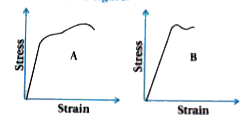
The stress-strain graphs for materials A...

The stress-strain graphs for materials A and B
The graphs are drawn to the same scale.
(a) Which of the materials has the greater Young's modulus ?
(b) Which of the two is the stronger material ?

Text Solution

Verified by Experts

It is clear from both the grpah that for material A.
Slope of graph`= (("Stress")/("Strain"))` is greater.
Hence Young modulus `(("Stress")/("Strain"))` of material A is more.
(b) The amount of stress required for fracting a material, corresponding to its fracture point gives the strength of material. Material A can withstand more strain than material B. Hence, material A is stronger than material B.
Promotional Banner

Topper's Solved these Questions

  • MACHANICAL PROPERTIES OF SOLIDS

    KUMAR PRAKASHAN|Exercise SECTION-C|66 Videos
  • MACHANICAL PROPERTIES OF SOLIDS

    KUMAR PRAKASHAN|Exercise SECTION-D|29 Videos
  • MACHANICAL PROPERTIES OF SOLIDS

    KUMAR PRAKASHAN|Exercise SECTION-A TRY YOURSELF (VSQs)|40 Videos
  • LAW OF MOTION

    KUMAR PRAKASHAN|Exercise (QUESTION PAPER) SECTION-D|1 Videos
  • MECHANICAL PROPERTIES OF FLUIDS

    KUMAR PRAKASHAN|Exercise QUESTION PAPER (SECTION -C)|3 Videos

Similar Questions

Explore conceptually related problems

The stress-strain graphs for two materials are shown in figure. (Assume same scale).

Figure shows the strain-stress curve for a given material. What are (a) Young's modulus and (b) approximate yield strength for this material ?

The following four wires are made of the same material which of these will have the largest extension when the same tension is applied

In the figure shown the straing versus stress graph for two values of young's modulus ? (i) which material is more ductile ? Explain. (ii) Which material is more brittle ? Explain. (iii) Which material is stronger ? Explain.

Figure shows the relationship between tensile stress and strain for a typical material. Below proportional point A, stress is directly proportional to strain which means Young's moudulus (Y) is a constant. In this region the material obeys Hooke's law. Provided the strain is below the yield point 'B' the material returns to its original shape and size when the force is removed. Beyond the yield point, the material retains a permancnt deformation after the stress is removed. For stresses beyond the yeld point, the material exhibit plastic flow, which means that it continues to elongate for little increases in the stress. Beyond C a local constriction occurs. The material fractures at D (i.e. breaking point). The graph below shows the stress-strain curve for 4 different materials. If you bough a new shoe which bites in the beginning and later on fits perfectly, then the material used to making the shoe is

Figure shows the relationship between tensile stress and strain for a typical material. Below proportional point A, stress is directly proportional to strain which means Young's moudulus (Y) is a constant. In this region the material obeys Hooke's law. Provided the strain is below the yield point 'B' the material returns to its original shape and size when the force is removed. Beyond the yield point, the material retains a permancnt deformation after the stress is removed. For stresses beyond the yeld point, the material exhibit plastic flow, which means that it continues to elongate for little increases in the stress. Beyond C a local constriction occurs. The material fractures at D (i.e. breaking point). The graph below shows the stress-strain curve for 4 different materials. Material which is good for making wires by stretching is

Figure shows the relationship between tensile stress and strain for a typical material. Below proportional point A, stress is directly proportional to strain which means Young's moudulus (Y) is a constant. In this region the material obeys Hooke's law. Provided the strain is below the yield point 'B' the material returns to its original shape and size when the force is removed. Beyond the yield point, the material retains a permanent deformation after the stress is removed. For stresses beyond the yeld point, the material exhibit plastic flow, which means that it continues to elongate for little increases in the stress. Beyond C a local constriction occurs. The material fractures at D (i.e. breaking point). The graph below shows the stress-strain curve for 4 different materials. Material which is most brittle is

Which of the follOwing materials has more number of free electrons in a given volume?

Two different types of rubber are found to have the stress-strain curves shown in fig. (a) In which significant ways do these curves differ form the stress-strain curve of a metal wire. (b) A heavy machine is to be installed in a factory. To absorb vibrations of the machine, a block of rubber is placed between the machinery and the floor. which of the two rubbers A and B would you perfer to use for this purpose? why? (c) Which of the two rubber materials would you choose for a car tyre ?

A pendulum made of a uniform wire of cross sectional area A has time period T. When an additional mass M is added to its bob, the time period changes to T_(M). If the Young's modulus of the material of the wire is Y then 1/Y is equal to: (g = gravitational acceleration)

KUMAR PRAKASHAN-MACHANICAL PROPERTIES OF SOLIDS -SECTION-B
  1. A steel wire of length 4.7 m and cross-sectional area 3.0 xx 10 ^(-5) ...

    Text Solution

    |

  2. Figure shows the strain-stress curve for a given material. What are (a...

    Text Solution

    |

  3. The stress-strain graphs for materials A and B The graphs are drawn...

    Text Solution

    |

  4. Read the following two statements below carefully and state, with reas...

    Text Solution

    |

  5. Two wires of diameter 0.25 cm, one made of steel and the other made of...

    Text Solution

    |

  6. The edge of an aluminium cube is 10 cm long. One face of the cube is f...

    Text Solution

    |

  7. Four identical hollow cylindrical columns of mild steel support a big ...

    Text Solution

    |

  8. A piece of copper having a rectangular cross section of 15.2 mm x 19.1...

    Text Solution

    |

  9. A steel cable with a radius of 1.5 cm supports a chairlift at a ski ar...

    Text Solution

    |

  10. A rigid bar of mass 15 kg is supported symmetrically by three wires ea...

    Text Solution

    |

  11. A 14.5 kg mass, fastened to the end of a steel wire of unstretched len...

    Text Solution

    |

  12. Compute the bulk modulus of water from the following data: Initial vol...

    Text Solution

    |

  13. What is the density of water at a depth where pressure is 80.0 atm, gi...

    Text Solution

    |

  14. Compute the fractional change in volume of a glass slab, when subjecte...

    Text Solution

    |

  15. Determine the volume contraction of a solid copper cube, 10 cm on an e...

    Text Solution

    |

  16. How much should the pressure on a litre of water be changed to compres...

    Text Solution

    |

  17. Anvils made of single crystals of diamond, with the shape as shown in ...

    Text Solution

    |

  18. A rod of length 1.05 m having negligible mass is supported at its ends...

    Text Solution

    |

  19. A mild steel wire of length 1.0 m and cross sectional area 0.50 xx 10 ...

    Text Solution

    |

  20. Two strips of metal are riveted together at their ends by four rivets,...

    Text Solution

    |
