Home
Class 11
PHYSICS
A rod of length 1.05 m having negligible...

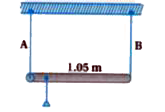
A rod of length 1.05 m having negligible mass is supported at its ends by two wires of steel (wire A) and aluminium (wire B) of equal lengths as shown in figure. The cross-sectional areas of wires A and B are 1.0 `mm^(2)` and 2.0 `mm^(2),` respectively. At what point along the rod should a mass m be suspended in order to produce (a) equal stresses and (b) equal strains in both steel and aluminium wires.

Text Solution

Verified by Experts
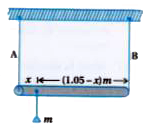
Let system 1 for streel and 2 for aluminium,
Length of steel wire `A, l _(1) = l`
Area of cross section of steel wire `A _(1) = 1 mm ^(2)`
Young.s modulus of steel wire `Y_(1) = 2 xx 10 ^(11) Nm ^(-2)`

Length of aluminium `l _(2) =l`
Area of cross-section
`A _(2) =2mm ^(2)`
Young.s modulus `Y_(2) = 7 xx 10 ^(10) Nm ^(-2)`
(a) Let mass m be suspended from the rod at distance x from the end.
Let `F_(1) and F_(2)` be the tension in two wires and there is equal stress in two wires then,
`therefore (F _(1))/(A _(1)) = (F_(2))/(A _(2))`
`therefore (F _(1))/(F_(2)) = (A_(1))/(A_(2))`
`therefore (F _(1))/(F_(2)) = 1/2 " "...(1)`
Taking moment of forces about the point of suspension of mass from the rod.
`F_(1) x =F_(2) (1.05 -x)`
`therefore (F_(1))/(F _(2))= (1.05 -x)/(x)`
`therefore 1/2 = (1.05 -x)/(x) " "[because` From equation (1)]
`therefore x =2.1 -2x`
`therefore 3x =2.1`
`therefore x =0.7 m or x = 70 cm`
(b) Let mass m be suspended from the rod at distance x from the end. There is equal strain in two wires,
`Y = (F //A)/( epsi _(l ))` where `epsi _(l) =` longitudinal strain
`therefore epsi _(l) = (F)/(AY)`
`therefore` For steel wire `: (epsi _(l)) _(1) = (F_(1))/( A _(1) Y_(1))`
For aluminium wire `: (epsi _(l)) _(1) = (F_(1))/( A _(1) Y_(1))`
For aluminium wire `: (epsi _(l)) _(2) = (F_(2))/(A_(2) Y_(2))`
but `(epsi l ) _(1) = (epsi _(l)) _(2)`
`therefore (F._(1))/(A _(1) Y _(1)) =(F._(2))/(A _(2) Y_(2))`
`therefore (F ._(1))/(F ._(2)) = (A_(1)Y _(1))/( A _(2) Y _(2))`
`= 1/2 xx (2 xx 10 ^(11))/( 7 xx 10 ^(10))`
`(F._(1))/(F ._(2)) = (10)/(7)" "...(2)`
Taking moment of force about the point of suspension of mass from the rod,
`F._(1) x = F ._(2) (1.05 -x)`
`therefore (F._(1))/(F._(2)) = (1.05 -x)/(x)`
`(10)/(7) = (1.05 -x)/(x) " "[because `From equation (2)]
`therefore 10 x =7.35 -7x`
`therefore 17 x -7.35`
`therefore x = (7.35)/(17) =0.43235 m or ~~43.2 cm`
Promotional Banner

Topper's Solved these Questions

  • MACHANICAL PROPERTIES OF SOLIDS

    KUMAR PRAKASHAN|Exercise SECTION-C|66 Videos
  • MACHANICAL PROPERTIES OF SOLIDS

    KUMAR PRAKASHAN|Exercise SECTION-D|29 Videos
  • MACHANICAL PROPERTIES OF SOLIDS

    KUMAR PRAKASHAN|Exercise SECTION-A TRY YOURSELF (VSQs)|40 Videos
  • LAW OF MOTION

    KUMAR PRAKASHAN|Exercise (QUESTION PAPER) SECTION-D|1 Videos
  • MECHANICAL PROPERTIES OF FLUIDS

    KUMAR PRAKASHAN|Exercise QUESTION PAPER (SECTION -C)|3 Videos

Similar Questions

Explore conceptually related problems

A rod of length 1 and negligible mass is suspended at its two ends by two wires of steel (wire A) and aluminium (wire B) of equal lengths as shown in figure. The cross-sectional areas of wires A and B are 1.0 mm^(2) and 2.0 mm^(2) respectively. Y_("steel”) = 200 xx 10 ^(9) Nm ^(-2) and Y_("auminium”) = 70 xx 10 ^(9) Nm ^(-2)

A light rod AC of length 2.00 m is suspended from the ceiling horizontally by means of two vertical wires of equal length tied to its ends. One of the wires is made of steel and is of cross-section 10^(-3) m^(2) and the other is of brass of cross-section 2xx10^(-3) m^(2) . The position of point D from end A along the rod at which a weight may be hung to produce equal stress and strain in both the wires is [Young's modulus of steel is 2xx10^(11) Nm^(2) and for brass is 1xx10^(11) Nm^(-2) ]

A 14.5 kg mass, fastened to the end of a steel wire of unstretched 1.0 m, is whirled in a vertical circle with an angular velocity of 2 rev/s at the bottom of the circle. The cross- sectional area of the wire is 0.065" cm"^(2) . Calculate the elongation of the wire when the mass is at the lowest point of its path.

If specific resistance of a potentiometer wire is 10^(–7 ) Omega m , the current flow through it is 0.1 A and the cross-sectional area of wire is 10^(–6) m^(2) then potential gradient will be

Two wires of diameter 0.25 cm, one made of steel and the other made of brass are loaded as shown in figure. The unloaded length of steel wire is 1.5 m and that of brass wire is 1.0 m. Compute the elongations of the steel and the brass wires.

A thin wire of length l and mass m is bent in the form of a semicircle as shown in the figure. Its moment of inertia about an axis joining its free ends will be

Young's modulus of brass and steel are 10 xx 10^(10) N//m^(2) and 2 xx 10^(11) N//m^(2) , respectively. A brass wire and a steel wire of the same length are extended by 1 mm under the same force. The radii of the brass and steel wires are R_(B) and R_(S) respectively. Then

As shown in figure, masses of 2 kg and 4kg are tied to two ends of a wire passed over a pulley. Cross-sectional area of wire is 2 cm^(2). Calculate longitudinal strain produced in wire. (g = 10 ms ^(-2) Y= 2 xx 10 ^(11) Pa

A steel wire of 4.0 m in length is stretched through 2.00 mm. The cross-sectional area of the wire is 2.0mm^(2) if young's modulus of steel is 2.0xx10^(11)N//m^(2) find (i) the energy density of wire (ii) the elastic potential energy stored in the wire.

Length and cross sectional area of a wire are 5 m and 2.5 mm^(2). Calculate work required to be done to increase its length by 1 mm. Young's modulus of material of wire =2 xx 10 ^(11) Nm ^(-2)

KUMAR PRAKASHAN-MACHANICAL PROPERTIES OF SOLIDS -SECTION-B
  1. What is the density of water at a depth where pressure is 80.0 atm, gi...

    Text Solution

    |

  2. Compute the fractional change in volume of a glass slab, when subjecte...

    Text Solution

    |

  3. Determine the volume contraction of a solid copper cube, 10 cm on an e...

    Text Solution

    |

  4. How much should the pressure on a litre of water be changed to compres...

    Text Solution

    |

  5. Anvils made of single crystals of diamond, with the shape as shown in ...

    Text Solution

    |

  6. A rod of length 1.05 m having negligible mass is supported at its ends...

    Text Solution

    |

  7. A mild steel wire of length 1.0 m and cross sectional area 0.50 xx 10 ...

    Text Solution

    |

  8. Two strips of metal are riveted together at their ends by four rivets,...

    Text Solution

    |

  9. The Marina trench is located in the Pacific Ocean, and at one place it...

    Text Solution

    |

  10. A steel wire of length 5 m and diameter 10^(-3) m is hanged vertically...

    Text Solution

    |

  11. A mass of 15 kg is tied at the end of a steel wire of the length lm. I...

    Text Solution

    |

  12. As shown in figure 10 N force is applied at two ends of a rod. Calcula...

    Text Solution

    |

  13. Length and cross sectional area of a wire are 5 m and 2.5 mm^(2). Calc...

    Text Solution

    |

  14. Figure shows a composite rod of cross-sectional area 10^(-4) m^(2) mad...

    Text Solution

    |

  15. A wire of length L and cross section area A is kept on a horizontal su...

    Text Solution

    |

  16. As shown in figure, masses of 2 kg and 4kg are tied to two ends of a w...

    Text Solution

    |

  17. A steel wire of cross section 1 mm2 is heated at 60^(@) C and tied bet...

    Text Solution

    |

  18. Figure shows a wire of length 2L and crosssectional area A, stretched ...

    Text Solution

    |

  19. An object of mass 5 kg is suspended by a copper wire of length 2 m and...

    Text Solution

    |

  20. Derive an expression for elastic potential energy per unit volume stor...

    Text Solution

    |

