Home
Class 11
PHYSICS
A rod of length 1 and negligible mass is...

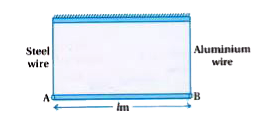
A rod of length 1 and negligible mass is suspended at its two ends by two wires of steel (wire A) and aluminium (wire B) of equal lengths as shown in figure. The cross-sectional areas of wires A and B are `1.0 mm^(2) and 2.0 mm^(2)` respectively. `Y_("steel”) = 200 xx 10 ^(9) Nm ^(-2) and Y_("auminium”) = 70 xx 10 ^(9) Nm ^(-2)`

A

Mass m should be suspended close to wire A to have equal stresses in both the wires.

B

Mass m should be suspended close to B to have equal stresses in both the wires.

C

Mass m should be suspended at the middle of the wires to have equal stresses in both the wires.

D

Mass m should be suspended close to wire A to have equal strain in both wires.

Text Solution

Verified by Experts

The correct Answer is:
B, D

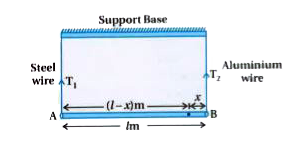
Suppose, mass m hangs at distance x from wire B.

Let 1 is for steel wire and 2 is for aluminium wire. `T_(1) and T_(2)` are the tension in steel and aluminium wire respectively and `S_(1) and S_(2)` are stress and `in _(1) and in _(2)`are strain `a_(1) and a_(2)` are cross sectional areas.
For balance of wire.
`sum T = 0`
`therefore T_(2) x - T_(1) (l -x) =0`
`therefore T _(2) x = T (l -x)`
`therefore (T_(2))/( T _(1)) = (l-x)/( x) " "...(1)`
Stress:
For steel wire `S _(1) = (T_(1))/(a_(1)) " "...(2)`
For aluminium wire `S_(2) = (T_(2))/( a _(2)) " "...(3)`
If stress is equal,
`S_(1) = S_(2)`
`therefore (T_(1))/( a _(1)) = (T_(2))/(a_(2))`
`therefore (T_(1))/( T _(2)) = (a_(1))/( a _(2)) = (1.0)/( 2.0 ) = 1/2 `
`therefore (x)/( l -x) = 1/2 [ because ` From eq. (1)]
`therefore 2x =l -x`
`therefore 3x =l`
`therefore x = l /3` is the distance from end B
and `l-x =l - l/3 = (2l)/(3)` is the distance from end A.
`therefore (l)/(3) lt (2l)/(3)` hence option (B) is correct.
Now, if strain are same,
`Y_(1) = (S_(1))/( in _(1)) .and Y_(2) = (S_(2))/( in _(2))`
but ` in _(1) = in _(2)`
`therefore ( Y_(1))/( Y _(2)) = (S_(1))/( S _(2)) `
`therefore (200 xx 10 ^(9))/( 70 xx 10 ^(9)) = (T_(1))/( a _(1)) xx (a _(2))/( T_(2))`
[`because` From equation (2) and (3)]
`therefore (20)/(7) =(T_(1))/( T _(2)) xx (a _(2))/( a _(1))`
`therefore (20 )/(7) = (x)/(l -x) xx (2.0)/(10) [because ` From eq. (1)]
`therefore ( 10 )/(7) = (x)/( l -x)`
`therefore 10 l -10 x = 7x`
`therefore 10l = 17x`
`therefore x = (10 l )/(17)` is the distance from end B
`and l - x =l - (10l)/(17) = (7l)/(17)` is distance from end A.
`therefore ( 7l)/(17) lt (10 l)/( 17)` hence option (D) is correct.
Promotional Banner

Topper's Solved these Questions

  • MACHANICAL PROPERTIES OF SOLIDS

    KUMAR PRAKASHAN|Exercise SECTION-E|28 Videos
  • MACHANICAL PROPERTIES OF SOLIDS

    KUMAR PRAKASHAN|Exercise SECTION-F|11 Videos
  • MACHANICAL PROPERTIES OF SOLIDS

    KUMAR PRAKASHAN|Exercise SECTION-C|66 Videos
  • LAW OF MOTION

    KUMAR PRAKASHAN|Exercise (QUESTION PAPER) SECTION-D|1 Videos
  • MECHANICAL PROPERTIES OF FLUIDS

    KUMAR PRAKASHAN|Exercise QUESTION PAPER (SECTION -C)|3 Videos

Similar Questions

Explore conceptually related problems

A rod of length 1.05 m having negligible mass is supported at its ends by two wires of steel (wire A) and aluminium (wire B) of equal lengths as shown in figure. The cross-sectional areas of wires A and B are 1.0 mm^(2) and 2.0 mm^(2), respectively. At what point along the rod should a mass m be suspended in order to produce (a) equal stresses and (b) equal strains in both steel and aluminium wires.

A mass of 15 kg is tied at the end of a steel wire of the length lm. It is whirled in a vertical plane with angular velocity 1 rad/s. Cross sectional area of the wire is 0.06 cm^(2). Calculate the elongation of the wire when the mass is at its lowest position. Y_("steel”) = 2 xx 10 ^(11) Nm ^(-2)

Length and cross sectional area of a wire are 5 m and 2.5 mm^(2). Calculate work required to be done to increase its length by 1 mm. Young's modulus of material of wire =2 xx 10 ^(11) Nm ^(-2)

A steel rod of cross-sectional area 16 cm^(2) and two brass rods each of cross-sectional area 10 cm^(2) together support a load of 5000 kg as shown in the figure. ( Given, Y_(steel) = 2xx10^(6) kg cm^(-2) and Y_(brass) = 10 ^(6) kg cm^(-2)) . Choose the correct option(s).

If specific resistance of a potentiometer wire is 10^(–7 ) Omega m , the current flow through it is 0.1 A and the cross-sectional area of wire is 10^(–6) m^(2) then potential gradient will be

The resistance of 300 m long wire with cross-sectional area 10^(-6)m^2 and resistivity 10^(-7) Omegam is …………… .

Work done in stretching a wire of length 1 m and of cross-sectional area 1 mm^(2) through 2 mm if Young's modulus of the material of the wire is 2 xx 10 ^(11) N//m^(2) is .......

A steel wire of 4.0 m in length is stretched through 2.00 mm. The cross-sectional area of the wire is 2.0mm^(2) if young's modulus of steel is 2.0xx10^(11)N//m^(2) find (i) the energy density of wire (ii) the elastic potential energy stored in the wire.

The graph shows the extension of a wire of length 1m suspended from the top of a roof at one end and with a load W connected to the other end. If the cross sectional area of the wire is 1mm^(2) , then the young's modulus of the material of the wire is (a). 2xx10^(11)Nm^(-2) (b). 2xx10^(10)Nm^(-2) (c). (1)/(2)xx10^(11)Nm^(-2) (d). none of these

A fine steel wire of length 4 m is fixed rigidly in a heavy brass frame as ashown in figure . It is just taut at 20^(@)C . The tensile stress developed in steel wire it whole system is heated to 120^(@)C is :- ( Given alpha _("brass") = 1.8 xx 10^(-5) .^(@)C^(-1), alpha_("steel") = 1.2 xx 10^(-5) .^(@)C, Y_("steel") = 2 xx 10^(11) Nm^(-2), Y_("brass")= 1.7xx10^(7) Nm^(-2) )

KUMAR PRAKASHAN-MACHANICAL PROPERTIES OF SOLIDS -SECTION-D
  1. The stress-strain graphs for two materials are shown in figure. (Assum...

    Text Solution

    |

  2. A wire is suspended from the ceiling and stretched under the action of...

    Text Solution

    |

  3. A rod of length 1 and negligible mass is suspended at its two ends by ...

    Text Solution

    |

  4. For an ideal liquid

    Text Solution

    |

  5. A copper and a steel wire of the same diameter are connected end to en...

    Text Solution

    |

  6. The Young's modulus for steel is much more than that for rubber. For t...

    Text Solution

    |

  7. The Young's modulus for steel is much more than that for rubber. For t...

    Text Solution

    |

  8. Identical springs of steel and copper are equally stretched. On which ...

    Text Solution

    |

  9. What is the Young's modulus for a perfect rigid body?

    Text Solution

    |

  10. What is the bulk modulus of a perfectly rigid body?

    Text Solution

    |

  11. A wire of length L and radius r is clamped rigidly at one end. When th...

    Text Solution

    |

  12. A steel rod of length 1 m and area of cross section 1 cm^(2) is heated...

    Text Solution

    |

  13. To what depth must a rubber ball be taken in deep sea so that its volu...

    Text Solution

    |

  14. A truck is pulling a car out of a ditch by means of a steel cable that...

    Text Solution

    |

  15. Two identical solid balls, one of ivory and the other of wet-clay are ...

    Text Solution

    |

  16. Consider a long steel bar under a tensile stress due to force F acting...

    Text Solution

    |

  17. (a) A steel wire of mass u per unit length with a circular cross secti...

    Text Solution

    |

  18. A steel uniform rod of length 2L cross sectional area A and mass Mis s...

    Text Solution

    |

  19. An equilateral triangle ABC is formed by two copper rods AB and BC and...

    Text Solution

    |

  20. In nature the failure of structural members usually result from large ...

    Text Solution

    |

