Home
Class 11
PHYSICS
3hati and 5hatj are vector along x-axi...

`3hati and 5hatj` are vector along x-axis and y-axis respectively. Find the resultant vector

Text Solution

Verified by Experts
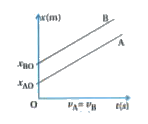
Consider two particles A and B moving along the X-axis with uniform velocity `v_(A) and v _(B).`
Let `x_(OA) and x_(OB)` be their displacemetn from the origin O at `t=0.`
If `x_(A) and x_(B)` arfe tieir position co-ordinates then at `t=t,`
`therefore x_(A) =x_(OA) +v_(A)t`
`x_(B) =x_(OB) +v_(B)t`
At `t=t` the displacement of particle B with respect to particle A,
`x_(B) -x_(A) =(x_(OB) -x_(OA)) (v_(B)-v_(A))t`
where `x_(OB)-x_(OA)` =displacement of particle B with respect to particle A at t =0 and `v_(B) - v _(A)=v _(BA)` is the relative velocity of B with respect to particle A.

When `v _(A) = v_(B)` then from equation `x _(B) - x _(A) = x _(OB)- x _(OA)` this means that the distance between two particles will remain equal to initial distance at any instant of time.

If `v_(A) gt v _(B)` both teh particles will meet at time t at this instant their relative displacment will be` x_(B) - x_(A) =0.`These after particle A overtakes particle B at this time.
If `v_(B) gt v_(A)` then the relative displacment `x_(B) -x_(A)` of both the particles will increase with time. Therefore they will never meetn on their path.

If the velocities of two trains moving in mutually opposite directions are `v_(A) and v _(B)` respectively, then
`v _(AB) =- v_(BA)`
Let, train A is moving in positive direction and train B is moving in negative direction, then
`v _(A) =+ v _(A) and v _(B) =- v _(B)`
`v _(AB) = v _(A) -v_(B)` `= v _(A) - (-v_(B))`
`=v_(A) + v_(B)`
and `v_(BA) =v_(B) -v_(A)`
`=- v_(B) -v_(A)`
` =- (v_(A) + v _(B))`
Hence, the relative velocity is greater than individual velocities of the trains.
Promotional Banner

Topper's Solved these Questions

  • MOTION IN A STRAIGHT LINE

    KUMAR PRAKASHAN|Exercise SECTION-A TRY YOUR SELF (VSQs)|52 Videos
  • MOTION IN A STRAIGHT LINE

    KUMAR PRAKASHAN|Exercise SECTION-B|58 Videos
  • MECHANICAL PROPERTIES OF FLUIDS

    KUMAR PRAKASHAN|Exercise QUESTION PAPER (SECTION -C)|3 Videos
  • OBJECTIVE QUESTIONS AS PER NEW PAPER STYLE

    KUMAR PRAKASHAN|Exercise CHAPTER - 8 (Match Type questions)|5 Videos

Similar Questions

Explore conceptually related problems

hatiandhatj are unit vectors along x - and y- axis respectively . What is the magnitude and direction of the vectors hati+hatjandhati-hatj ? What are the components of a vector A=2hati+3hatj along the directions of hati+hatjand hati-hatj ? [ You may use graphical method]

A vector vec(A) and vec(B) make angles of 20^(@) and 110^(@) respectively with the X-axis. The magnitudes of these vectors are 5m and 12m respectively. Find their resultant vector.

If hati,hatj and hatk are unit vectors along X,Y & Z axis respectively, then tick the wrong statement:

If hati,hatj and hatk represent unit vectors along the x,y and z-axes respectively, then the angle theta between the vectors (hati+hatj+hatk) and (hati+hatj) is equal to :

A particle projected from origin moves in x-y plane with a velocity vecv=3hati+6xhatj , where hati" and "hatj are the unit vectors along x and y axis. Find the equation of path followed by the particle :-

A body constrained to move along the z-axis of a coordinate system is subject to a constant force F given by F= -hati+2hatj+3hatk N where hati, hatj, hatk are unit vectors along the x-, y- and z-axis of the system respectively. What is the work done by this force in moving the body a distance of 4m along the z-axis?

Dot product of a vector vec(a) with hati+hatj-3hatk,hati+3hatj-2hatk and 2hati+hatj+4hatk are 0, 5 and 8 respectively. Find the vector.

The unit vector along 2hati+3hatj is

Find out the angle made by (hati+hatj) vector from X and Y axes respectively.

