Home
Class 12
CHEMISTRY
Write a note on S(N)1 reaction....

Write a note on `S_(N)1` reaction.

Text Solution

Verified by Experts
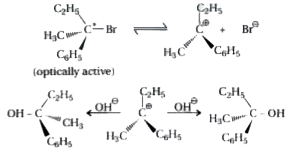
The reaction in which the rate is independent of concentration of nuclephile and depends only on the concentration of substrate is called `S_(N)1` reaction. Thus `S_(N)1` reaction follows first order kinetics.
`(CH_(3))_(3)C-Br+""^(-)OH to(CH_(3))_(3)C-OH+Br^(-)`
Rate `alpha[(CH_(3))_(3)C-Br]`
The `S_(N)1` reaction takes place in two steps :
Step - 1 : The polarised C - Br bond undergoes cleavage slowly to form a carbocation and a bromide ion. The carbocation thus formed is then attacked by nucleophile in step - II to complete the substitution reaction.
`CH_(3)-overset(CH_(3))overset("| ")underset(CH_(3))underset("| ")("C ")-Br overset(" Slow ")hArr CH_(3)-overset(CH_(3))overset("| ")underset(CH_(3))underset("| ")(C^(o+))+Br^(Θ)`
The step - 1 is the slow and reversible and thus it is a rate determining step. The energy required for breaking of C - Br bond is obtained through solvantion of halide ion with the proton of a protic solvent. The rate of reaction depends only on concentration of alkyl halide and not on the concentration of `""^(-)H` ion because slow step involves only the alkyl halide.
Step - 2 : The carbocation being planar is attacted from either side by nucleophile to form a final product. It is a fast step.
`CH_(3)-overset(CH_(3))overset("| ")underset(CH_(3))underset("| ")(C^(o+))+""^(ө)OH overset(" Fast ")rarr CH_(3)- overset(CH_(3))overset("| ")underset(CH_(3))underset("| ")("C ")-OH`
In case if the substrate is optically active, the `S_(N)1` reaction results in partial racemisation. Due to planar structure of carbocation, the nucleophile attacks from either side to give enantiomers. The attack from backside is more favourable and thus the enantiomers are not obtained in equal amount.

For the given alkyl group the reactivity of alkyl halides follow the order.
`R-I gt R-Br gt R-Cl gt R-F`
Promotional Banner

Topper's Solved these Questions

  • HALOALKANES AND HALOARENES

    KUMAR PRAKASHAN|Exercise SECTION - B INTEXT QUESTIONS AND ANSWERS|20 Videos
  • HALOALKANES AND HALOARENES

    KUMAR PRAKASHAN|Exercise SECTION - C TEXTUAL EXERCISE|87 Videos
  • HALOALKANES AND HALOARENES

    KUMAR PRAKASHAN|Exercise SECTION - E Multiple Choice Questions|260 Videos
  • GENERAL PRINCIPLES AND PROCESSES OF ISOLATION OF ELEMENTS

    KUMAR PRAKASHAN|Exercise SECTION - E (MCQs ASKED IN GUJET/BOARD EXAMS)|46 Videos
  • POLYMERS

    KUMAR PRAKASHAN|Exercise SECTION - E (MCQs asked in Board Exams)|51 Videos
KUMAR PRAKASHAN-HALOALKANES AND HALOARENES-SECTION - A QUESTIONS
  1. Write a note on S(N)2 mechanism.

    Text Solution

    |

  2. Explain the factors favouring S(N)2 reaction.

    Text Solution

    |

  3. Write a note on S(N)1 reaction.

    Text Solution

    |

  4. Explain the factors affecting S(N)1 reaction.

    Text Solution

    |

  5. Enlist the main points of difference between S(N)1 and S(N)2 reactions...

    Text Solution

    |

  6. What is retention and inversion of configuration ? Explain with suitab...

    Text Solution

    |

  7. Explain stereochemistry of S(N)1 reaction with suitable example.

    Text Solution

    |

  8. Explain stereochemistry of S(N)2 reaction with suitable example.

    Text Solution

    |

  9. Explain Elimination reactions of alkyl halides.

    Text Solution

    |

  10. Explain dehydrohalogenation (beta - elimination) of alkyl halides.

    Text Solution

    |

  11. Explain how sustitution and elimination reactions compete in the same ...

    Text Solution

    |

  12. Write a note on Grignard Reagent.

    Text Solution

    |

  13. Write a note on Wurtz Reaction.

    Text Solution

    |

  14. Explain why aryl halides are extermely less reactive towards nucleophi...

    Text Solution

    |

  15. Give the reaction of hydroxyl group with chlorobenzene.

    Text Solution

    |

  16. Explain why the electron withdrawing groups such as -NO(2) show its ef...

    Text Solution

    |

  17. Why aryl halides undergo electrophilic substitution reactions at o - a...

    Text Solution

    |

  18. Give following reaction of aryl halides : (i) Halogenation (ii...

    Text Solution

    |

  19. Give reactions of aryl halides with metals.

    Text Solution

    |

  20. State the various uses of : Dichloromethane (Methylene chloride)

    Text Solution

    |

