Home
Class 12
CHEMISTRY
Explain why aryl halides are extermely l...

Explain why aryl halides are extermely less reactive towards nucleophilic substitution reactions.

Text Solution

Verified by Experts
Aryl halides are extremely less reactive towards nucleophilic substitution reactions due to the following reasons :
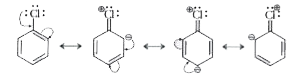
(i) Resonance effect : In haloarenes, the electron pairs on halogen atom are in conjugation with `pi` - electrons of the ring and the following resonating structures are possible.

The C - Cl bond acquires a partial double bond character due to resonance. As a result, the bond cleavage in haloarene is difficult than haloalkane and therefore, they are less reactive towards nucleophilic substitution reaction.
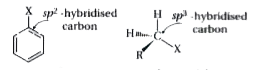
(ii) Difference in hybridisation of carbon atom in C - X bond : In haloalkane, the carbon atom attached to halogen is `sp^(3)` hybridised while in case of haloarene, the carbon atom attached to halogen is `sp^(2)` - hybridised.

The `sp^(2)` hybridised carbon with a greater s - character is more electronegative and can hold the electron pair of C - X bond more tightly than `sp^(3)` -hybridised carbon in haloalkane with less s - chararcter. Thus, C - Cl bond length in haloalkane is 177 pm while in haloarene is 169 pm. Since it is difficult to break a shorter bond than a longer bond, therefore, haloarenes are less reactive than haloalkanes towards nucleophilic substitution reaction.
(iii) Instability of phenyl cation : In case of haloarenes, the phenyl cation formed as a result of self - ionisation will not be stabilised by resonance and therefore, `S_(N)1` mechanism is ruled out.
(iv) Electronic Repulsions : It is less likely for the electron rich nuclephile to approach electron rich arenes.
Promotional Banner

Topper's Solved these Questions

  • HALOALKANES AND HALOARENES

    KUMAR PRAKASHAN|Exercise SECTION - B INTEXT QUESTIONS AND ANSWERS|20 Videos
  • HALOALKANES AND HALOARENES

    KUMAR PRAKASHAN|Exercise SECTION - C TEXTUAL EXERCISE|87 Videos
  • HALOALKANES AND HALOARENES

    KUMAR PRAKASHAN|Exercise SECTION - E Multiple Choice Questions|260 Videos
  • GENERAL PRINCIPLES AND PROCESSES OF ISOLATION OF ELEMENTS

    KUMAR PRAKASHAN|Exercise SECTION - E (MCQs ASKED IN GUJET/BOARD EXAMS)|46 Videos
  • POLYMERS

    KUMAR PRAKASHAN|Exercise SECTION - E (MCQs asked in Board Exams)|51 Videos

Similar Questions

Explore conceptually related problems

Aryl halides are less reactive towards nucleophilic substitution reaction as compared to alyl halides due to

Statement-I: Vinylic halides are reactive towards nucleophilic substitution reaction. Because Statement-II: Reactivity is due to the polarity of carbon-halogen bond.

KUMAR PRAKASHAN-HALOALKANES AND HALOARENES-SECTION - A QUESTIONS
  1. Explain stereochemistry of S(N)1 reaction with suitable example.

    Text Solution

    |

  2. Explain stereochemistry of S(N)2 reaction with suitable example.

    Text Solution

    |

  3. Explain Elimination reactions of alkyl halides.

    Text Solution

    |

  4. Explain dehydrohalogenation (beta - elimination) of alkyl halides.

    Text Solution

    |

  5. Explain how sustitution and elimination reactions compete in the same ...

    Text Solution

    |

  6. Write a note on Grignard Reagent.

    Text Solution

    |

  7. Write a note on Wurtz Reaction.

    Text Solution

    |

  8. Explain why aryl halides are extermely less reactive towards nucleophi...

    Text Solution

    |

  9. Give the reaction of hydroxyl group with chlorobenzene.

    Text Solution

    |

  10. Explain why the electron withdrawing groups such as -NO(2) show its ef...

    Text Solution

    |

  11. Why aryl halides undergo electrophilic substitution reactions at o - a...

    Text Solution

    |

  12. Give following reaction of aryl halides : (i) Halogenation (ii...

    Text Solution

    |

  13. Give reactions of aryl halides with metals.

    Text Solution

    |

  14. State the various uses of : Dichloromethane (Methylene chloride)

    Text Solution

    |

  15. State the various uses of : Trichloromethone (Chloroform)

    Text Solution

    |

  16. State the various uses of : Tri - iodomethane (Iodoform)

    Text Solution

    |

  17. State the various uses of : Tetrachloromethane (Carbon tetrachlorid...

    Text Solution

    |

  18. State the various uses of : Freons

    Text Solution

    |

  19. State the adverse effects of polyhalogenated compounds. How the advers...

    Text Solution

    |

  20. Write a note on DDT.

    Text Solution

    |