Home
Class 12
CHEMISTRY
Explain why the electron withdrawing gro...

Explain why the electron withdrawing groups such as `-NO_(2)` show its effect only at o - position and p - position and not at m - positions.

Text Solution

Verified by Experts
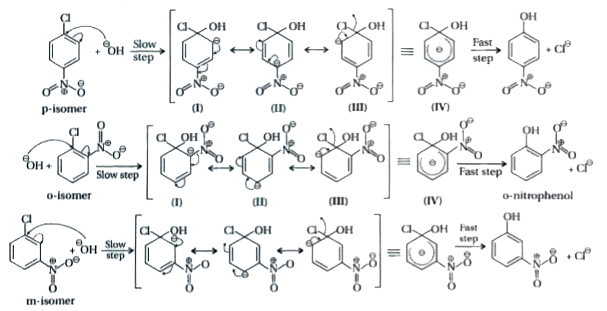

As shown in figure, the presence `- NO_(2)` electron withdrawing group at ortho - and para - positions withdraws the electron density from the benzene ring and thus facilitates the attack of the nucleophile on haloarene. The carbanion thus formed is stabilised through resonance.
At ortho - and para - positions with respect to the halogen substituent, the negative charge appeared is stabilised by `- NO_(2)`, whereas in case of meta - nitrobenzene, none of the resonating structures bear the negative charge on carbon bearing the `- NO_(2)` group. Therefore, the presence of nitro group at metaposition does not stabilise the negative charge and no effect on reactivity is observed by the presence of `-NO_(2)` group at meta - position.
Promotional Banner

Topper's Solved these Questions

  • HALOALKANES AND HALOARENES

    KUMAR PRAKASHAN|Exercise SECTION - B INTEXT QUESTIONS AND ANSWERS|20 Videos
  • HALOALKANES AND HALOARENES

    KUMAR PRAKASHAN|Exercise SECTION - C TEXTUAL EXERCISE|87 Videos
  • HALOALKANES AND HALOARENES

    KUMAR PRAKASHAN|Exercise SECTION - E Multiple Choice Questions|260 Videos
  • GENERAL PRINCIPLES AND PROCESSES OF ISOLATION OF ELEMENTS

    KUMAR PRAKASHAN|Exercise SECTION - E (MCQs ASKED IN GUJET/BOARD EXAMS)|46 Videos
  • POLYMERS

    KUMAR PRAKASHAN|Exercise SECTION - E (MCQs asked in Board Exams)|51 Videos

Similar Questions

Explore conceptually related problems

A bob of mass 0.1 kg hung from the ceiling of a room by a string 2 m long is set into oscillation. The speed of the bob at its mean position is 1 m s^(-1) . What is the trajectory of the bob if the string is cut when the bob is (a) at one of its extreme positions, (b) at its mean position.

Acceleration of a particle moving along the x-axis is defined by the law a=-4x , where a is in m//s^(2) and x is in meters. At the instant t=0 , the particle passes the origin with a velocity of 2 m//s moving in the positive x-direction. (a) Find its velocity v as function of its position coordinates. (b) find its position x as function of time t. (c) Find the maximum distance it can go away from the origin.

A simple harmonic oscillator of angular frequency 2 "rad" s^(-1) is acted upon by an external force F = sint N . If the oscillator is at rest in its equilibrium position at t = 0 , its position at later times is proportional to :-

A and B are two points. The position vector of A is 6b-2a. A point P divides the line AB in the ratio 1:2. if a-b is the position vector of P, then the position vector of B is given by

KUMAR PRAKASHAN-HALOALKANES AND HALOARENES-SECTION - A QUESTIONS
  1. Explain stereochemistry of S(N)1 reaction with suitable example.

    Text Solution

    |

  2. Explain stereochemistry of S(N)2 reaction with suitable example.

    Text Solution

    |

  3. Explain Elimination reactions of alkyl halides.

    Text Solution

    |

  4. Explain dehydrohalogenation (beta - elimination) of alkyl halides.

    Text Solution

    |

  5. Explain how sustitution and elimination reactions compete in the same ...

    Text Solution

    |

  6. Write a note on Grignard Reagent.

    Text Solution

    |

  7. Write a note on Wurtz Reaction.

    Text Solution

    |

  8. Explain why aryl halides are extermely less reactive towards nucleophi...

    Text Solution

    |

  9. Give the reaction of hydroxyl group with chlorobenzene.

    Text Solution

    |

  10. Explain why the electron withdrawing groups such as -NO(2) show its ef...

    Text Solution

    |

  11. Why aryl halides undergo electrophilic substitution reactions at o - a...

    Text Solution

    |

  12. Give following reaction of aryl halides : (i) Halogenation (ii...

    Text Solution

    |

  13. Give reactions of aryl halides with metals.

    Text Solution

    |

  14. State the various uses of : Dichloromethane (Methylene chloride)

    Text Solution

    |

  15. State the various uses of : Trichloromethone (Chloroform)

    Text Solution

    |

  16. State the various uses of : Tri - iodomethane (Iodoform)

    Text Solution

    |

  17. State the various uses of : Tetrachloromethane (Carbon tetrachlorid...

    Text Solution

    |

  18. State the various uses of : Freons

    Text Solution

    |

  19. State the adverse effects of polyhalogenated compounds. How the advers...

    Text Solution

    |

  20. Write a note on DDT.

    Text Solution

    |

