Home
Class 12
CHEMISTRY
Assertion (A) : It is difficult to repla...

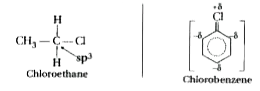
Assertion (A) : It is difficult to replace chlorine by - OH in chlorobenzene in comparison to that in chloroethane.
Reason (R ) : Chlorine - carbon (C - Cl) bond in chlorobenzene has a partial double bond character due to resonance.

A

Assertion and reason both are correct and reason is correct explanation of assertion.

B

Assertion and reason both are wrong statements.

C

Assertion is correct but reason is wrong statement.

D

Assertion is wrong but reason is correct statement.

Text Solution

Verified by Experts

The correct Answer is:
A

Promotional Banner

Topper's Solved these Questions

  • HALOALKANES AND HALOARENES

    KUMAR PRAKASHAN|Exercise SECTION - D NCERT EXEMPLAR SOLUTION (Long Answer Type Questions)|3 Videos
  • HALOALKANES AND HALOARENES

    KUMAR PRAKASHAN|Exercise SECTION - E Multiple Choice Questions|260 Videos
  • HALOALKANES AND HALOARENES

    KUMAR PRAKASHAN|Exercise SECTION - D NCERT EXEMPLAR SOLUTION (Matching The Columns)|6 Videos
  • GENERAL PRINCIPLES AND PROCESSES OF ISOLATION OF ELEMENTS

    KUMAR PRAKASHAN|Exercise SECTION - E (MCQs ASKED IN GUJET/BOARD EXAMS)|46 Videos
  • POLYMERS

    KUMAR PRAKASHAN|Exercise SECTION - E (MCQs asked in Board Exams)|51 Videos

Similar Questions

Explore conceptually related problems

Nucleophilic substitution reactions generally expressed as Nu^(-) +R-L rarr R-Nu +L^(-) Where Nu^(-) rarr Nucleophile , R-L rarr substrate, L rarr leaving group The best leaving groups are those that become the most stable ions after they depart. since most leaving group leave as a negative ion, the best leaving groups are those ions that stabilize a negative charge most effectively. A good leaving group should be (a) electron-withdrawing to polarize the carbon (b) stable once it has left (not a strong base) (c) polarise able to maintain partial bonding with the carbon in the transition state (both S_(N)1 and S_(N)2) . This bonding helps to stabilise the transition state and reduces the activation energy. Among the following which is false statement?

Nucleophilic substitution reactions generally expressed as Nu^(-) +R-L rarr R-Nu +L^(-) Where Nu^(-) rarr Nucleophile , R-L rarr substrate, L rarr leaving group The best leaving groups are those that become the most stable ions after they depart. since most leaving group leave as a negative ion, the best leaving groups are those ions that stabilize a negative charge most effectively. A good leaving group should be (a) electron-withdrawing to polarize the carbon (b) stable once it has left (not a strong base) (c) polarise able to maintain partial bonding with the carbon in the transition state (both S_(N)1 and S_(N)2) . This bonding helps to stabilise the transition state and reduces the activation energy. Among the following which is feasible?

Nucleophilic substitution reactions generally expressed as Nu^(-) +R-L rarr R-Nu +L^(-) Where Nu^(-) rarr Nucleophile , R-L rarr substrate, L rarr leaving group The best leaving groups are those that become the most stable ions after they depart. since most leaving group leave as a negatibe ion, the best leaving groups are those ions that stabilize a negative charge most effectively. A good leaving group should be (a) electron-withdrawing to polarize the carbon (b) stable once it has left (not a strong base) (c) polarise able to maintain partial bonding with the carbon in the transition state (both S_(N)1 and S_(N)2) . This bonding helps to stabilise the transition state and reduces the activation energy. (I) CI^(-) (II) CH_(3)O^(-) (III) CH_(3)S^(-) (IV) I^(-) The correct order of increasing leaving group capability of above anions

