

Home
Class 11
PHYSICS
A boy throws a ball with velocity v(0) =...

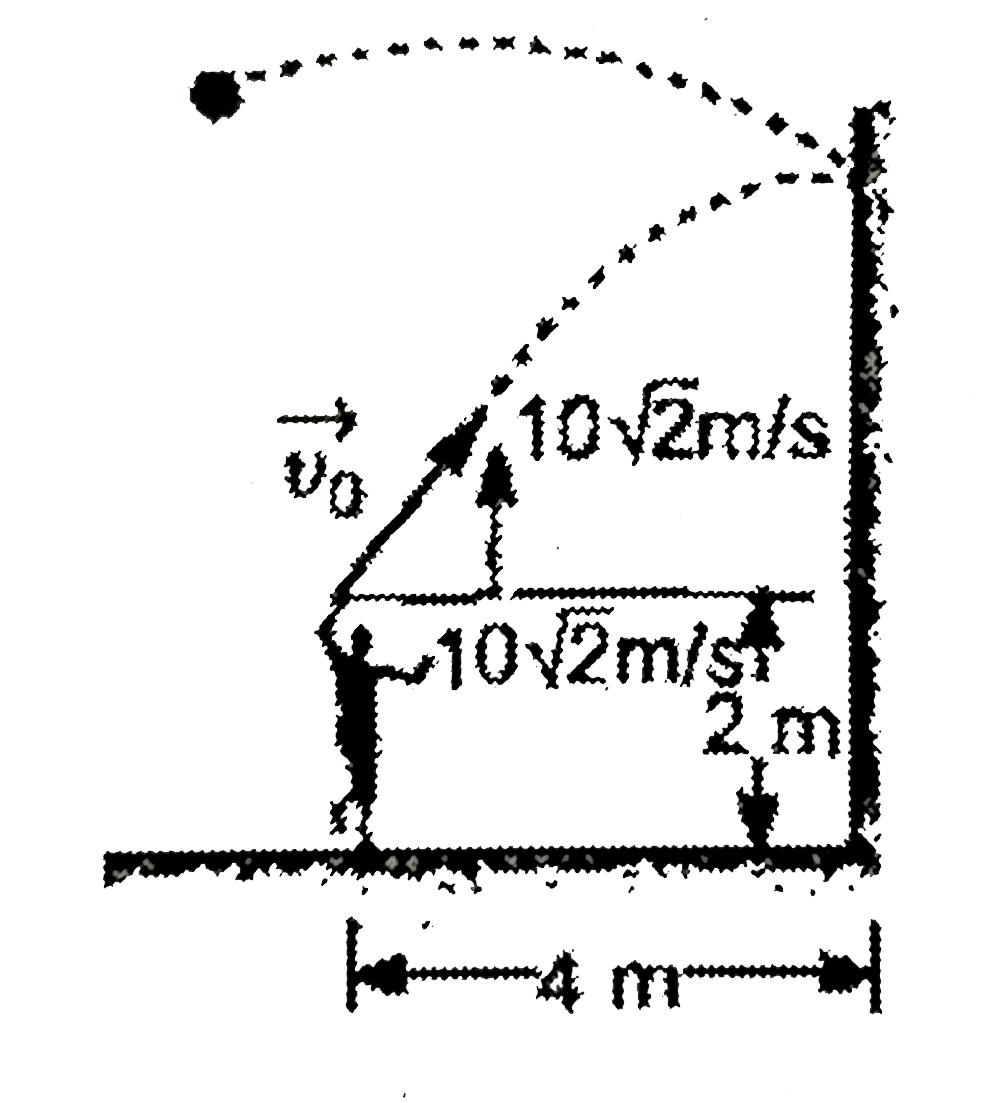
A boy throws a ball with velocity `v_(0) =10sqrt2 m//s` at an angle of `45^(@)` as shown in the figure .After collision with the ball the vertical component of ball's velocity is unchanged and the horizontal. Component is reversed in direction .Where does the ball hit the ground?

Promotional Banner

Similar Questions

Explore conceptually related problems

A boy throws a ball with a velocity of 15 m/s at an angle of 15° with the horizontal. The distance at which the ball strikes the ground is

A boy throws a ball with a velocity of 15 m/s at an angle of 15° with the horizontal. The distance at which the ball strikes the ground is

A boy throws a cricket ball with a velocity u at an angle theta with the horizontal.Name the path followed by the ball.

A volleyball is spiked so that it has an initial velocity of 15 m/s directed downward at an angle of 55^(@) below the horizontal. What is the horizontal component of the ball's velocity when the opposing player fields the ball?

A boy throws a ball at an angle theta with the vertical. If the vertical component of the initial velocity is 20ms^(-1) and the wind imparts a horizontal acceleration of 8ms^(-2) to the left, the angle at which the ball must be thrown so that the ball returns to the boy's hand is theta . What is the value of 10(tan theta)

A boy throws a ball at an angle theta with the vertical. If the vertical component of the initial velocity is 20ms^(-1) and the wind imparts a horizontal acceleration of 8ms^(-2) to the left, the angle at which the ball must be thrown so that the ball returns to the boy's hand is theta . What is the value of 10(tan theta)

A ball of mass m moving with velocity v_(0) collides with a wall as shown in Fig. After impact it rebounds with a velocity' (v_(0))//2 The component of impulse acting on the ball along the wall is

A ball of mass m moving with velocity v_(0) collides with a wall as shown in Fig. After impact it rebounds with a velocity' (v_(0))//2 The component of impulse acting on the ball along the wall is

Velocity of the ball A after collision with the ball B as shown in the figure is (Assume perfectly inelastic and head - on collision)