

Home
Class 11
PHYSICS
A block is tied within two spring, each ...

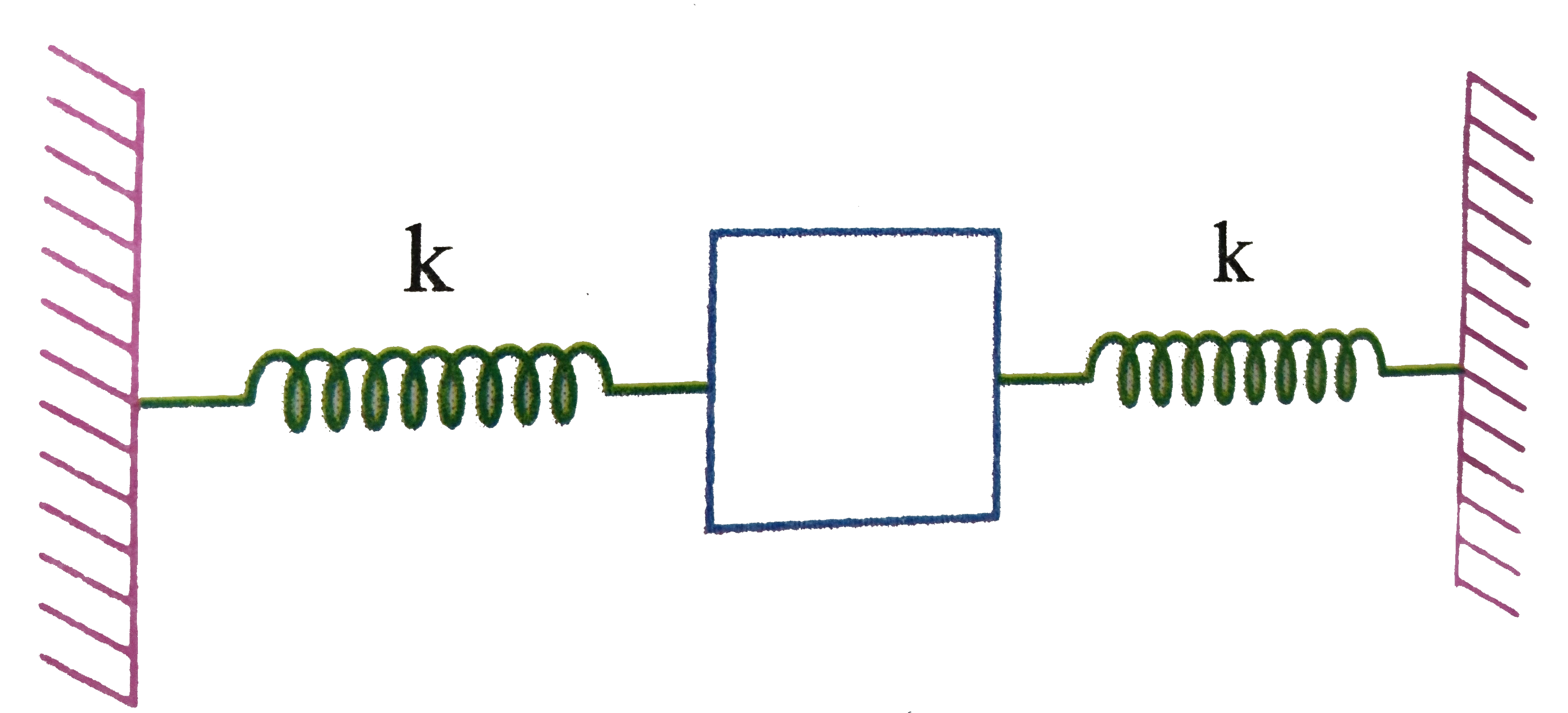
A block is tied within two spring, each having spring constant equal to `k`. Initially the springs are in their natural length and horizontal as shown. The block is released from rest. The springs are ideal, acceleration due to gravity is `g` downwards. Air resistance is to be neglect. The natural length of spring is `l_(0)`.

If the block is under equilibrium and the angle made by the spring with horizontal is `60^(@)` then the mass of the block is:

Promotional Banner

Similar Questions

Explore conceptually related problems

A block is tied within two spring, each having spring constant equal to k . Initially the springs are in their natural length and horizontal as shown. The block is released from rest. The springs are ideal, acceleration due to gravity is g downwards. Air resistance is to be neglect. The natural length of spring is l_(0) . If the decrease in height of the block till it reaches equilibrium is sqrt(3l_(0)) then the mass of the block is:

A block is tied within two spring, each having spring constant equal to k . Initially the springs are in their natural length and horizontal as shown. The block is released from rest. The springs are ideal, acceleration due to gravity is g downwards. Air resistance is to be neglect. The natural length of spring is l_(0) . If the decrease in height of the block till its speed becomes zero is sqrt(8l_(0)) then the mass of the block is:

Find the maximum tension in the spring if initially spring at its natural length when block is released from rest.

Find the maximum tension in the spring if initially spring at its natural length when block is released from rest.

A block of mass m is attached with a spring in vertical plane as shown in the figure. If initially spring is in its natural length and the block is released from rest, then maximum extension in the spring will be

A block of mass m is attached to a spring of force constant k whose other end is fixed to a horizontal surface. Initially the spring is in its natural length and the block is released from rest. The average force acting on the surface by the spring till the instant when the block has zero acceleration for the first time is

A block of mass m is attached to a spring of force constant k whose other end is fixed to a horizontal surface. Initially the spring is in its natural length and the block is released from rest. The average force acting on the surface by the spring till the instant when the block has zero acceleration for the first time is

Initially spring is in natural length and both blocks are in rest condition. Then deter mine maximum extension in spring . K = 20 N/M

Initially spring is in natural length and both blocks are in rest condition. Then deter mine maximum extension in spring . K = 20 N/M