

Home
Class 12
PHYSICS
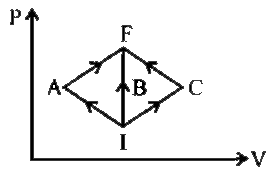
In the P - V diagram, I is the initial s...

In the P - V diagram, I is the initial state and F is the final state. The gas goes from I to F by
(i) IAF, (ii) IBF and (iii) ICF.

The heat absorbed by the gas is

Promotional Banner

Similar Questions

Explore conceptually related problems

One mole of an ideal gas is taken from state A to state B by three different processes (a) ACB , (b) ADB and (c ) AEB as shown in the P - V diagram. The heat absorbed by the gas is

One mole of an ideal gas is taken from state A to state B by three different processes (a) ACB , (b) ADB and (c ) AEB as shown in the P - V diagram. The heat absorbed by the gas is

One mole of an ideal gas is taken from state A to state B by three different processes (a) ACB , (b) ADB and (c ) AEB as shown in the P - V diagram. The heat absorbed by the gas is

From the diagram, state the result in case I, II and III.

Calculate the amount of work done in taking the gas from the state (i) P to Q (ii) Q to R (iii) R to P (iv) the entire cycle,

Figure shows the P- V diagram of an ideal gas undergoing a change of state from A to B. Four different parts I, II, III and IV as shown in the figure may lead to the same change of state.

An ideal gas goes from State A to state B via three different process as indicate in the P-V diagram. If Q_(2), Q_(3) indicates the heat absorbed by the gas along the three processes and DeltaU_(1), DeltaU_(2), DeltaU_(3) indicates the change in internal energy along the three processes respectively, then

Figure shows the p-V diagram of an ideal gas undergoing a change of state from A to B. Four different parts I, II, III and IV as shown in the figure may lead to the same change of state. ltBrgt

Figure shows the p-V diagram of an ideal gas undergoing a change of state from A to B. Four different parts I, II, III and IV as shown in the figure may lead to the same change of state. ltBrgt