

Home
Class 11
PHYSICS
Two identical particle each of mass m ar...

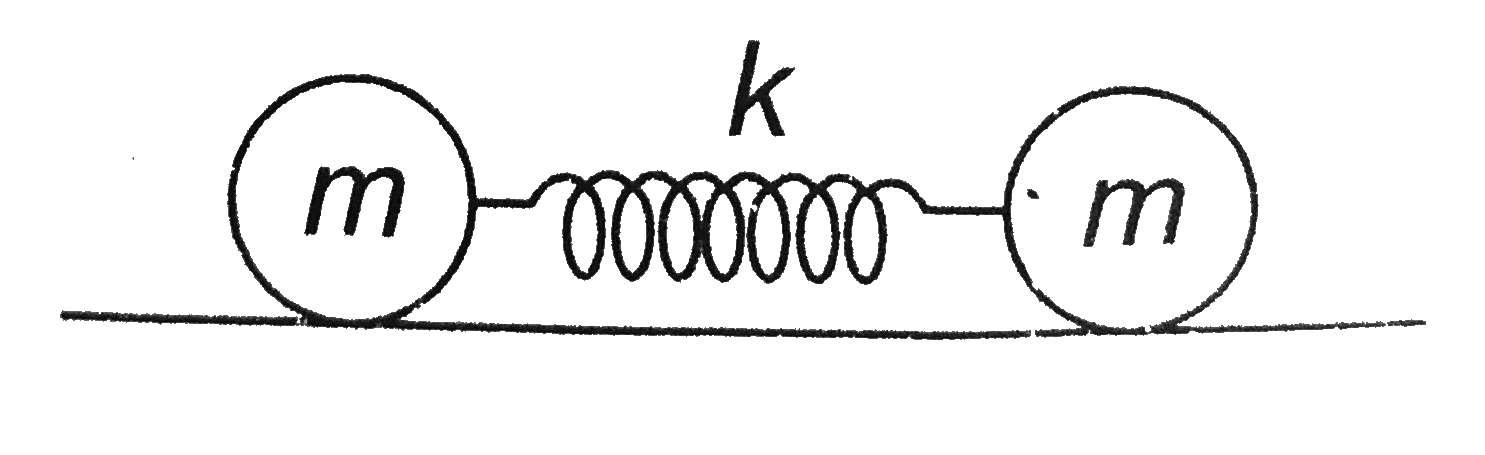
Two identical particle each of mass `m` are interconnectes by a light spring of stiffress `k` the time perticle for small oscitation is equal to

Promotional Banner

Similar Questions

Explore conceptually related problems

Two indentical particles each of mass 0.5 kg are interconnected by a light spring of stiffness 100 N/m, time period of small oscillation is

Two identical particles each of mass 0.5kg are interconnected by a light springs of stiffness 100N//m , time period of small oscillation is ….

Two identical particles each of mass m are connected by a light spring of stiffness K. The initial deformation of the spring when the system was at rest, x_(0) . After releasing the system, if one of the particles has a speed v and the deformation of the spring is x, find the speed of the other particle neglecting friction.

Two identical particles each of mass m are connected by a light spring of stiffness K. The initial deformation of the spring when the system was at rest, x_(0) . After releasing the system, if one of the particles has a speed v and the deformation of the spring is x, find the speed of the other particle neglecting friction.

Two identicle particles A and B, each of mass m, are interconnected by a spring of stiffness k. If particle B experiences a forec F and the elongation of the spring is x, the acceleration of particle B relative to particle A is equal to

Two identicle particles A and B, each of mass m, are interconnected by a spring of stiffness k. If particle B experiences a forec F and the elongation of the spring is x, the acceleration of particle B relative to particle A is equal to

Two identical bodies, each of mass m, are connected by a spring having spring constant k and they are placed on a frictionless floor. The spring is compressed a little and then released. What will be the frequency of oscillation of the system?

A light smooth inextensible string connected with two identical particles each of mass m, passes through a light ring R. If a force F pulls ring, the relative acceleration between the particles has magnitude :

Two identical balls each of mass m interconnected by a small light inextensible string are kept on a smooth horizontal surface. One of the balls is pushed towards the other with a speed v_(0) find the loss of K.E. of the ball. What will be the final velocities of the balls ? (e=1).