

Home
Class 11
PHYSICS
An aluminium rod and a copper rod of equ...

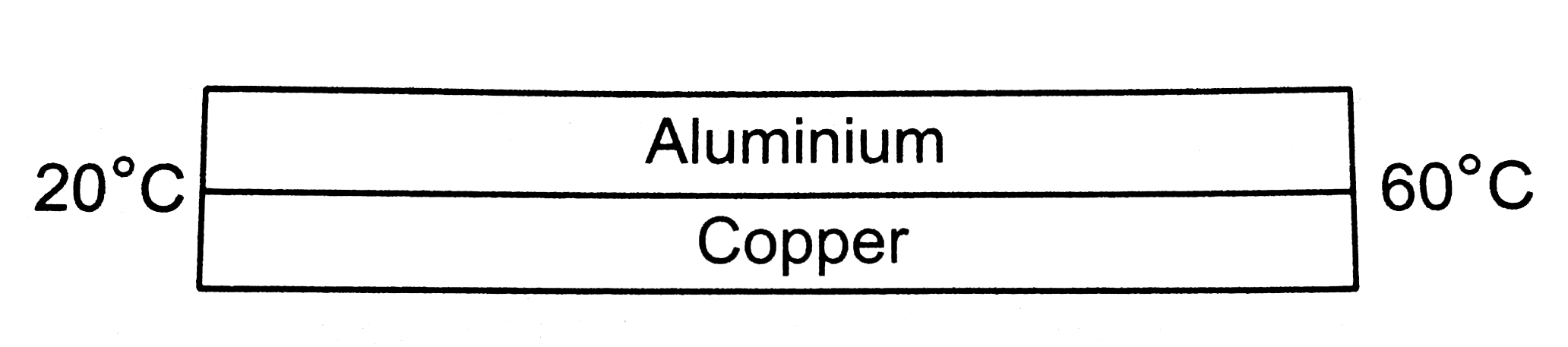
An aluminium rod and a copper rod of equal length `1.0 m` and cross-sectional area. `1cm^(2)` are welded together as shown in figure. One end is kept at a temperature of `20^(@)C` and the other at `60^(@)C` Calculate the amount of heat taken out per second from the hot end. thermal conuctivity of aluminium `=200Wm^(-1)`^(@)C^(-1)` and of copper `=390Wm^(-1)`^(@)C^(-1)` .

Promotional Banner

Similar Questions

Explore conceptually related problems

An aluminium rod and copper rod of equal length 1 m and cross-sectional area 1 cm^(2) are welded as shown. K_(A1) = 200 W//m^(@)C, K_(Cu) = 400 W//m^(@)C . Find heat current

An aluminium rod and copper rod of equal length 1 m and cross-sectional area 1 cm^(2) are welded as shown. K_(A1) = 200 W//m^(@)C, K_(Cu) = 400 W//m^(@)C . Find heat current

Figure shows an aluminium rod joined to a copper rod. Each of the rods has a length of 20cm and area of ccross section 0.20cm^(2) . The junction is maintained at a constant temperature 40^(@)C and the two ends are maintained at 80^(@)C . Calculate the amount of heat taken out from the cold junction in one minute after the steady state is reached. The conductivities are K_(Al)=200Wm^(-1) ^(@)C^(-1) . and K_(Cu)=400Wm^(-1) ^(@)C^(-1) .

Figure shows an aluminium rod joined to a copper rod. Each of the rods has a length of 20cm and area of cross section 0.20cm^(2) . The junction is maintained at a constant temperature 40^(@)C and the two ends are maintained at 80^(@)C . Calculate the amount of heat taken out from the cold junction in one minute after the steady state is reached. The conductivities are K_(Al)=200Wm^(-1)C^(-1) . and K_(Cu)=400Wm^(-1)C^(-1) .

Figure shows an aluminium rod joined to a copper rod. Each of the rods has a length of 20cm and area of cross section 0.20cm^(2) . The junction is maintained at a constant temperature 40^(@)C and the two ends are maintained at 80^(@)C . Calculate the amount of heat taken out from the cold junction in one minute after the steady state is reached. The conductivities are K_(Al)=200Wm^(-1)C^(-1) . and K_(Cu)=400Wm^(-1)C^(-1) .

Three rods of material x and three of material y are connected as shown in figure. All the rods are identical in length and cross sectional area. If the end A is maintained at 60^(@)C and the junction E at 10^(@)C , calculate the temperature of the junction B. The thermal conductivity of x is 800Wm^(-1) ^(@)C^(-1) and that of y is 400Wm^(-1) ^(@)C^(-1) .

Three rods of material x and three of material y are connected as shown in figure. All the rods are identical in length and cross sectional area. If the end A is maintained at 60^(@)C and the junction E at 10^(@)C , calculate the temperature of the junction B . The thermal conductivity of x is 800Wm^(-1).^(@)C^(-1) and that of y is 400Wm^(-1).^(@)C^(-1) .

Three rods of material x and three of material y are connected as shown in figure. All the rods are identical in length and cross sectional area. If the end A is maintained at 60^(@)C and the junction E at 10^(@)C , calculate the temperature of the junction B . The thermal conductivity of x is 800Wm^(-1).^(@)C^(-1) and that of y is 400Wm^(-1).^(@)C^(-1) .

Figure shows a copper rod joined to a steel rod. The rods have equal length and and the equal cross sectional area. The free end of the copper rod is kept at 0^(@)C and that of the steel rod is kept at 100^(@)C . Find the temperature at the junction of the rods. conductivity of copper =390WM^(-1) ^(@)C^(-1) and that of steel =46Wm^(-1) (@)C^(-1) .