

Home
Class 11
PHYSICS
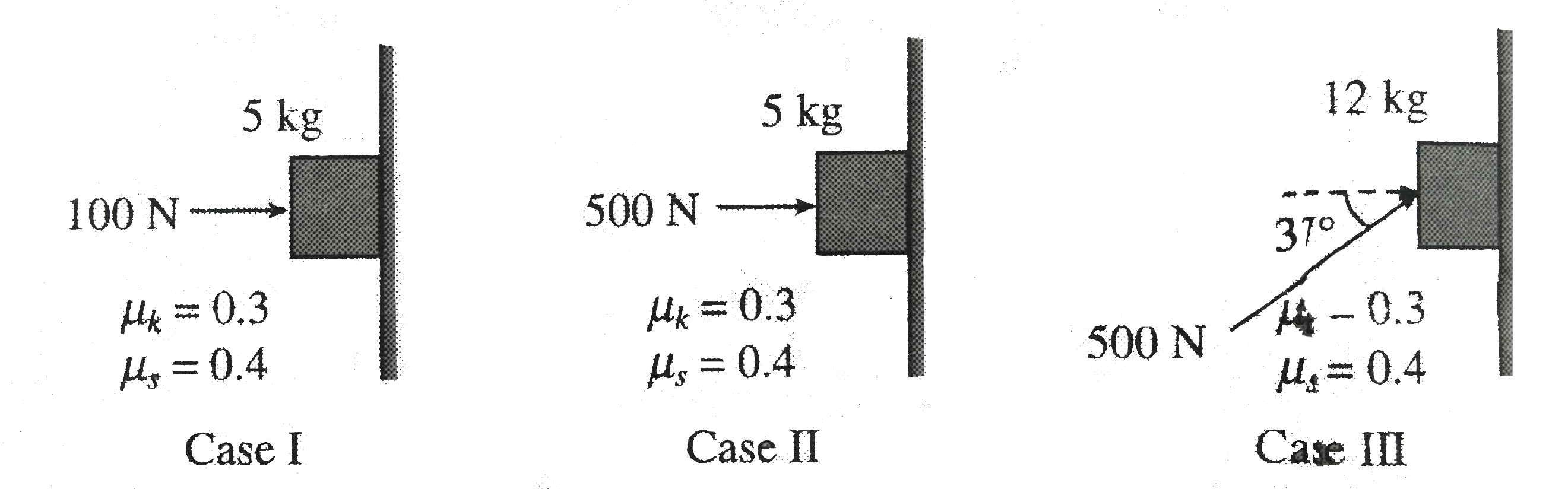
Determine the magnitude of frictional fo...

Determine the magnitude of frictional force and acceleration of the block in each of the following cases :

Promotional Banner

Similar Questions

Explore conceptually related problems

A 2.5 kg block is initially at rest on a horizontal surface. A horizontal force vecF of magnitude 6.0 N and a vertical force vecP are then applied to the block (Fig. 6-31). The coefficients of friction for the block and surface are mu = 0.40 and mu = 0.25 . Determine the magnitude of the frictional force acting on the block if the magnitude of vecP is (a) 8.0 N. (b) 10 N, and (c) 12 N

The magnitud of difference in accelerations of blocks of mass m in . Both the cases shown below is

The magnitude of difference in accelerations of block of mass m in both the cases shown below is

Assertion: Magnitude of the contact force is always greater than the magnitude of frictional force. Reason: Contact force is the resultant of the friction force and normal reaction.

Friction force acting on the block is?

A block of mass 2kg is placed on a trolley of mass 20 kg free to move on a frictionless floor. What are the frictional force, accelerations of the block and trolley if the block is pulled by a force of 3 N ? The coefficient of friction between block and trolley is 0.25. What will be the values of all three if the block is pulled by 8 N force ? At what value of the applied force will the bodies just tend to separate ? [Hint : So long as the force applied does not produce the limiting frictional force the two will move with common acceleration. When the force applied exceeds that limiting value the block will move on the trolley with a different acceleration]

34.The magnitude of acceleration of blocks of mass

A 3.5 kg block is pushed along a horizontal floor by a force vecF of magnitude 15 N at an angle theta = 40^(@) with the horizontal (Fig. 6-33). The coefficient of kinetic friction between the block and the floor is 0.25. Calculate the magnitudes of (a) the frictional force on the block from the floor and (b) the block's acceleration.

In the three figure shown, find acceleration of block and force of friction on it in each case.