In the arrangement shown in Fig. gas is thermally insulated. An ideal gas is filled in the cylinder having pressure `P_(0)` (gt atmospheric pressure `P_(0)`). The spring of force constant `K` is initially unstretched. The piston of mass `m` and area `S` is frictionless. In equilibrium, the piston rises up by distance `x_(0)`, then
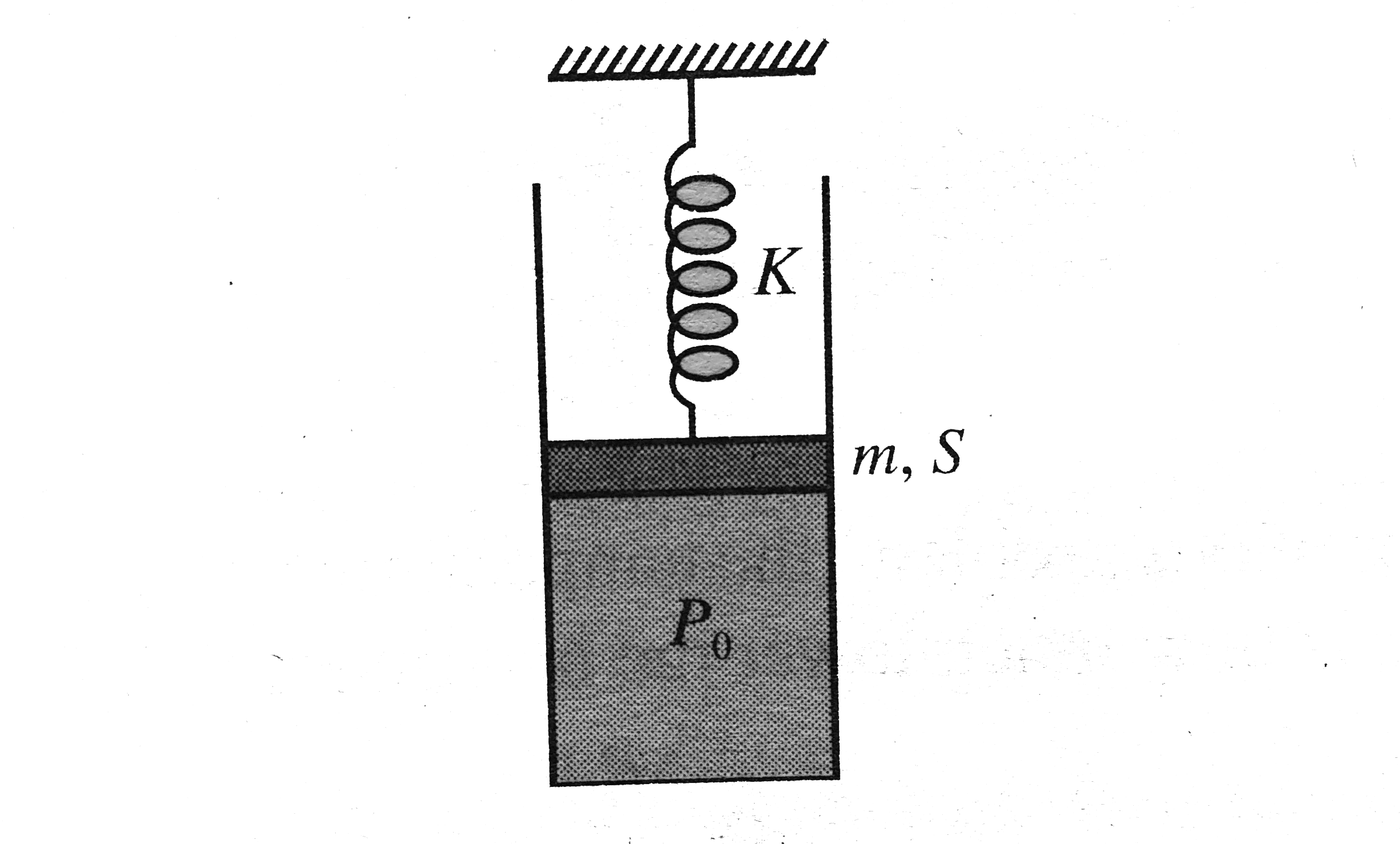
In the arrangement shown in Fig. gas is thermally insulated. An ideal gas is filled in the cylinder having pressure `P_(0)` (gt atmospheric pressure `P_(0)`). The spring of force constant `K` is initially unstretched. The piston of mass `m` and area `S` is frictionless. In equilibrium, the piston rises up by distance `x_(0)`, then



Similar Questions
Explore conceptually related problems
Choose the correct option: In the arrangement shown in Fig. gas is thermally insulated. An ideal gas is filled in the cylinder having pressure P_(0) (gt atmospheric pressure P_(a) ). The spring of force constant K is initially un-stretched. The piston of mass m and area S is frictionless. In equilibrium, the piston rises up by distance x_(0) , then
A thermally insulated chamber of volume 2V_(0) is divided by a frictionless piston of area S into two equal part A and B . Part A has an ideal gas at pressrue P_(0) and temperature T_(0) and part B is vacuum. A massless spring of force constant K is connected with the piston and the wall of the container as shown. Initially the spring is unstretched. The gas inside chamber A is allowed to expand. Let in equilibrium the spring be compressed by x_(0) . Then
A thermally insulated chamber of volume 2V_(0) is divided by a frictionless piston of area S into two equal part A and B . Part A has an ideal gas at pressrue P_(0) and temperature T_(0) and part B is vacuum. A massless spring of force constant K is connected with the piston and the wall of the container as shown. Initially the spring is unstretched. The gas inside chamber A is allowed to expand. Let in equilibrium the spring be compressed by x_(0) . Then
A thermally insulated chamber of volume 2V_(0) is divided by a frictionless piston of area S into two equal part A and B . Part A has an ideal gas at pressrue P_(0) and temperature T_(0) and part B is vacuum. A massless spring of force constant K is connected with the piston and the wall of the container as shown. Initially the spring is unstretched. The gas inside chamber A is allowed to expand. Let in equilibrium the spring be compressed by x_(0) . Then
A thermally insulated chamber of volume 2V_(0) is divided by a frictionless piston of area S into two equal part A and B . Part A has an ideal gas at pressrue P_(0) and temperature T_(0) and part B is vacuum. A massless spring of force constant K is connected with the piston and the wall of the container as shown. Initially the spring is unstretched. The gas inside chamber A is allowed to expand. Let in equilibrium the spring be compressed by x_(0) . Then
An ideal monoatomic gas is confined in a cylinder by a spring-loaded piston of cross-section 8.0xx10^-3m^2 . Initially the gas is at 300K and occupies a volume of 2.4xx10^-3m^3 and the spring is in its relaxed (unstretched, unompressed) state, fig. The gas is heated by a small electric heater until the piston moves out slowly by 0.1m. Calculate the final temperature of the gas and the heat supplied (in joules) by the heater. The force constant of the spring is 8000 N//m , atmospheric pressure is 1.0xx10^5 Nm^-2 . The cylinder and the piston are thermally insulated. The piston is massless and there is no friction between the piston and the cylinder. Neglect heat loss through lead wires of the heater. The heat capacity of the heater coil is negligible. Assume the spring to be massless.
An ideal monatomic gas is confined in a cylinder by a spring-loaded piston of cross-section 8.0xx10^-3m^2 . Initially the gas is at 300K and occupies a volume of 2.4xx10^-3m^3 and the spring is in its relaxed (unstretched, unompressed) state, fig. The gas is heated by a small electric heater until the piston moves out slowly by 0.1m. Calculate the final temperature of the gas and the heat supplied (in joules) by the heater. The force constant of the spring is 8000 N//m , atmospheric pressure is 1.0xx10^5 Nm^-2 . The cylinder and the piston are thermally insulated. The piston is massless and there is no friction between the piston and the cylinder. Neglect heat loss through lead wires of the heater. The heat capacity of the heater coil is negligible. Assume the spring to be massless.
An ideal monoatomic gas is confined in a cylinder by a spring-loaded piston of cross-section 8.0xx10^-3m^2 . Initially the gas is at 300K and occupies a volume of 2.4xx10^-3m^3 and the spring is in its relaxed (unstretched, unompressed) state, fig. The gas is heated by a small electric heater until the piston moves out slowly by 0.1m. Calculate the final temperature of the gas and the heat supplied (in joules) by the heater. The force constant of the spring is 8000 N//m , atmospheric pressure is 1.0xx10^5 Nm^-2 . The cylinder and the piston are thermally insulated. The piston is massless and there is no friction between the piston and the cylinder. Neglect heat loss through lead wires of the heater. The heat capacity of the heater coil is negligible. Assume the spring to be massless.
An ideal monoatomic gas is confined in a cylinder by a spring-loaded piston of cross-section 8.0xx10^-3m^2 . Initially the gas is at 300K and occupies a volume of 2.4xx10^-3m^3 and the spring is in its relaxed (unstretched, unompressed) state, fig. The gas is heated by a small electric heater until the piston moves out slowly by 0.1m. Calculate the final temperature of the gas and the heat supplied (in joules) by the heater. The force constant of the spring is 8000 N//m , atmospheric pressure is 1.0xx10^5 Nm^-2 . The cylinder and the piston are thermally insulated. The piston is massless and there is no friction between the piston and the cylinder. Neglect heat loss through lead wires of the heater. The heat capacity of the heater coil is negligible. Assume the spring to be massless.
Figure shows initial state of an ideal gas trapped in a container with conducting walls and a piston (mass m ) which can move without any friction. The container is placed on point supports and its wall are conducting. Assuming that atmospheric pressure is P_(0) and the mass of the ideal gas is negligible as compared to the mass of the piston and the mass of container. Take the cross section area of piston to be A. The piston is slowly lifted by an external agent and held in its position. Let M be the maximum mass of container so that it may "lift off" while pulling the piston upwards and P_(i) be the pressure of ideal gas in initial state. Pick the correct choice:
Recommended Questions
- In the arrangement shown in Fig. gas is thermally insulated. An ideal ...
Text Solution
|
- A thermally insulated chamber of volume 2V(0) is divided by a friction...
Text Solution
|
- In the arrangement shown in Fig. gas is thermally insulated. An ideal ...
Text Solution
|
- A smooth piston of mass m area of cross - section A is in equilibrium ...
Text Solution
|
- The air tight and smooth piston of a cylindrical vessel are connected ...
Text Solution
|
- A closed and isolated cylinder contains ideal gas. An adiabatic separa...
Text Solution
|
- 2000 mole of an ideal diatmic gas is enclosed in a vertica cylinder fi...
Text Solution
|
- A vertical thermally insulated cylinder of volume V contain n moles of...
Text Solution
|
- An adiabatic cylinder of cross section A is fitted with a mass less co...
Text Solution
|