

Home
Class 12
PHYSICS
One end a light spring of natural length...

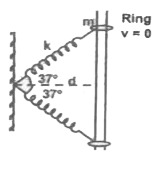
One end a light spring of natural length d and spring constant `k ( = mg //d) ` is fixed on a rigid support and the other end is fixed to a smoth ring of mass m which can slide without friction on a vertical rod fixed at a distance d from the support. Initially , the spring makes an angle of `37^(@)` with the horizontal as shown in the figure. The system is released from rest. The speed of the ring at the same angle subtended downward will be

Promotional Banner

Similar Questions

Explore conceptually related problems

One end of a light spring of natural length 4m and spring constant 170 N/m is fixed on a rigid wall and the other is fixed to a smooth ring of mass (1)/(2) kg which can slide without friction in a verical rod fixed at a distance 4 m from the wall. Initially the spring makes an angle of 37^(@) with the horizontal as shown in figure. When the system is released from rest, find the speed of the ring when the spring becomes horizontal.

One end of a light spring of natural length 4m and spring constant 170 N/m is fixed on a rigid wall and the other is fixed to a smooth ring of mass (1)/(2) kg which can slide without friction in a verical rod fixed at a distance 4 m from the wall. Initially the spring makes an angle of 37^(@) with the horizontal as shown in figure. When the system is released from rest, find the speed of the ring when the spring becomes horizontal.

One end of a light spring of natural length 4m and spring constant 170 N/m is fixed on a rigid wall and the other is fixed to a smooth ring of mass (1)/(2) kg which can slide without friction in a verical rod fixed at a distance 4 m from the wall. Initially the spring makes an angle of 37^(@) with the horizontal as shown in figure. When the system is released from rest, find the speed of the ring when the spring becomes horizontal.

One end of a light spring of natural length d and spring constant k is fixed on a rigid wall and the other is attached to a smooth ring of mass m which can slide without friction on a vertical rod fixed at a distance d from the wall. Initially the spring makes an angle of 37^(@) with the horizontal as shown in fig. When the system is released from rest, find the speed of the ring when the spring becomes horizontal. [ sin 37^(@) = 3/5]

One end of a light spring of natural length d and spring constant k is fixed on a rigid wall and the other is attached to a smooth ring of mass m which can slide without friction on a vertical rod fixed at a distance d from the wall. Initially the spring makes an angle of 37^(@) with the horizontal as shown in fig. When the system is released from rest, find the speed of the ring when the spring becomes horizontal. [ sin 37^(@) = 3/5]

On end of a light spring of natural length d and spring constant k is fixed on a rigid wall and the other is attached to a smooth ring of mass m which can slide without friction on a vertical rod fixed at a distance d from the wall. Initially the spring makes an angle of 37^@ with the horizontal. as shown in figure. When the system is released from rest, find the speed of the ring when the spring becomes horizontal. (sin 37^@=3/5) .

On end of a light spring of natural length d and spring constant k is fixed on a rigid wall and the other is attached to a smooth ring of mass m which can slide without friction on a vertical rod fixed at a distance d from the wall. Initially the spring makes an angle of 37^@ with the horizontal. as shown in figure. When the system is released from rest, find the speed of the ring when the spring becomes horizontal. (sin 37^@=3/5) .

one end of a spring of natural length ha and spring constant k is fixed at the ground and the other is fitted with a smooth ring of mass m which is allowed to slide on a horizontal rod fixed at a height h figure. Initially, the spring makes an angle of 37^0 with the vertical when the system is released from rest. find the speed of the ring when the spring becomes vertical.